
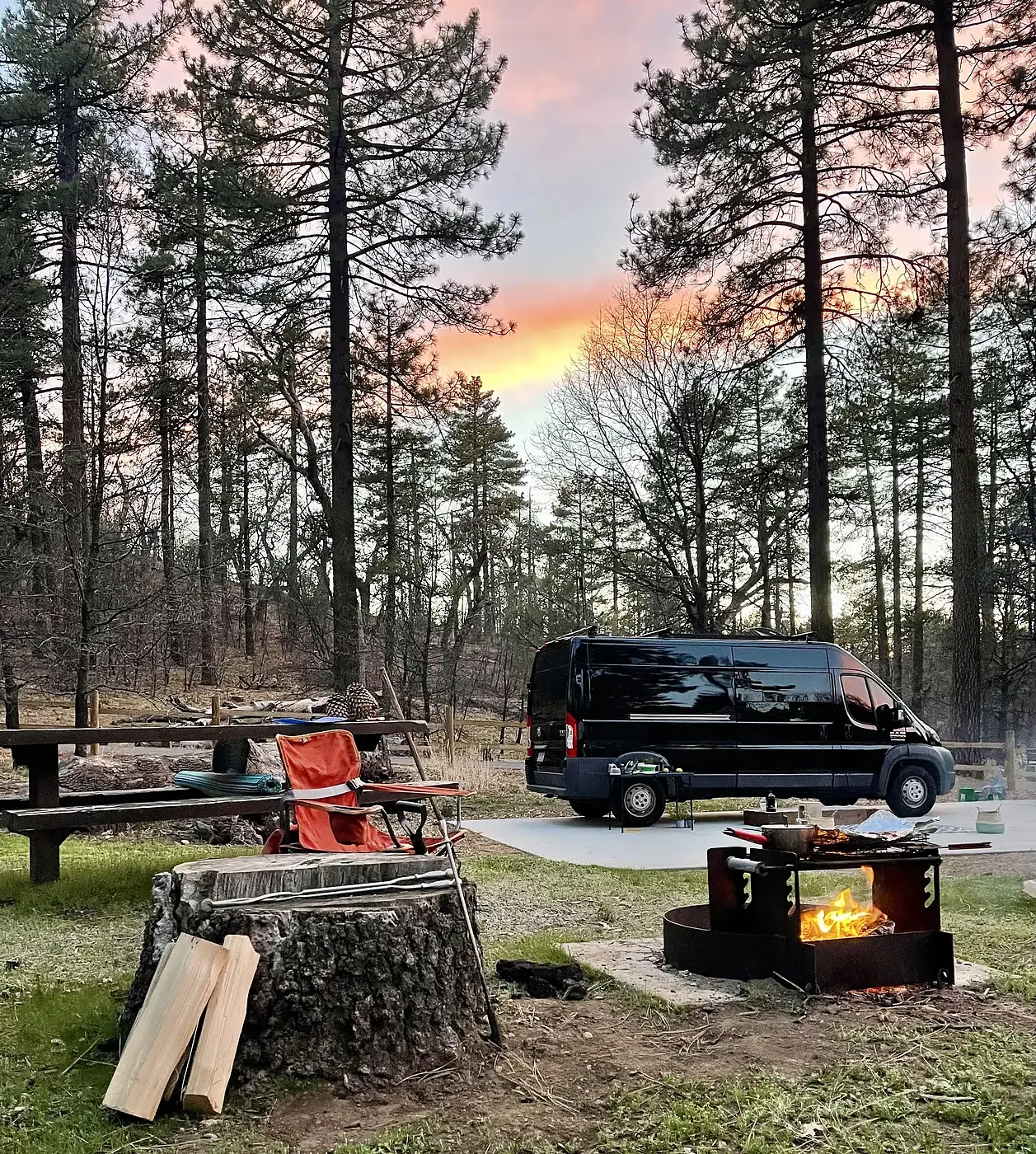
Eight years. One van. Karlee and I have driven through Florida summers, Colorado winters, New York Novembers, and long stretches of nowhere in between. We’ve run a chest fridge 24/7, two MaxxAir fans, a weBoost booster, a laptop, and eventually an air fryer.
Never once plugged in a gas generator.
It isn’t a decision I revisit every season, or a principle I’m asking you to adopt. It’s just the way it’s always been, and after eight years I can tell you exactly what that looks like when things go wrong, because things do go wrong.
What people assume about going generator-free#
The assumption is that without a generator, a bad week means you’re out of power. No backup. Stuck.
That’s not how it works.
A generator isn’t really about having unlimited energy. It’s about having a fast, reliable way to recover when everything else fails: solar isn’t producing, you haven’t found shore power, and the battery is getting low. That’s the actual problem a generator solves.
A power station with fast AC charging solves the same problem. The difference is how you do it.
What a bad week looks like for us#
Florida was our hardest stretch in both directions, for opposite reasons.
Winter is a supply problem. The sun sits low, our panels are fixed-mounted and not tilted, and when the angle drops in December and January production nearly stops. The load stays ordinary. What we can make of it doesn’t.
Summer is a demand problem. The fridge runs hard in the humidity, and the days that hurt are the overcast ones, when the draw peaks at the same moment the panels can’t refill. That’s the combination that ran us dry on the Gulf coast, not the temperature by itself.
Either way the enemy is the same: high load meeting low sun. Cooking twice a day on top of it is what tips the week.
During the Yeti 1400 years, the move was simple: pull the station out of the van and carry it somewhere with a wall outlet. Coffee shop, library, anywhere with an hour or two available. A coffee shop at Mission Beach in San Diego was a regular spot: I’d carry the 45-lb Yeti in, sit with a coffee, and let it charge. At 25 hours wall-to-full, we’d get maybe 8% in a two-hour window. Not fast. But it worked, and we did it.
When we upgraded to the BLUETTI Elite 200 V2, the same bad-week move went from a 25-hour charger to about 1.5 hours wall-to-full. That’s the whole game. A generator doesn’t give you silence at a campsite or zero fumes in a parking garage. But neither does it give you the ability to carry your power source into a coffee shop and leave with it charged.
The alternator handles travel days: drive a few hours and you’re topped up before you get where you’re going.
What you give up without a generator#
Peak wattage. A 2,000W inverter handles most things: fridge, fans, laptop, phone charging, a good air fryer. It won’t handle an electric space heater pulling 1,500W continuously alongside everything else, or high-draw power tools. Gas generators can often exceed this. If your build depends on sustained high-wattage loads, a power station has real limits.
Unlimited runtime from fuel. A gas generator runs as long as you have fuel. A power station runs until the battery is empty. If you’re parked for a week with no solar and no access to a wall outlet, a generator wins. For most van life setups (where you’re driving regularly, have some solar, and can find an outlet when needed) this scenario doesn’t come up.
That’s it. Everything else people worry about (cost, noise, maintenance, fumes, campground rules) goes in the other direction.
What you gain#
Silence. Power stations are quiet. Under heavy load or in heat a fan kicks on, but you’d have to be right next to the unit to notice. In eight years of van life, including a lot of stealth parking and campgrounds, noise from the power station has never been the issue. A gas generator would make stealth camping impossible: you can’t run one in a residential neighborhood, a parking lot, or anywhere you’re trying to stay low-profile. It’s not a quiet-hours problem. It’s an all-hours problem.
No fumes. You cannot run a gas generator inside a van. You’d have to open doors and run cords, which defeats the point in bad weather and makes it unusable in most urban spots. Power stations live inside the van and produce nothing.
Campground legal. Most campgrounds restrict or ban generators during quiet hours, typically 10pm to 8am. Power stations have no such restriction. If you camp at established campgrounds regularly, this matters constantly.
No maintenance. Oil changes, fuel stabilizer for storage, carburetor issues after sitting, pull-cord problems. A power station has none of this. Plug it in, use it, put it away.
It moves. The Mission Beach coffee shop trick only worked because I could carry the Yeti inside. You can’t do that with a generator. Portability is part of the recovery toolkit for power stations in a way it never will be for generators.
When a generator still makes sense#
If you run high-draw tools consistently (angle grinders, circular saws, large air compressors), a power station may not cover the peak wattage you need.
If you’re doing extended boondocking in places where you can’t drive regularly and have no solar, and you need to run air conditioning, a generator may be the right call.
For most van lifers (people running a fridge, a laptop, fans, and everyday devices), a power station handles it. Especially now, when you can get 3kWh of LiFePO4 capacity with 1.5-hour wall charging and 6,000-cycle battery life.
What I’d recommend if you’re switching#
If you’re currently running a generator and want to replace it, the math is simple: get more capacity than you think you need and prioritize fast AC charging over everything else. You want to be able to fully recover from a wall outlet in the time you’d realistically have access to one.
For most van life setups replacing a generator, we’d start at the 2kWh tier and go up from there. Two we’d buy:
For the full lineup at this tier: Best Power Stations for Van Life. Not sure how much capacity you need before switching? Start Here.