
Ten dresses. Twelve everyday shirts. Six undershirts. Five jumpers, five pairs of shorts, two pairs of flowy pants. Some swimsuits, a bag of athletic wear, a few warm layers, and a bag for underwear, bras and socks.
That’s me, and that’s all of it. Eight years.
I’m starting with the count because “not much” is what every van post says and it tells you nothing. A number you can picture is the only useful answer.
Where Our Clothes Live#
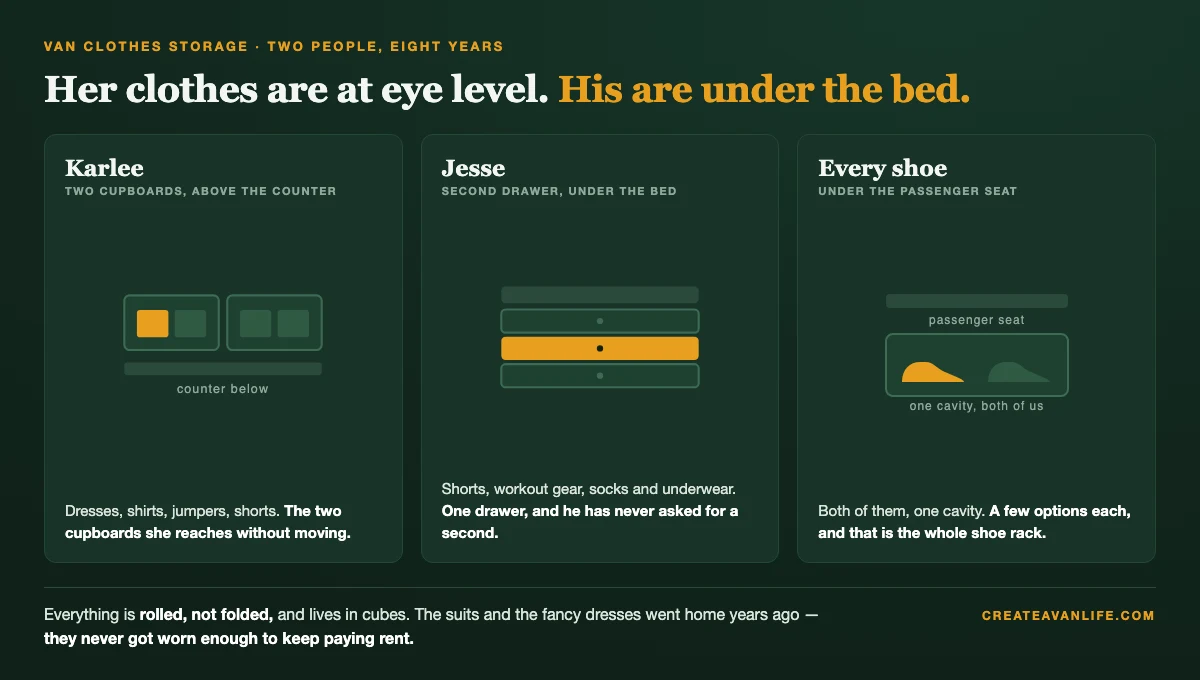
Two cupboards above the counter, on the left. That’s my entire wardrobe, at eye level, in the middle of the living space.
Jesse’s clothes are in the second drawer under the bed. About ten pairs of shorts, workout gear, and a bag for socks and underwear. One drawer, and he has never asked for a second one.
Every shoe we own is under the passenger seat. A few options each. That’s the whole shoe rack.
The Split Nobody Plans#
What I didn’t notice for years: my clothes are in the best storage in the van and his are under the bed.
That wasn’t a negotiation. It happened because I get dressed more times a day than he does and I change for more reasons. The person who opens something most often ends up with the spot that’s easiest to open, and if you let it happen naturally it usually sorts itself out correctly.
If you’re planning a build, that’s the question worth asking early. Not “how do we split the storage evenly.” Who opens this more?
Rolled, In Cubes#
We roll everything and it lives in storage cubes. Rolling fits noticeably more in the same space than folding, and the cubes are what stop a cupboard becoming one pile you dig through.
That’s the entire system. There’s no hanging rail, no closet, no over-door organizer. In a van, anything that hangs swings while you drive.
What We Stopped Carrying#
The really nice clothes. Our suits, my fancy dresses.
We kept them for a while because it felt reckless not to have something good to wear. Then a year went by and we hadn’t touched them, and they were taking up space we actually needed. So they went.
Nothing has come up since where I wished I still had them. Not once in years. If something needs a real outfit, that’s a thing you can buy or borrow when it happens, and it happens rarely enough that storing for it every single day of your life is a bad trade.
That’s the part I’d say to anyone about to move into a van. You’re not packing for the life you have. You’re packing for the life you’re about to have, and the clothes that go with the old one are usually the first thing you can lose.
What I’d Tell Someone Packing Now#
Count what you own before you decide what fits. Most people pack a van by feel and then discover the problem in month two. A number tells you immediately.
Give the best spot to whoever opens it most. Not the person who has more clothes.
Roll it, and cube it. Two habits, and they’re the whole difference between a cupboard and a pile.
The nice clothes are the easy cut. They feel like the hard one. They aren’t.