
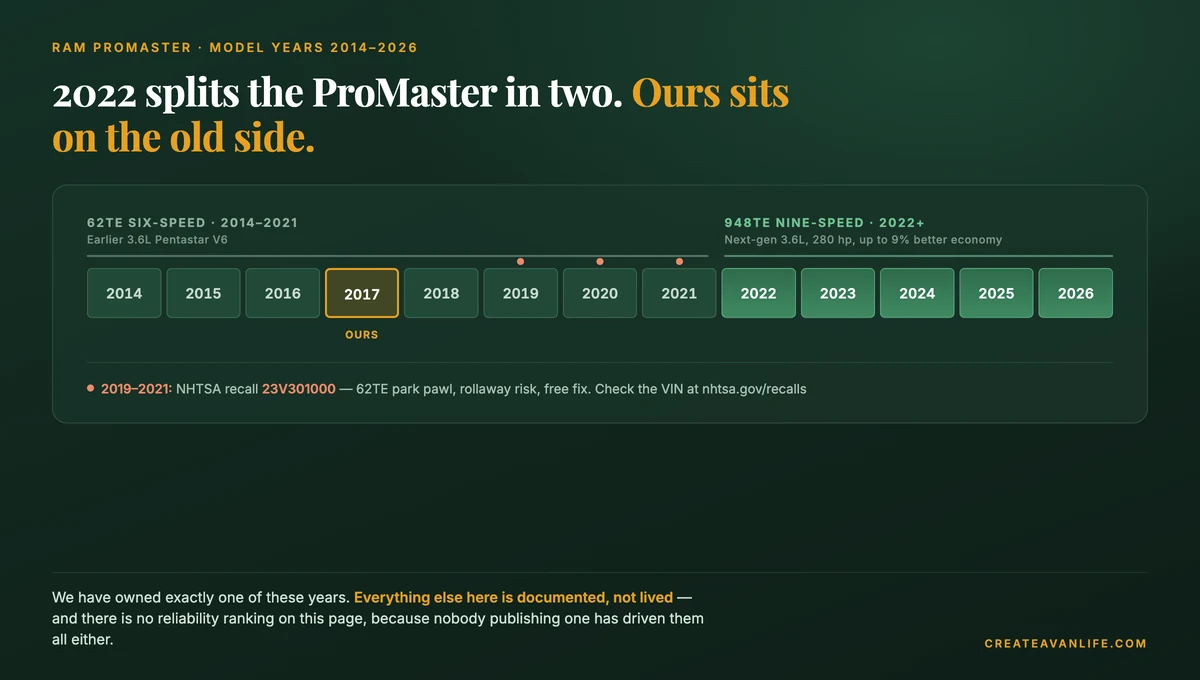
Search for ProMaster reliability by year and you will find a lot of confident pages ranking every model year against each other. I want to start by telling you what this page is not, because that is the useful part.
I have owned one model year. A 2017 ProMaster 2500, bought used at 30,000 miles, now reading 130,039. Everything I know from the driver’s seat is about that one van, and I am not going to dress up research as experience.
What I can do is separate what is documented from the things people are guessing at, because those two categories are badly mixed up on this topic.
The One Year I Can Speak To#
Ours is a 2017. In eight years and 100,000 miles of our own driving it needed two major repairs: the engine’s rollers failed at 98,000 miles and the engine was replaced, and about a year later the radiator gave out and the cooling system was replaced. That is written up in full, with what it cost, in the engine post, and the whole ownership ledger is on the reliability page.
One van, one data point. That is the weight of it.
What Changed, Year by Year#
These are documented model-year changes, not opinions about them.
| Year | What changed |
|---|---|
| 2014 | Launch year. Front-wheel drive, two roof heights, three wheelbases, gas V6 or diesel four-cylinder |
| 2015 | A 2500 chassis cab version added to the lineup |
| 2019 | Super high roof configuration, restyled front end, improved headlights, roll-up rear door option |
| 2022 | New nine-speed transmission and updated engine. The big one, below |
Reported Compiled from manufacturer specifications and trade press coverage, not from owning these vans.
The 2022 Line#
If you remember nothing else from this page, remember that 2022 splits the ProMaster into two different vehicles.
| 2014–2021 | 2022 and newer | |
|---|---|---|
| Transmission | 62TE six-speed | 948TE TorqueFlite nine-speed |
| Engine | 3.6L Pentastar | Next-generation 3.6L Pentastar |
| Output | 280 hp, 260 lb-ft | |
| Fuel economy | up to 9% better than before | |
| Infotainment | Uconnect5, 7in or 10in touchscreen |
Spec Powertrain figures are manufacturer-stated for the 2022 model year.
This matters more than any reliability ranking, and here is why: our van is on the old side of that line. The 2017 has the six-speed and the earlier engine. So when somebody asks me whether a 2024 ProMaster is reliable, the answer is that I have no idea, and neither does anybody quoting our experience at you. Different transmission, different engine, different vehicle.
If you are shopping and you want the newer powertrain, that is a 2022 or later, full stop. That is a clean, checkable line, not a vibe.
Which Side Of The Line Is Your Year On?#
Almost every version of this question arrives as “is a 2016 ProMaster reliable” or “how reliable is the 2018 ProMaster 2500.” The first answer is which powertrain generation that year shipped with, because that part is checkable rather than an opinion.
| If your year is | Powertrain | Is it the generation ours is? |
|---|---|---|
| 2014 to 2021 | 62TE six-speed, 3.6L Pentastar | Yes |
| 2022 to 2026 | 948TE nine-speed, next-generation Pentastar | No |
So if you are looking at a 2018, it carries the same engine and the same transmission as our 2017. Our eight years is a data point about that mechanical package.
⚠️ That is not the same as saying a 2018 is our van. It has its own maintenance history, its own previous owner and its own rust, and the years in that range still differ from each other in other ways. The 2019 restyle in the table above is one of them.
If you are looking at a 2022 or newer, including a 2025, nothing we have learned transfers to the powertrain. Different transmission, different engine.
Reported Generation split compiled from manufacturer specifications and trade press, not from owning these vans.
If you mean the electric one#
There is also a ProMaster EV, a battery-electric version of the same van: a 200 kW drive module making 268 horsepower and 302 lb-ft, a 110 kWh battery pack, front-wheel drive, and a targeted range of up to 174 miles.
Spec Manufacturer-stated figures.
I have never driven one, so there is no reliability verdict on it here. If you searched for ProMaster EV reliability and landed on this page, the answer is simple: this page is about the gas van, and an electric drivetrain has almost none of the parts that failed on ours.
A Recall Worth Checking Yourself#
If you are shopping a 2019 to 2021 van, this one is worth knowing by name.
| NHTSA campaign | 23V301000 |
| Filed by | Chrysler (FCA US, LLC), 27 April 2023 |
| Vehicles | Certain 2019–2021 Ram ProMaster with the 62TE transmission |
| Defect | Debris inside the transmission can stop the park pawl fully engaging the park gear |
| Consequence | Vehicle rollaway, with the crash and injury risk that carries |
| Remedy | PCM software update, plus inspection and replacement of the transmission or its internals, free of charge |
| FCA’s own code | 44A. Owner letters mailed 22 June 2023 |
Reported Straight from NHTSA’s recall record, not from somebody else’s summary.
⚠️ Do not take my word for whether a specific van was fixed. Put the VIN into the NHTSA recall lookup at nhtsa.gov/recalls. It is free, it takes a minute, and it tells you about that exact vehicle rather than about the model year in general.
Honestly, do that for any used vehicle you are about to buy regardless of what this page says.
Why I Am Not Giving You a Years-To-Avoid List#
I went looking for one, on the assumption I would summarize the consensus. There is no consensus. There is a content genre.
Two things I found that stopped me:
A specific statistic with nothing behind it. One page asserted that the Pentastar tick affects a precise percentage of engines after a particular mileage. No study, no source, no methodology, just a number sitting there looking authoritative. That number would be useful if it were real. I could not find anything supporting it, and I am not going to launder it onto this site by repeating it.
Direct contradictions between confident sources. One page listed a model year among the worst of the run. Another described that same year’s era as bringing the biggest mechanical improvement in the van’s history. Both were written in the same certain tone. At least one of them is wrong, and a reader has no way to tell which.
The reliability scores you see, the ones formatted as 68 out of 100, are mostly generated by aggregating complaint counts. Complaint counts track how many of a thing were sold and how motivated owners were to file, not how likely your van is to break.
A confident number from an unknown source is worse than no number, because it stops you looking further.
So I would rather hand you the mechanical facts and the VIN lookup than a ranking I would have to invent.
How I’d Shop One#
Decide which side of 2022 you want first. Newer powertrain and better economy, or a lower price on a van whose failure modes are now well documented by owners. That single decision narrows everything else.
If you are looking at 2019 to 2021, run the VIN through NHTSA. Recall 23V301000 is specific, serious and free to fix, and a seller may not know whether it was done.
Ask for maintenance records and mean it. This is the thing I would push hardest on, and it is not model-year specific. Our engine claim was approved because we could produce every oil change record. On a used van, that folder tells you more about how it was treated than the model year does. If a seller has no records, price that in.
Listen for a tick at idle. On any 3.6L Pentastar, that noise is worth taking seriously instead of explaining away. Ours started as a general clicking and got steadily worse for a long time before I acted on it.
Do not pay a premium for a model year because a listicle called it the good one. Pay for condition and documentation.
The Limits Of This Page#
I cannot rank these years for you. I have driven one of them.
I cannot tell you how the nine-speed holds up over 100,000 miles, because our van does not have it and by the time anybody knows, that will be somebody else’s ownership record rather than mine.
I cannot tell you whether your specific van will make it to 130,000 the way ours did. What decides that is maintenance, rust prevention, and luck, and only one of those three is in your control.
What I can tell you is what one 2017 cost across eight years, in dollars, with the engine failure included. That is on this site in full, and it is the only part of this subject I actually earned.
What We Bolted To Ours#
Whichever year you land on, this is the gear that stayed on the van. Long-term reviews of our own units.