
Eight years in a front-wheel-drive van, and the drivetrain is still the only thing about this vehicle I would change. Not because it broke. Because of where it could not go.
One thing up front, because it changes how much this page is worth to you. We winter in San Diego most years. The winter driving below comes from the two or three full Colorado winters we actually sat through, not from eight of them. Anybody telling you they have eight winters of ProMaster snow data probably has a different travel pattern than we do, and I would rather say that than let you assume it.
Where Front-Wheel Drive Wins#
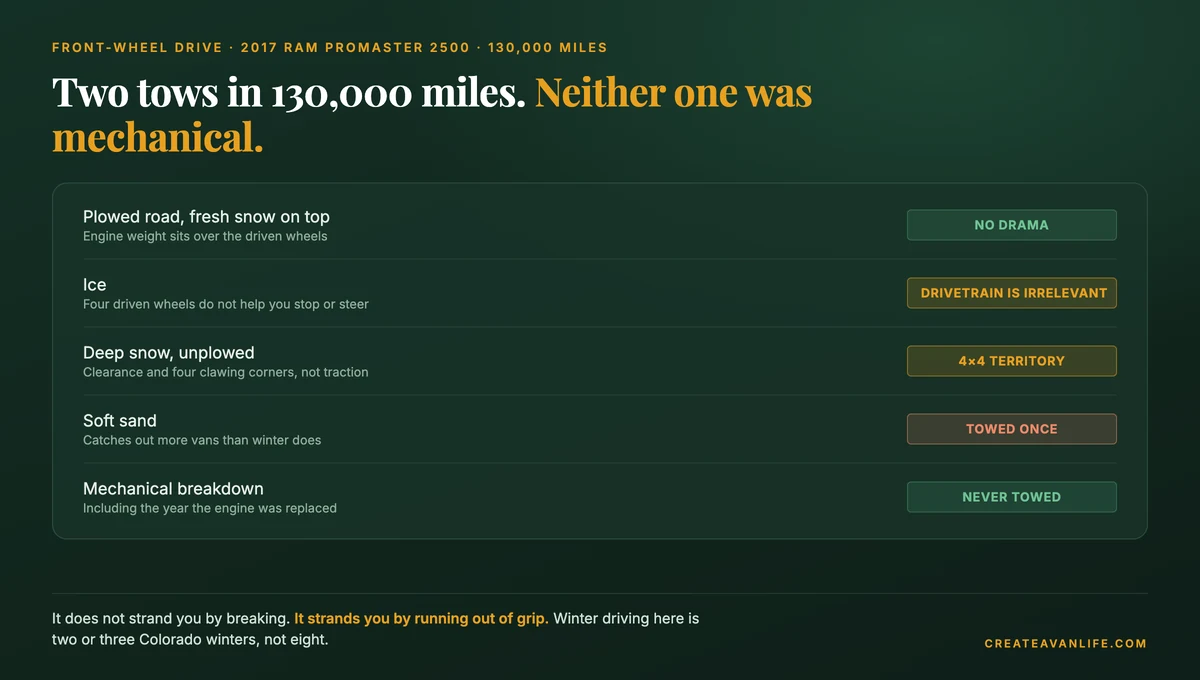
FWD is better in light snow than people expect, and the reason is simple: the engine’s weight sits directly over the wheels doing the pulling. Rear-wheel-drive vans have the opposite problem, an empty rear end trying to push a heavy front.
On plowed mountain-town roads with fresh snow on top, ours handled it without drama. Not white-knuckle, not a special technique. It just went.
That covers more winter driving than people assume, because most winter driving is on roads somebody has already plowed.
What It Is Not Good At, And Why It Is Not The Drivetrain’s Fault#
Ice does not care where your drive wheels are.
This is the part that gets argued about wrongly. On ice, a 4x4 and a FWD van and a rear-drive pickup all need the same three things: slow speeds, smooth inputs and good tires. Four driven wheels help you get moving. They do not help you stop, and they do not help you steer once the tires have let go.
Where a 4x4 would have been a different vehicle for us is deep snow and ice together. Unplowed roads. The kind of conditions where the question is not traction but ground clearance and whether all four corners can claw.
We do not drive in those. Which brings up the actual skill.
Knowing When Not To Drive#
Those Colorado winters taught us that the right move in dangerous conditions is to stay put. Park, wait, let the plows run.
That sounds like a cop-out until you remember what this vehicle is. It is our house. We are not commuting to a job at a fixed hour. When the weather is bad, the correct response is almost always to be somewhere else already, or to not move today.
A van you live in has an advantage no commuter has: you can decide the trip is tomorrow.
If your life does not allow that, weight the drivetrain question much more heavily than we did. A 4x4 buys you the ability to move when you would otherwise have to wait. That is worth real money to some people and nothing at all to others.
The Only Two Tows in 130,000 Miles#
The van has been towed twice. Both times it was stuck, once in sand and once in snow. Neither was mechanical.
That number is the whole argument in one line. In eight years and 130,000 miles, including the year the engine failed at 98,000, this van has never once needed a tow for a breakdown. It has only ever needed one for grip.
That is the shape of the front-wheel-drive limitation. It does not strand you by breaking. It strands you by running out of traction somewhere you would rather it had not.
Who Should Skip This Van#
Be honest about where you will park. Not where you picture yourself parking. If the answer is mostly pavement, trailheads with maintained access, and towns, FWD is fine and you are buying a lot of interior space and a lower price for that compromise.
If soft sand is in your plans, take it seriously. One of our two tows was sand, not snow. Beaches and desert washes catch out more vans than winter does, and people shopping for a snow-capable van often forget sand entirely.
Ask whether you can wait. This is the bigger question, and it is about your schedule, not your vehicle. If you can always choose to not drive today, FWD costs you very little. If you cannot, it will eventually cost you a day you needed.
Tires matter more than the argument about drivetrains. On ice this is most of what you control.
What I Cannot Tell You#
I cannot tell you how a ProMaster handles a full winter of daily unplowed driving, because we have never done that and we deliberately structure our year to avoid it.
I also cannot compare it to a 4x4 van from experience. I have not owned one. Everything above is what eight years in this one taught me, plus two or three Colorado winters of actual snow driving, and I would rather give you that with the limits attached than a confident comparison I have not earned.