
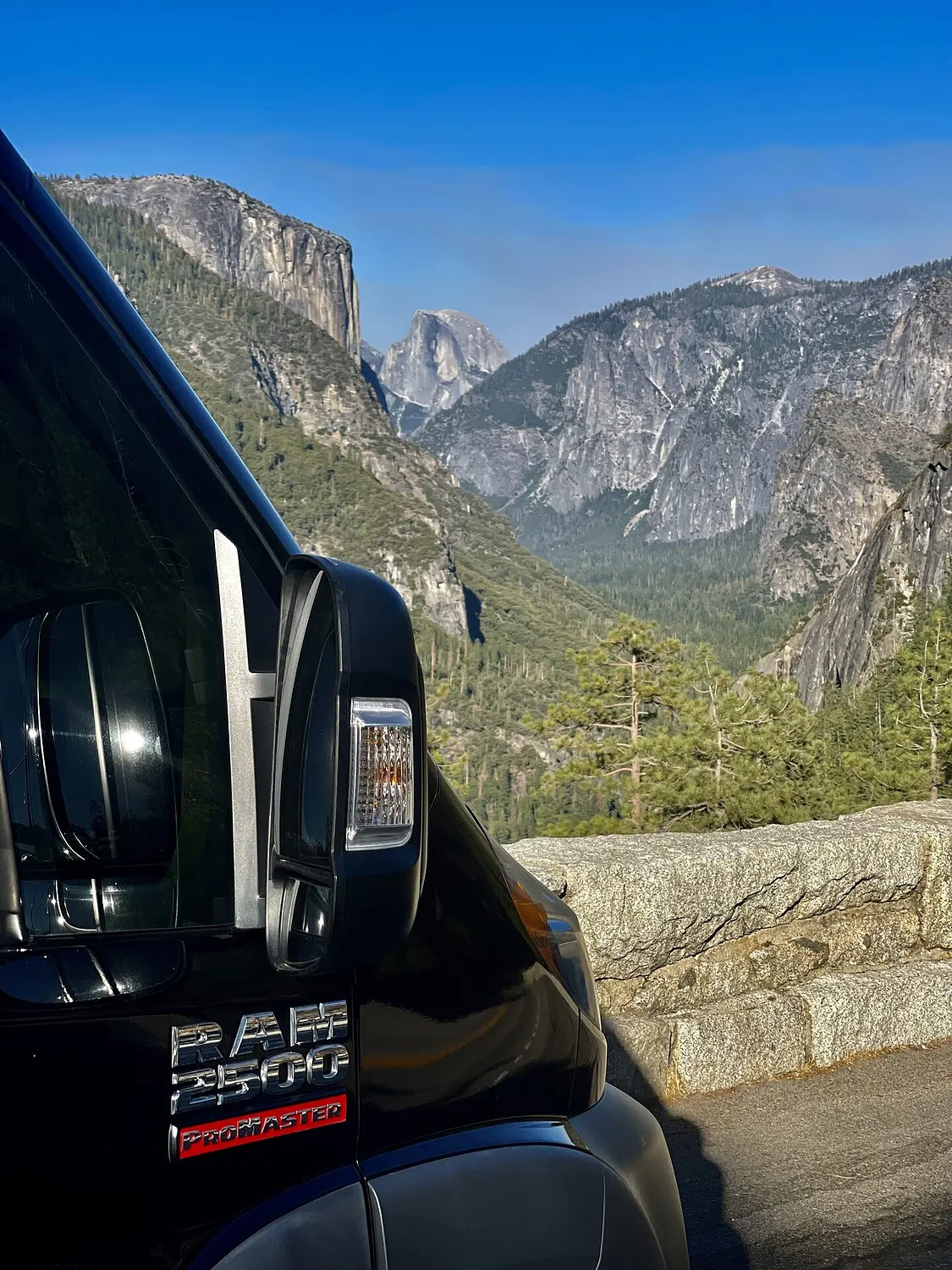
Our black 2017 Ram ProMaster 2500 reads 130,000 miles. We bought it used at 30,000 and have put the other 100,000 on ourselves, living in it full-time for eight years across multiple climates and all 48 continental states. In that time it has needed two major repairs. The big one: the engine’s roller lifters failed at 98,000 miles and the engine was replaced. About a year after that, the radiator gave out and the cooling system was replaced.
I’d still buy this van again. Both of those things are true, and the second one only means something if I show you the first.
One thing to clear up before the numbers, because search engines keep confusing the two: this is the full-size ProMaster 2500 high roof, 159" wheelbase. It is not the ProMaster City, which is a much smaller van on a completely different platform. I have never owned a City and nothing below applies to it. Here’s how to tell the two apart.
Ours is a 2017. Shopping a different year? ProMaster reliability by model year covers the one powertrain change that splits them.
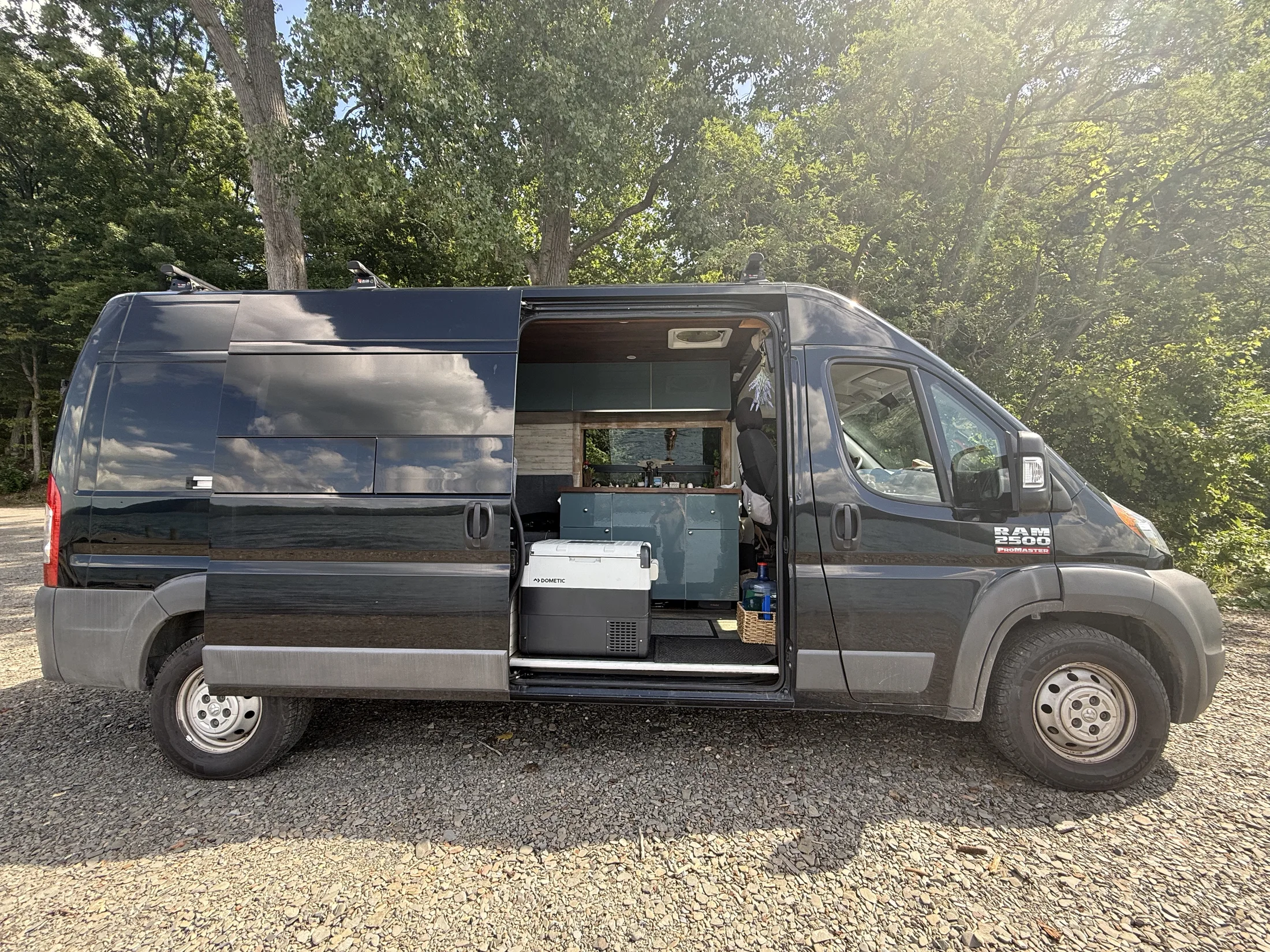
How Many Miles Will a ProMaster Last?#
Ours is at 130,000 and still running. The original 3.6L Pentastar V6 reached 98,000 before the roller lifters failed, and the remanufactured engine that replaced it has about 32,000 miles on it now.
Anyone quoting you a hard lifespan number for a ProMaster is guessing, and that includes me. What decides your mileage is maintenance records, rust prevention, and luck with the lifters. The body has never rusted, and the van has never needed a tow for anything mechanical. The rest of this page is the evidence behind that sentence.
Is It Reliable? The Short Answer#
Yes, with an asterisk that has nothing to do with the engine.
The ProMaster is worth recommending as a van life platform, especially at the price it occupies in the used market. Eight years in, ours is still running, still livable, and still the van I’d buy if I were starting over. The body has never rusted, and it has never needed a tow for anything mechanical.
The asterisk is front-wheel drive, not durability. That’s the thing that has cost us, and it’s covered further down.
Every Repair in 100,000 Miles#
This is the part most ProMaster reviews can’t give you, because most of them were written by someone who didn’t own one. Here is everything that has gone wrong, what it cost, and when.
| What | When | Cost to us | Notes |
|---|---|---|---|
| Engine replaced, roller lifters | late 2023, 98,000 mi | ~$4,000 | Total job ~$8,000–9,000; extended warranty covered about half. We paid the difference to get a remanufactured engine instead of a used one |
| Cooling system replaced | ~1 year later | ~$1,700–2,000 | Rock damage through the grille bent the fins. Out of warranty by then |
| Window regulator, passenger side | July 2026 | small | Common failure, not a surprise at this age |
| Roof seam sealer | ongoing | sealant | The black factory seam sealer can leak with age. Ours did by the sliding door. Clear sealant over it |
| Blinker switch | ongoing | $0 | Doesn’t self-cancel on left turns. Dealer “fixed” it for about a week |
| Brakes | twice in 100k | routine | Normal wear |
| Tires | every 40–50k | routine | One flat in 100,000 miles |
| Recalls | a few, minor | $0 | Nothing that changed how the van drove |
Estimate Costs are from memory, not receipts. Ranges are honest ranges, not hedging.
Add it up and the unscheduled repair spend across 100,000 miles of full-time living is roughly $6,000, of which $4,000 was a single day. Put the $2,300 extended warranty on top and the all-in number is about $8,300 over eight years. For a vehicle that has also been our house, I’ll take that.
The Engine: Roller Lifters at 98,000 Miles#
It started as a knocking noise. The diagnosis was the roller lifters, and the mechanic had to video scope the engine to prove the failure to the warranty company before they would approve anything. Reported
Then came the part nobody warns you about. The warranty company asked for every oil change record. Not a summary, the actual history. We had them, because we’ve run full synthetic every 4,000–7,000 miles for eight years and kept the paperwork. The claim was approved. The full version of that story, including what is documented about this engine and why the ProMaster sits outside the Pentastar class action, is here: ProMaster engine failure at 98,000 miles.
I’m convinced that documentation requirement is one of the main ways these claims get denied. If you own a van under any kind of warranty, keep every receipt. It’s the cheapest insurance there is, and we only learned how much it mattered on the day it mattered.
There was one more decision worth knowing about. The warranty would have installed a similar used engine, one with a history nobody could tell me anything about. I paid roughly $4,000 out of pocket to get a remanufactured engine instead. The van is also our home, so I wanted an engine with a known history, not a used one with none. That made it an easy call, but it’s $4,000 a warranty claim won’t automatically save you.
That reman engine now has about 32,000 miles on it and has given us nothing to report.
The Warranty Math Nobody Checks#
Here’s the trap, and I fell in it myself. I spent years believing our engine would have been covered by the factory 100,000-mile powertrain warranty anyway, which made the extended policy I’d bought feel like money wasted.
It wasn’t. The 100,000-mile powertrain figure applies to the diesel ProMaster. On the gas 3.6L Pentastar, factory powertrain coverage is 5 years or 60,000 miles, whichever comes first. Mopar’s own 2017 ProMaster warranty booklet is filed under the name “5/60 Gas.” Spec
Our lifters went at 98,000 miles in late 2023. That is 38,000 miles past the mileage limit, and past the five-year clock as well.
| Extended warranty (dealer, 100k bumper-to-bumper) | –$2,300 |
| What the factory powertrain warranty paid | $0, expired at 60k |
| What the extended warranty paid | ~$4,000–5,000 |
| Net | roughly $2,000 ahead, on one claim |
Estimate
I went into this page ready to tell you I probably wouldn’t buy the extended warranty again. Running the actual numbers changed my mind, and I’d rather show you that than pretend I had it right the first time. If you’re buying a used gas ProMaster, check what your real powertrain coverage is before you assume you have 100,000 miles of it.
What Has Held Up#
No rust on the body. This is the one that surprises people, because we’ve spent serious time in Florida, on the Gulf, and in coastal humidity, exactly the conditions that eat vans. There’s some surface rust on the suspension, but I don’t know of a vehicle that avoids that after a few years. The body is clean. The van came with an underbody rust protection coating that wore off after a few years, which I suspect did the early work. Since then it’s been ours to maintain: a full wax every 3–5 years and a wax with the car washes in between. Eight years in, I have never found rust on the body.
The body and cargo area. The high-roof 2500 gives you real standing height, which matters when you live in it. The floor, walls, and ceiling structure have taken a full build with no complaints.
Front-wheel drive, on pavement. Dry, wet, light snow, highway: it handles competently. The weight sits over the driven wheels and the van spends most of its life on pavement, where the layout works.
The value. ProMasters run cheaper used than comparable Transit or Sprinter builds. When you’re spending real money on the conversion itself, a lower entry price is what makes the project possible.
The Quirks You’ll Live With#
None of these are dealbreakers. All of them are things I wish someone had told me.
The grille lets rocks through. The design funnels road debris straight into the cooling stack, and bent fins are how our cooling system ended up needing replacement. My fix afterward: chicken wire fitted inside the grille. It stopped the rock strikes completely and honestly looks better than stock. If you’re buying a ProMaster, do this before it costs you a radiator, not after.
Reseal the roof seams. The roof pieces are joined with a black factory seam sealer, and as it ages it can let water in. Ours leaked at the seam by the sliding door, and other owners report the same spot online. The fix is cheap: run a bead of clear sealant down the black seam, ideally before you’re chasing a drip.
The blinker switch doesn’t always cancel. Signal left and the stalk pops back up, so you cancel it by hand. We took it to Dodge, it was fixed for about a week, and we’ve simply lived with it since.
Window regulators fail. Ours went on the passenger side in July 2026, at 130,000 miles and nine model years. That’s a wear item on a van this age rather than a defect.
Our Maintenance Routine#
Nothing exotic. The maintenance routine is the boring part that made the warranty claim work.
- Oil: full synthetic, every 4,000–7,000 miles, records kept every time
- Tires: a new set every 40,000–50,000 miles, rotated every 5,000
- Brakes: twice in 100,000 miles
- Wax: a full one every 3–5 years, plus with car washes. This is the rust plan
One tire note that runs against the usual advice: we run highway tires, not all-terrain. All-terrains wear noticeably faster, and for a van that lives mostly on pavement the trade wasn’t worth it to us. If your routes are rough, weigh that differently, but understand you’re buying traction with tread life, and a set every 40,000 miles is already a real cost.
The FWD Reality in Winter#
Front-wheel drive behaves differently than 4x4 or RWD. We winter in San Diego most years, so this comes from the two or three full Colorado winters we’ve actually sat through, not from eight of them.
FWD is better than people expect in light snow. Engine weight over the driven wheels helps. On plowed mountain-town roads with occasional fresh snow, the ProMaster handles it without drama.
Ice doesn’t care where your drive wheels are. On ice it needs what every vehicle needs: slow speeds, smooth inputs, good tires. Ice and deep snow together are where 4x4 would make a real difference.
Know when not to drive. Those Colorado winters taught us the right move in dangerous conditions is to stay put. Park, wait, let the plows run.
The only times this van has ever been towed were getting stuck in sand and snow, never a mechanical failure. That’s the shape of the FWD limitation: it doesn’t break, it just runs out of grip somewhere you’d rather it didn’t.
What We’d Do Differently#
Get 4x4 if the budget allows. This is the real gap in the platform, and we’ve hit it three times: an icy mountain road above a cliff, a campground below Flagstaff where packed dirt that read as rock-solid sank under the van’s weight, and deep sand at Lone Rock on Lake Powell. The first two are in We Almost Went Off a Cliff. The third was a silly mistake: I drove too far down without realizing how deep the sand got, and a truck helped us back to the hard sand.
The catch is money. Matched to our van’s size (high roof, the closest length to our 159" ProMaster), for the 2026 model year: a Transit 148" extended with AWD starts around $59K, and a Sprinter 170" high roof with AWD lands around $67K before options. The same-size ProMaster 2500 starts around $51K. That’s roughly $8,000 to $16,000 more for AWD before a dollar goes into the build. Estimate New-van pricing moves every model year, so treat those as the shape of the gap, not a quote. For most people building on a working budget, the ProMaster is still my recommendation, with a front-wheel-drive asterisk.
Rust proof during the build, and re-seal early. We got lucky with a factory coating and a wax habit. Doing rust protection after the walls and insulation go up is twice the job, and the roof seams are cheaper to get ahead of than to chase.
Screen the grille on day one. See above. The chicken wire cost nothing and the cooling system cost $1,700–2,000.
Overall Verdict#
Would we buy it again? Yes. One engine in 130,000 miles, no body rust after eight years in humid coastal climates, and roughly $6,000 in unscheduled repairs across 100,000 miles of full-time use. The high-roof space is excellent and the entry price is what made the build possible.
Would we upgrade if budget were different? The 4x4 conversation is real, and it’s about terrain, not toughness. If we were starting again with unlimited budget we’d look hard at AWD, because of those two times front-wheel drive ran out of road.
Who should look elsewhere? Anyone planning serious off-road use, frequent mountain winter driving, or routes with trails and technical terrain should budget for 4x4 from the start. The ProMaster will disappoint you there, and the lesson comes at your expense.
And if you’re shopping used? Buy the maintenance records, not the mileage. Ours has 130,000 miles on it and the engine has 32,000. The odometer tells you almost nothing on its own. Ask what’s been documented, find out what powertrain coverage actually remains, and screen that grille before you drive it home.
Frequently Asked Questions
- Is the Ram ProMaster reliable?
- Over eight years and 100,000 miles of full-time living, ours needed two major repairs: the engine’s roller lifters failed at 98,000 miles and the engine was replaced, and about a year later the radiator gave out and the cooling system was replaced. Everything else has been routine maintenance plus small stuff (a window regulator, a blinker switch that never got fixed). I would buy the van again, with the caveat that front-wheel drive has real limits in snow and off-pavement.
- How many miles will a Ram ProMaster last?
- Ours reads 130,000 miles. The original 3.6L Pentastar V6 made it to 98,000 before the roller lifters failed and it was replaced with a remanufactured engine, which now has about 32,000 miles on it. Anyone quoting a hard lifespan number for a ProMaster is guessing. What decides your mileage is maintenance records, rust prevention, and luck with the lifters.
- What is the factory warranty on a gas Ram ProMaster?
- Five years or 60,000 miles on the powertrain, whichever comes first, plus 3 years/36,000 miles bumper-to-bumper. The 5-year/100,000-mile figure people repeat applies to the diesel, not the gas 3.6L Pentastar. Mopar’s own 2017 ProMaster warranty booklet is filed as ‘5/60 Gas’. Our engine failed at 98,000 miles, which was 38,000 miles past that limit.
- Do Ram ProMaster engines have roller lifter problems?
- Ours failed at 98,000 miles: a knocking noise that the mechanic confirmed with a video scope before the warranty company would approve the claim. The 3.6L Pentastar V6 is a widely used engine and lifter failure is a known discussion point among owners. I can tell you it happened once to our van at 98,000 miles; I can’t tell you how common it is across the fleet.
- Is an extended warranty worth it on a van?
- On ours it returned about double what it cost. We paid roughly $2,300 for a 100,000-mile bumper-to-bumper policy from the dealer, and it covered around half of an $8,000-9,000 engine replacement that the expired factory powertrain warranty would have paid nothing toward. The claim was only approved because we produced every oil change record.
If You Do End Up Buying One#
Eight years in, this is the gear still bolted to the van. Each one is a long-term review of our own unit, not a roundup of things we read about.
Related Reading#
ProMaster engine failure at 98,000 miles: the Pentastar tick
How living in 70 square feet changed everything: what life inside this van is actually like, on our other site, Moments in the Miles