
Most van build guides are written before someone has actually lived in the van. The advice is well-intentioned. The priorities are wrong.
Eight years of full-time use reveals which build decisions matter and which don’t, because the ones that matter show up every day, and the ones that don’t become irrelevant fast.
Mistake 1: Wood Directly on Metal Without Isolation#
This one takes about a week of rough road driving to understand why it matters.
When you attach wood directly to a metal van wall (paneling, framing, anything) without isolating the contact points, road vibration creates noise. Not at first. A new build is usually quiet. But over miles and time, the materials settle, the contact points develop micro-movement, and the squeak begins.
Once a squeak develops in a van, finding and eliminating it is difficult. You can’t always access the contact point without taking apart something you just built. You end up adding material, tightening fasteners, applying felt strips to areas you can reach. Sometimes it helps, sometimes it doesn’t.
The fix is simple and has to happen during the build: use rubber grommets, foam tape, or felt isolators at every wood-to-metal contact point. It adds an hour to the build. It prevents a noise that will be with you forever otherwise.
Mistake 2: Prioritizing 120V AC Inside the Van#
120V AC wiring inside a van adds complexity and fire risk that most builds don’t need. The instinct is understandable: most appliances run on AC, so putting AC outlets throughout the van feels like a complete solution.
The practical reality: a portable power station with a quality inverter handles AC appliances without running AC wiring through the walls. The appliances plug into the station, not into the van. If something goes wrong, the problem is localized. You can disconnect the station, move it, or replace it without touching the vehicle wiring.
Keep as much as possible on 12V direct circuits for things that run constantly: fridge, fans, lights, USB charging. Use the inverter in your portable station for AC appliances. Minimize 120V wiring inside the van itself.
If you do run 120V wiring, know what you’re doing or have someone qualified do it. A wiring fire in a van is catastrophic: there’s nowhere to go and the materials burn fast. This is not the place for learning as you go.
Mistake 3: Skipping Rust Protection#
After eight years there’s some surface rust on the suspension and none on the body, and that’s not luck, it’s maintenance. We stay on top of it: regular car washes, wax when we can, and keeping an eye on anything that looks like it’s starting. A lot of people don’t think about it until it’s too late, especially near the ocean: San Diego, Florida, anywhere with salt air. Prevention is easier than repair.
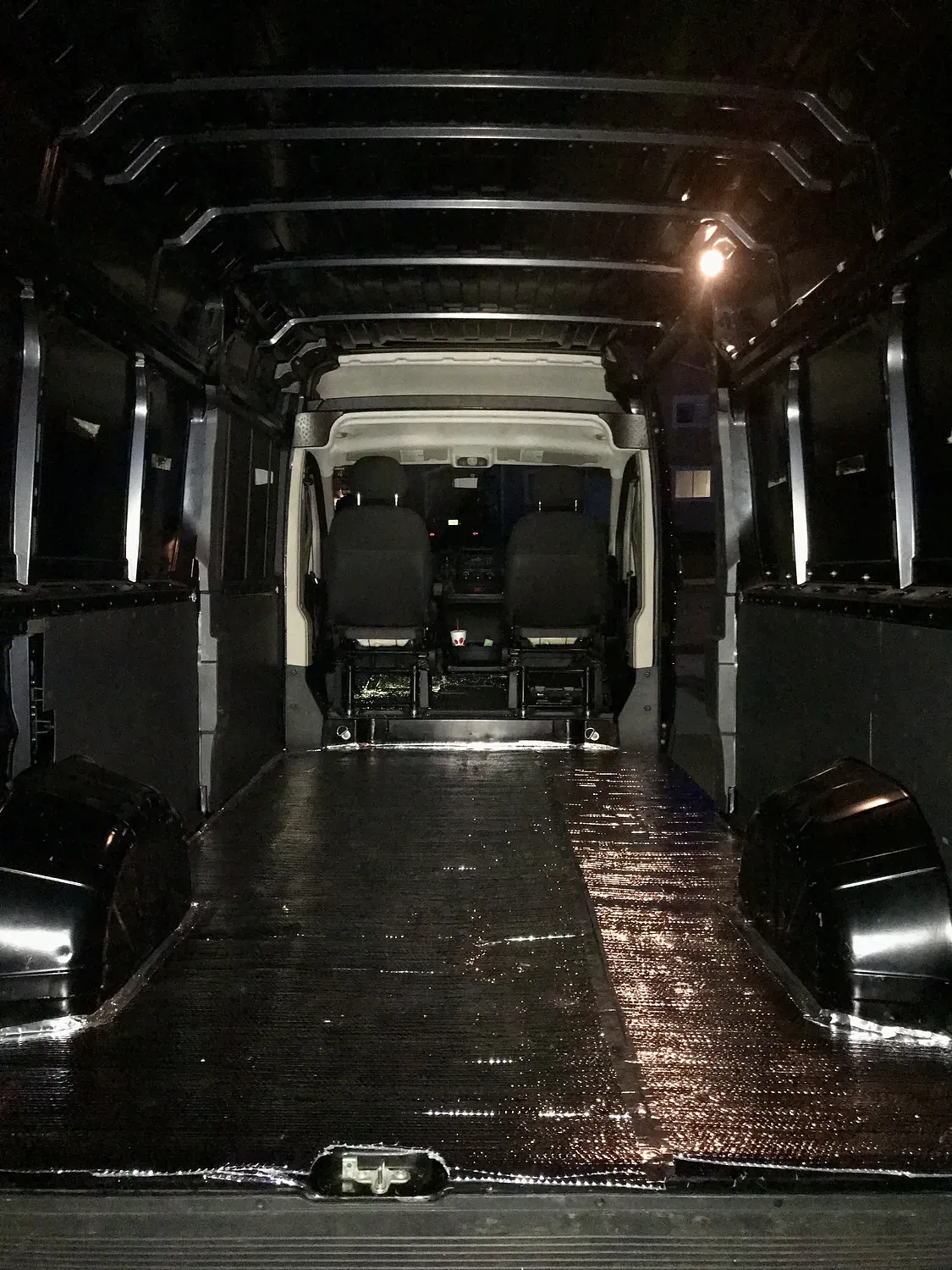
A van build disrupts the factory protection: you’re drilling holes, cutting openings, running wires through surfaces, removing factory panels. Each intervention is an entry point for moisture.
Rust protection during the build means: treating exposed metal before covering it, using rust-inhibiting primer on any cut or drilled surfaces, sealing penetrations properly, and using moisture barriers appropriate to the climate you plan to spend time in.
Doing this after the van is built is much harder. You have to remove panels to reach the surfaces that need treatment. Budget for rust protection during the build, especially if your travel pattern includes any humid climate.
Mistake 4: Standard Ceiling Racks Without Checking Height#
A standard rack can push a high-roof ProMaster (stock: 8'8") over the 9-foot clearance line that locks you out of drive-throughs, parking garages, and covered areas. The fix is a low-profile rack: ours keeps the van at 8'10" to 8'11" with solar and fans loaded.
Mistake 5: Venting Only One Side#
There was never a debate in our van about window style. Karlee raised T-vents early, I agreed, and we never seriously considered sliders. T-vent windows (a fixed frame with a hinged opening vent) are more secure when open, rattle less over rough roads, and seal cleaner when shut.
The argument we actually had was about how many. Karlee wanted one, on the sliding door side. I pushed for both walls. This is the rare one where I was right, and it is the mistake I watch other builds make: one opening is not ventilation, it is a hole. Air needs somewhere to come in and somewhere to leave. With a single window you get a partial path and a lot of still air.
With both walls opened, you get real crossflow, and it is the difference between a survivable night and a miserable one in Florida humidity. It is the cheapest comfort upgrade in the whole build and the one most likely to get cut for budget.
What We Got Right#
Portable power station over fixed system. Every year of van life reinforces this for us. The portability has saved us multiple times. The flexibility has made the system adaptable as our needs changed.
The low-profile rack. More expensive, clearly worth it. We use drive-throughs regularly and park in garages occasionally. The height management was worth every dollar.
Spending real money on the fridge. A quality 12V compressor fridge (the Dometic in our case) is not the place to save money in a van build. It runs every single day, and reliability matters more there than in any other appliance.
One caveat on that, because it is the other decision Karlee got right and I didn’t: I picked a chest fridge on the spec-sheet argument, and eight years of unloading it to reach the bottom layer has made the case for an upright better than any spec could. Buy the good fridge. Think harder than I did about which shape you want to open every day. The whole argument is in chest vs upright.
The Meta-Lesson#
Most van build mistakes come from optimizing for the build day rather than the daily use years. A decision that saves two hours during construction can cost two minutes every day for the life of the van, which is a bad trade over years. Think about what you’ll interact with every day, what will annoy you if it’s wrong, and spend your planning time there.