

Bad airflow causes more daily frustration than most first-time builders expect.
Mistake 1: No Crossflow Plan#
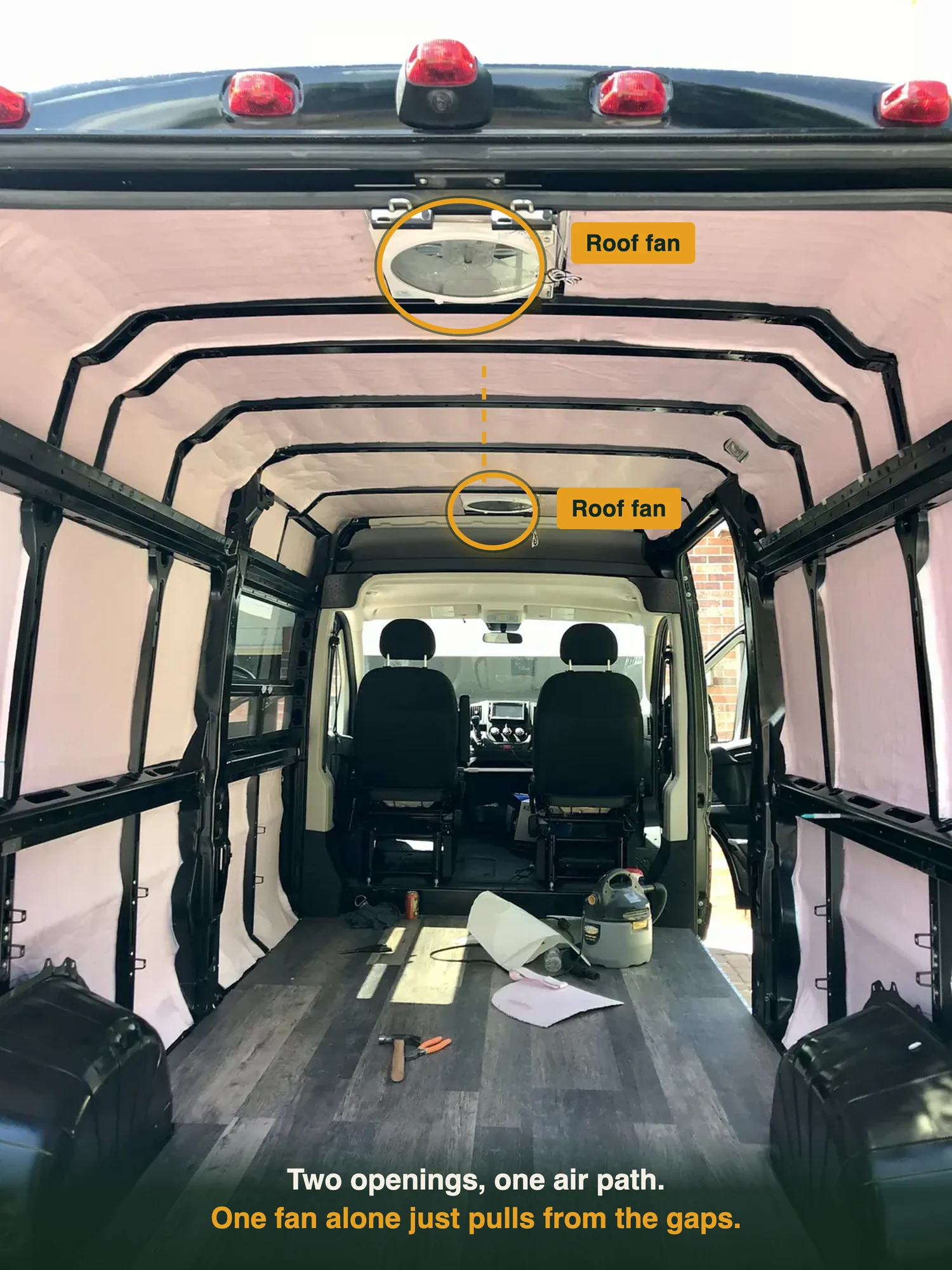
A roof fan creates low pressure at the ceiling, but low pressure alone doesn’t automatically pull fresh air from outside. It pulls from wherever air can find an entry path. In a sealed van with no intentional intake, that’s through gaps in the floor, around door seals, and through the cab. None of those paths give you clean, directed airflow through the living space.
Crossflow requires two openings. Without an intake, a roof fan sounds like it’s working but moves surprisingly little air through the area where you’re sleeping.
What works for us is two fans pointed opposite directions. Our MaxxFan Plus 4500 sits in the back over the bed, pushing air down and in. The MaxxFan Deluxe 7500 is up front, running outward on exhaust. Both are rated 900 CFM. Spec Lie on the bed with one fan pushing air over you and the other pulling the hot air out, and it’s a strong breeze, not the vague stir you get from a single fan. That is the setup we landed on after eight years, and it does more than any single upgrade we’ve made to the fans themselves.
One wrinkle in that pairing: the 7500 carries a permanent rain dome, and in our van it pulls something like half what the 4500 does even with the lid all the way open. Same 900 CFM rating, very different air. That is exactly why the fan doing the pushing over the bed is the one without the dome.
Windows are the other half of it. When we want to cool off the front of the van, we crack a T-vent window and put the exhaust fan on max. It pulls hard enough that air comes rushing in through the window, like a fan blowing straight at you from the side. A cracked rear pane does the same job for free if you aren’t ready to cut another hole.
Skipping the intake also costs you the fan. Ours only ever started squeaking when we ran them with little or no intake open, and the fix was pulling the motor apart to clean it. Give the fan somewhere to pull from and that never starts. A sealed van doesn’t just make a fan ineffective, it makes it work against itself. More on that in the long-term MaxxAir review.
Mistake 2: Treating Fan Noise As The Enemy#
Most ventilation advice tells you to chase the quietest fan you can find. That misses how a fan actually behaves in a van.
Steady fan noise is an asset. It covers the parking lot, the highway, the neighbors, the dog two sites over. Plenty of nights the fan running is the reason we sleep through something that would have woken us up otherwise. A silent van isn’t the goal. A van where the sound doesn’t change is the goal.
What ruins it is inconsistent noise. A squeak, a rattle, a bearing that whines at one particular speed. Your ear tunes out a constant sound in a few minutes and never tunes out an intermittent one. That’s why a rattling fan is worse at 2 AM than a louder fan running clean, and it shows up hardest at high speed, right when you need the air most.
Which makes this a mounting problem more than a spec problem. Any direct metal-to-metal, wood-to-metal or plastic-to-metal contact will eventually squeak on rough roads, and you’ll spend weeks hunting the source. We bedded ours on butyl tape with Dicor over the top, and in eight years neither fan has ever developed a mounting squeak. Measured That is a few dollars of tape at install, spent once, against years of chasing a rattle you cannot locate.
Variable speed still matters, but for tuning the sound rather than escaping it. Ten speed settings, which is what both of ours have, let you find the level that masks road noise without becoming the noise itself. Three settings, low and medium and high, often means picking between not enough airflow and more sound than you wanted.
Mistake 3: Buying One Fan For The Wrong Reason#
If you’re only buying one fan, buy for your climate, not for the price tag.
The rain-proof model, the MaxxFan Deluxe 7500, puts a permanent dome over the opening, and that dome costs real airflow even when the weather is fine. The MaxxFan Plus 4500 skips the dome and uses a rain sensor that closes the lid when water hits it instead. You give up the ability to run during an active downpour, and you get noticeably more air every other day of the year.
Rain is a few hours. Heat is every night of the summer. So for most vans, buy the 4500 first. The exception is if you mostly park where it rains a lot or stays cool, like Oregon or Washington: you don’t need maximum airflow there, and the 7500 is the better first fan because it never has to close. Run both if you can, one for airflow and one for weather.
Mistake 4: Skipping Moisture Strategy#
Cold-weather ventilation is the most commonly skipped part of a build plan. The instinct when temperatures drop is to seal up tight, which is reasonable for warmth but wrong for moisture. Two people sleeping in a van put out somewhere around a pint of water vapor a night through breathing and perspiration together. Reported Published figures vary a lot depending on what they count, so treat it as an order of magnitude rather than a precise number. Add cooking, and it climbs.
Moisture doesn’t disappear. It condenses on the coldest surfaces available, which in a van are typically the metal walls and ceiling behind your insulation panels. Over time that condensation degrades insulation performance, promotes mold growth, and rusts structural metal. The damage is hidden and cumulative.
A small cracked window on the leeward side is part of a real moisture strategy: not enough to drop interior temperature, just enough to create outward air movement. Brief, intentional ventilation for a few minutes after cooking matters too. This is a behavioral habit more than a hardware fix, and it’s cheaper than replacing insulation.
Mistake 5: Expecting A Fan To Be Air Conditioning#
A roof fan exchanges air. It does not cool air. On a day when the outside temperature is above your body temperature, pulling more of that air through the van doesn’t lower the number on the thermometer, and running the fan harder mostly spends power.
What a fan does well is dump accumulated heat when the outside air is cooler than the inside air, which in practice means evenings, nights, and early mornings. Get the hot air out before you close up for the evening and you start the night from a better place.
And “out of battery” is not a figure of speech. We measured ours on the station’s DC readout: one fan at speed 10 draws 32W, and both wide open draw 58W. Measured Run both at full tilt through an eight-hour night and that is 464Wh, which is a serious share of a 1,000Wh station before the fridge has taken its cut. The good news is that almost all of that cost is in how hard you run it: on speed one a fan pulls roughly 0.2A, call it 2 to 3W. Spec That is more than a tenfold spread between the two ends of the dial, so the speed you choose matters more to your battery than which fan you bought. Mid-range is where a fan you sleep through actually sits. But chasing a 2 PM heat peak with both fans wide open spends real capacity to move air that is already too hot to help.
The full per-speed breakdown, and why the published tables over-budget these fans by about 40%, is in the long-term MaxxAir review.