
The 30-second version
How many roof fans are you buying?
One fanTap for our pick
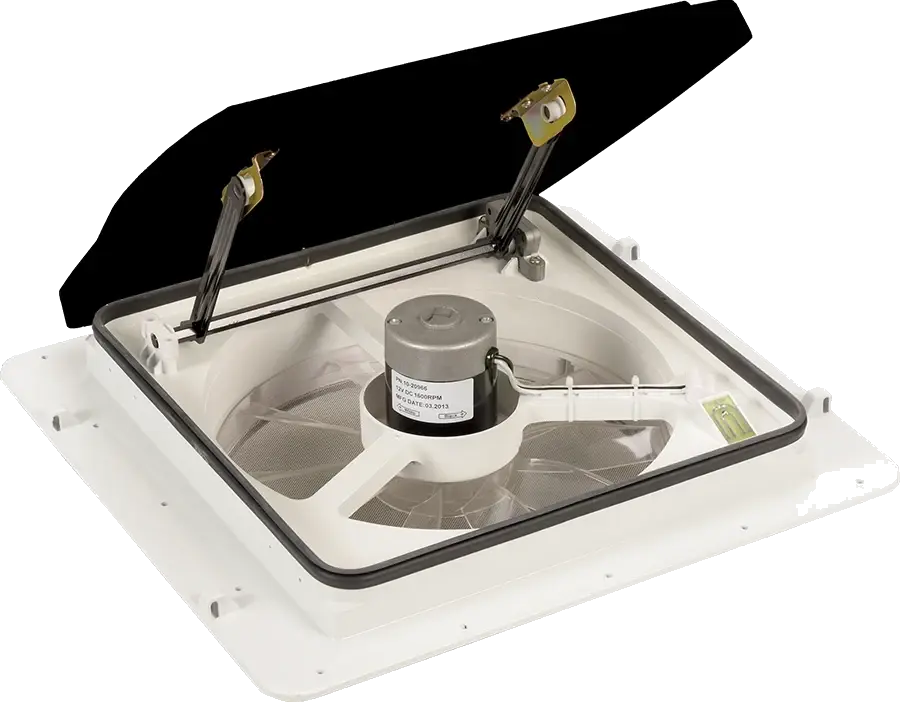
The MaxxAir 4500, for most vans. It moves the most air, and moving air is the whole job of a single fan. In our van the 7500 feels like about half.
The exception: if you mostly park somewhere rainy or cool, like Oregon or Washington, get the 7500. It stays wide open through a downpour.
Order the 00-04500K, not the 00-04000K. One digit apart, and the 04000K is manual with no remote.
Get the 4500 Rainy or cool? Get the 7500Two fansTap for our setup
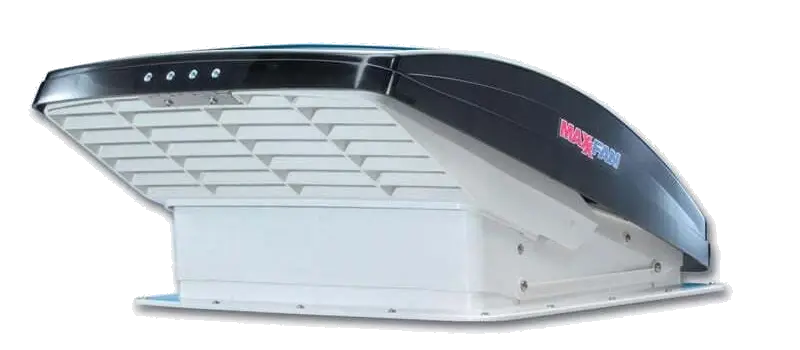
The 4500 in back over the bed, the 7500 up front. The 7500's dome lets it keep running in the rain, which makes it the right partner for the 4500. It's what we've run for eight years.
Get the 4500 Get the 7500Either way, a fan can only pull air it can get. We run T-vent windows on both sides for that.
Read the full story
Last reviewed: August 2026
Ventilation is not optional in a van. It controls sleep quality, manages moisture and mold risk, reduces heat buildup in summer, and pulls condensation out in winter. It’s also one of the most immediate quality-of-life upgrades you can make: the difference between waking up sweating and kicking off covers versus sleeping straight through.
We’ve run a MaxxAir 4500 and a MaxxFan Deluxe 7500 together in our ProMaster for eight years across San Diego winters, Colorado summers, Florida heat, and New York shoulder seasons. That’s a wider range of conditions than most van lifers put a ventilation system through. What follows is what matters.
Quick Answer
| Product | Best For | Price | Pros | Cons | CTA |
|---|---|---|---|---|---|
| MaxxAir 4500 | Your first fan, most vans | $$ | Most real airflow of the two, same 10 speeds, lower price | Closes itself in rain instead of running through it | Check Amazon Price |
| MaxxAir MaxxFan Deluxe 7500 | First fan if rainy or cool, otherwise the second | $$ | Runs with the lid open in rain, same 10 speeds and remote | Dome cuts real air pull roughly in half, costs more | Check Amazon Price |
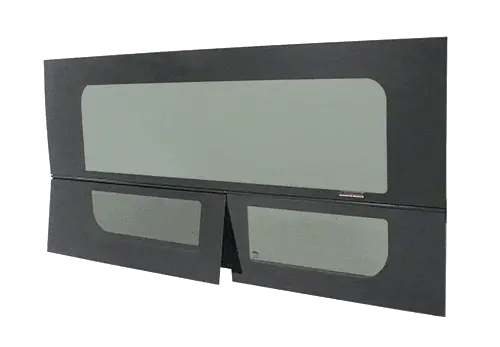 CRL T-Vent Window (ProMaster) CRL T-Vent Window (ProMaster) | Crossflow upgrade | $$$ | Real crossflow airflow, reduces condensation, better passive ventilation | Extra install complexity, higher cost | Check Amazon Price |
MaxxAir 4500
Best For: Your first fan, most vans
Price: $$
Pros: Most real airflow of the two, same 10 speeds, lower price
Cons: Closes itself in rain instead of running through it
MaxxAir MaxxFan Deluxe 7500
Best For: First fan if rainy or cool, otherwise the second
Price: $$
Pros: Runs with the lid open in rain, same 10 speeds and remote
Cons: Dome cuts real air pull roughly in half, costs more
CRL T-Vent Window (ProMaster)
Best For: Crossflow upgrade
Price: $$$
Pros: Real crossflow airflow, reduces condensation, better passive ventilation
Cons: Extra install complexity, higher cost
MaxxAir 4500
Check Amazon PriceIs this the right setup for you?#
Tap the situation that sounds like you.
🌴 I'm building for hot, humid climates (Florida, Gulf Coast, Southeast). Two fans + crossflow
This is the climate where ventilation actually has to work. Run the 7500 + 4500 together and add T-vent windows on both sides. Florida summer with the fridge at peak draw and humid nights is what stresses a ventilation system. Size for that, not for an average shoulder-season day.
The 7500's rain-open lid earns its premium here. Light rain plus humidity is exactly when you need ventilation most.
⛰️ I'll mostly camp in mild climates: coast, mountains, dry summers. One fan can work
One fan + T-vent windows handles most of this. San Diego winters and Colorado summers don't demand the second fan. Start with the 4500, which moves the most air. If rain or cool weather is the norm where you park, start with the 7500 instead, which stays open when it pours.
Skip the budget roof fans under $100: the failure points show up after 6–12 months of daily use.
🛌 Weekender or part-time build. One fan + opening windows
One quality roof fan and any opening window for crossflow is enough for weekend use. T-vents are nice to have but not essential at this usage level. Don't overbuy. The second fan is for full-timers in tough climates.
💸 Tight budget. Can I really skip the second fan? Yes, with crossflow
Yes. One fan + crossflow windows on opposite sides covers 80% of full-time use. Pick the 4500, unless you mostly park somewhere rainy or cool, where the 7500 makes more sense. The second fan is the marginal upgrade for hard climates. If the budget choice is fan #2 vs T-vent windows, take the windows: extraction without replacement air is incomplete.
What 8 years of full-time ventilation taught me#
We have never run just one fan +
Worth being straight about this, because most of the internet will tell you how a single-fan van feels. We have had both fans and T-vent windows on both sides since the build. We have never lived with one fan, so we are not going to describe it as if we had.
What eight years of running them side by side does tell you is which one is doing the work. With both lids open, the 4500 is obviously moving more air. That is where the buy-the-4500-first recommendation comes from: not from a theory about domes, but from standing under both of them for years.
For full-time use across changing climates, two fans is the right setup. For a weekender or a mild-climate build, one quality fan plus crossflow windows is a reasonable call, and the fan we would pick for that job is still the 4500.
Florida summer is the real test +
San Diego in winter is the easiest ventilation situation possible on paper: mild temps and you barely need the fan to stay comfortable. It has a hidden cost though, and it is the one thing I would warn a coastal van lifer about. Parked near the ocean you are pulling damp air through the van all night, and condensation builds up on and inside the fan itself. That the damp is salt air is what makes it bite: the moisture is the mechanism, the salt in it is why what condenses is corrosive rather than just wet. Running them hard makes it worse, because you are moving more of it through the housing. I suspect that is what killed the keypads on both of ours. Reported Be deliberate about running a roof fan on high near the coast, and give it dry days to clear out.
Beyond that, Florida in summer is the hardest: heat, humidity, and a fridge running at peak draw because of ambient temp. In those conditions, a fan at high speed all night isn't optional. The 4500 over the bed is what carries those nights, with the 7500 pulling out the other end.
Arizona is its own category: we have spent a lot of hot days there in late spring and driven through in the height of summer. Dry heat is a load you can pay for, because the same sun that is cooking the van is also filling the batteries. Colorado summers are easy. New York shoulder seasons are manageable. If you're building for a mild home climate, you have flexibility. If you're building to travel, size your ventilation for the hardest conditions you'll encounter.
The rain lid matters more than you think +
The MaxxFan 7500 runs fully open in the rain. That is the point people get wrong: you are not cracking it slightly and hoping, the permanent shield sits over the opening so the lid can be all the way up while it is pouring. Sounds like a convenience feature. In practice, it's a comfort feature in humid climates: when you need ventilation the most (humid night, light rain) is exactly when a fan without rain capability goes from useful to useless.
The 4500 doesn't have a rain-open lid. We leave it closed in rain and rely on the 7500. But if you're only buying one fan, buy the 4500 anyway, because the dome costs the 7500 about half its airflow and heat is every night of the summer. The exception is somewhere rainy or cool: there the 7500 wins, because you don't need maximum airflow and a fan that closes every time it rains is closed when you want it open.
Chasing a quiet fan is the wrong goal +
Steady fan noise is an asset, not a cost. It masks the parking lot, the highway, the neighbors. The fan running is often the reason we sleep through something that would otherwise have woken us.
What wrecks sleep is noise that changes: a buzz that appears at one speed, a rattle, a click. Your ear tunes out a constant sound in minutes and never tunes out an intermittent one. That is why a rattling fan is worse at 2am than a louder one running clean, and it is why the ten speeds matter for tuning the sound rather than escaping it.
Neither MaxxAir is meaningfully quieter than the other. They are the same fan body with a different rain strategy.
Crossflow is a real upgrade, not a nice-to-have +
A roof fan extracts air, but it needs replacement air coming in from somewhere. Without crossflow (windows or vents on opposite sides) you get incomplete air movement and dead zones, especially in sleeping areas.
We have T-vent windows on both sides of the ProMaster. I wanted the windows; Karlee only wanted one, on the sliding-door side. I pushed for both sides and that was the right call. You feel the difference immediately when both are open versus one, because one window plus a fan is extraction with a straw and two windows is a path through the van. Eight years on, the T-vents have held up. The only part either one has needed is a crank mechanism on the sliding-door side, which failed about two years ago and which I replaced myself. That is the window we open by far the most, so the one that wore out is the one Karlee had picked as the one that mattered. She was right about which window earns its keep. I was right that you want both.
Mind the fan height before parking +
One thing no fan review covers: when the MaxxAir lids are fully open, they push our ProMaster over the 9-foot clearance mark (the stock van plus rack stays under 9'). We learned to lower them before driving into any low-clearance areas: parking garages, gas station canopies, drive-throughs. Obvious in retrospect; build it into the habit early so you don't find out the hard way.
Both squeaks are avoidable, and they have different causes +
A squeaking fan is two separate problems people treat as one. The housing squeaks because of how it was mounted. The motor squeaks because of how you run it. Most reviews call the second one inevitable wear. It is not.
The housing: we have never had a mounting squeak in eight years, and I think that comes down to how the fans were sealed rather than luck. Direct metal-to-metal contact at the mounting flange is what squeaks on rough roads, so the goal is to never have metal riding on metal. The standard method is two layers doing two different jobs:
- Butyl tape underneath. A continuous bead around the flange before the fan goes down. It stays permanently soft, so it is both the primary water seal and the cushion that keeps the housing from riding on bare roof. Compress it with the screws, do not stretch it thin at the corners.
- Dicor self-leveling lap sealant on top. Run over the flange edge and the screw heads once the fan is down. It flows out flat on its own, which is the whole point of "self-leveling" on a horizontal roof, and it is the secondary seal that keeps water off the butyl.
Get that right and you get a quiet housing and a dry roof from the same job. Get it wrong and you chase both problems for years.
The motor: ours only ever start squeaking when we run them against a closed-up van. Open a second path for the air (another vent, a cracked door, a T-vent) and they stay quiet. Run one sealed and it strains, and eventually it tells you about it.
When one does start, it is fixable: take the motor apart and clean it. I have done that more than a handful of times. Fair warning though, getting it back together is fiddlier than taking it apart. If you are comfortable with small mechanical work you will be fine, and if that is not your thing there is no shame in leaving it alone or having someone else do it, because a squeaking fan still runs. The free fix is the same habit that makes the fan actually ventilate in the first place, which is open something else. A fan with nothing to pull from does not just move less air, it is the one that starts squeaking. More in the long-term review.
How to tell a 4500 from a 7500 once they're installed +
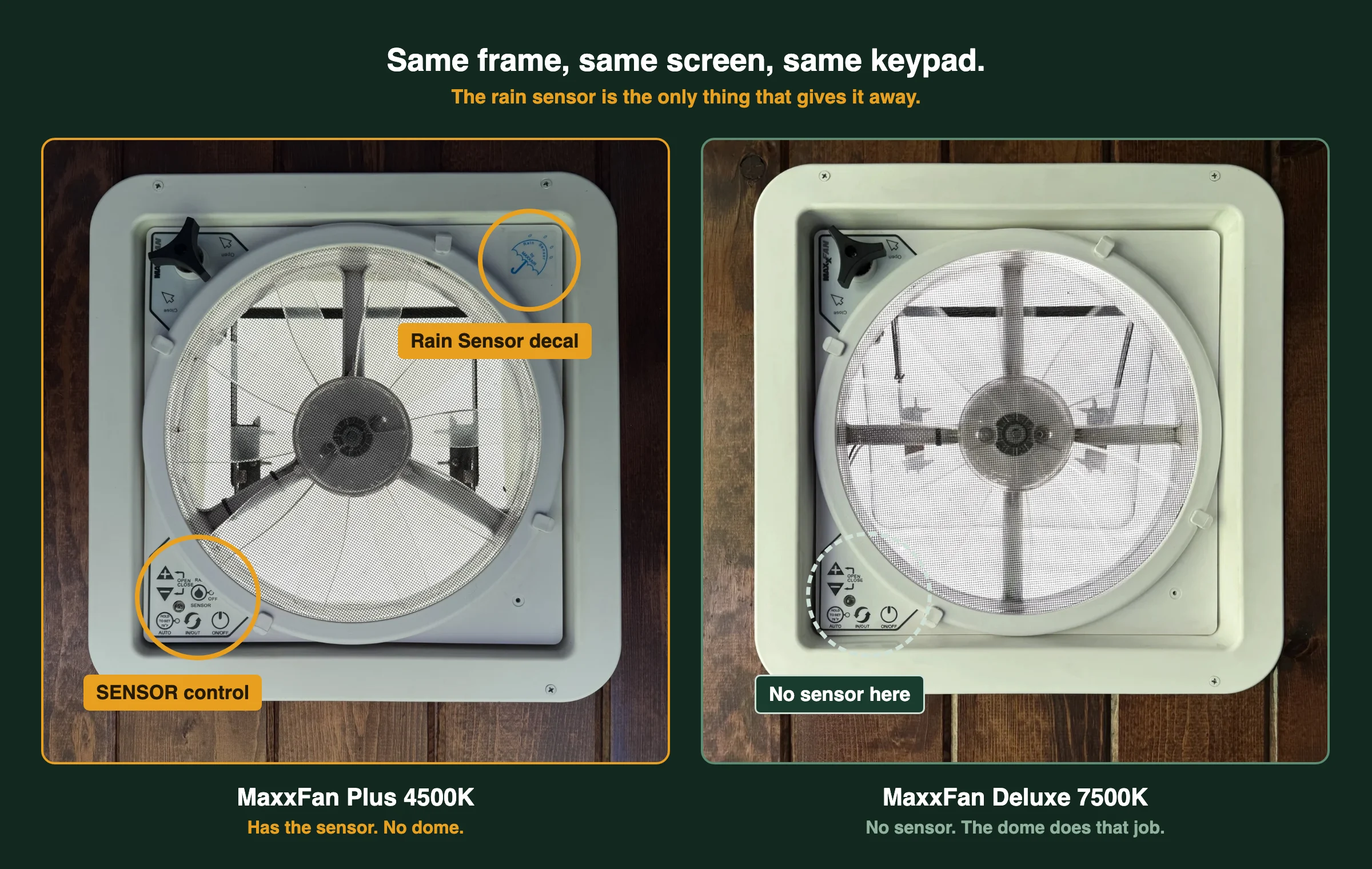
With the lids shut, from inside, these two look almost identical. Same frame, same screen, same keypad, same manual crank. We run one of each and still have to look twice.
The tell is the rain sensor. Only the 4500 has one, because without a dome it has to detect water and close itself. Spec The 7500 has none at all. Spec So the fan with the extra button on the ceiling panel is the cheaper one, which is backwards from what most people assume. Useful if you are buying used or you inherited a build and do not know what is up there.
Top picks explained#
Our primary fan, in the back over the bed. Same 900 CFM rating Spec and the same 10-speed reversible motor, thermostat and remote as the 7500, at a lower price, and it moves noticeably more real air because there is no rain dome restricting the path. The tradeoff is weather: its sensor closes the lid and stops the fan, where the 7500 keeps running. On a single-fan build that trade is worth it every time, because moving air is the whole job. Ours ran six years of daily duty before we replaced it with the same model.
MaxxAir 4500
Check Amazon PriceOur second fan, up front. Eight years and two units: the original gave six years of daily duty before we bought the same model again, which is the strongest endorsement I can give a roof fan. What the upcharge buys is weather, not airflow. The permanent dome lets it run straight through a storm, and it costs roughly half its real air pull to do it. The remote earns its place at 3am.
MaxxAir MaxxFan Deluxe 7500
Check Amazon PriceNot a fan, but the upgrade that makes fans perform better. T-vents on both sides create a real crossflow path. The improvement in overnight airflow comfort is meaningful, especially in humid climates. Higher install cost; worth it for full-time use.
CRL T-Vent Window (ProMaster)
Check Amazon PriceThe brushless question#
Every fan on this page so far uses a brushed motor. Spec That is worth understanding before you spend, because the alternative now exists and it is the one real argument for buying something other than a MaxxAir.
A brushed motor runs current through carbon brushes that physically press against a spinning commutator. They work, they are cheap, and they wear: the contact creates friction, the friction creates heat and dust, and over years it is what turns a smooth fan into a noisy one. A brushless motor switches electronically instead, so nothing rubs. In principle that means less drag, lower draw for the same airflow, and a fan that stays quiet as it ages rather than getting worse.
One caveat before you assume brushless solves the noise problem. Our MaxxAir motors only ever started squeaking when we ran them with little or no intake open. That is a strained motor, and a strained motor is a strained motor whatever the commutation. Brushless removes one wear path; it does not let you run a fan against a sealed van for free. Open something else either way. See the long-term review.
The two we’d look at first#
⚠️ We have not run either of these. Eight years of our own data is on the MaxxAir units, not on these, so treat the section below as a shortlist to research rather than a recommendation earned on the road.
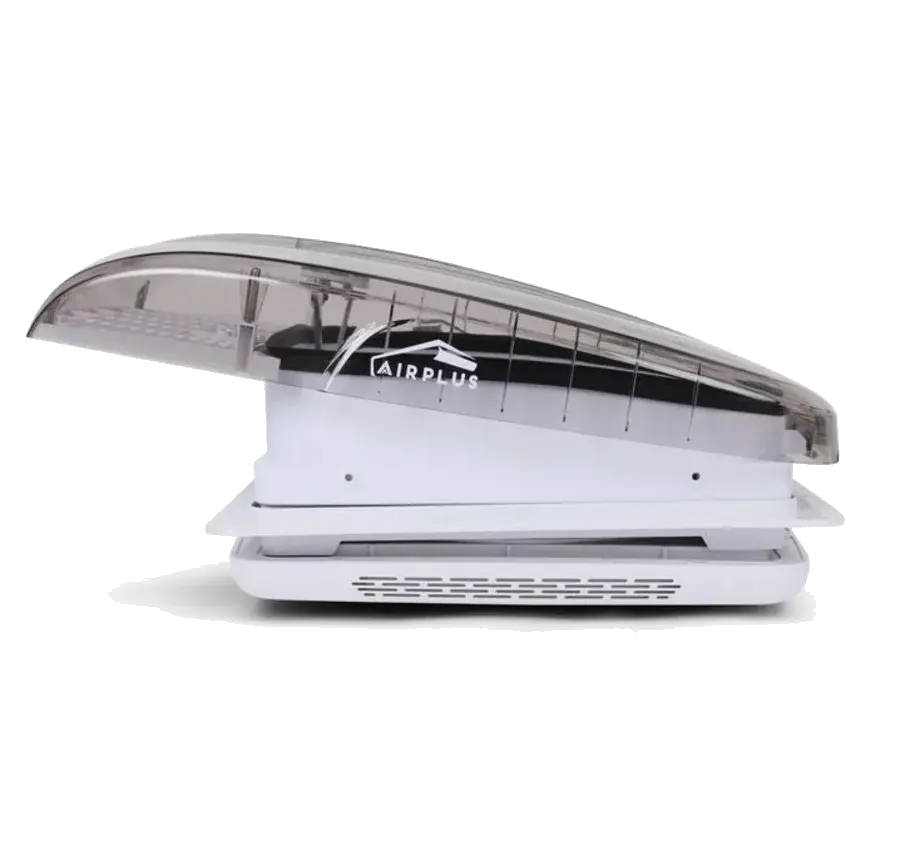
Brushless, 10 levels plus an auto mode, remote or touch control, integrated blind and fly screen, LED, rain protection, and it uses the same mounting flange as MaxxAir, so it drops into an existing 14×14 hole without re-cutting or re-sealing. Spec
Published figures: 3,000 m³/h of ventilation capacity and under 53 dB. Spec That converts to roughly 1,765 CFM, nearly double the MaxxAir rating, so the two are almost certainly not measured the same way.
⚠️ It sells on having a "lower amp draw" than a brushed motor and then never prints the number. The one spec that would prove the pitch is the one it leaves out.
~$369 as listed August 2026.
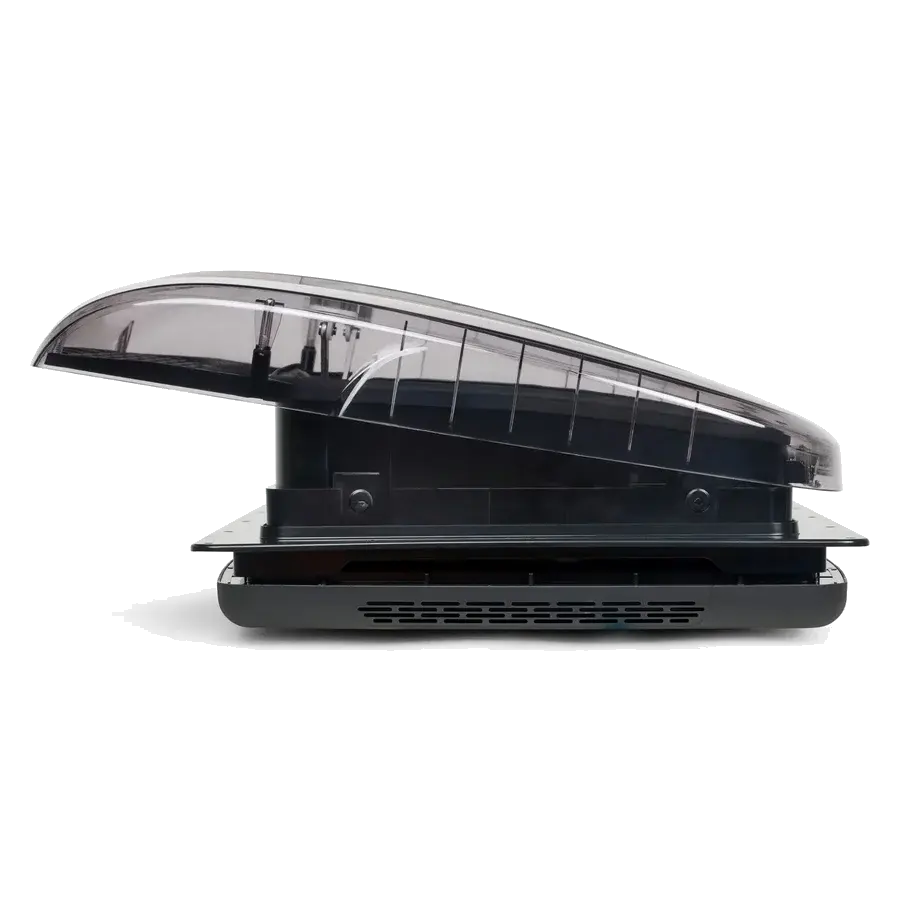
Brushless, 10 speeds, reversible for intake and exhaust, built-in LED, sold explicitly as a direct replacement for a MaxxAir 14×14. Spec If you already have a hole and a dead fan, this is the least disruptive way to try brushless.
It is the one that actually prints the number: 20W or less for the fan, plus 4W if you run the LEDs, on 12V DC. Spec Same 3,000 m³/h claim as the AirPlus, and noise broken out properly at 29 to 47 dB on exhaust and 32 to 53 dB on intake. Spec
~$350 as listed August 2026.
Read the efficiency claim with your eyes open#
ProBreeze is the only one of the two that prints a power figure: 20W or less for the fan on 12V DC. Spec Set that against the 32W we measured on our own MaxxAir at speed 10 Measured and it is a saving of a bit under 40%, which is an ordinary and entirely believable result from swapping a brushed motor for a brushless one. Take the power claim seriously.
The airflow claim is the one that still does not hold up. The same sheet lists 3,000 m³/h, about 1,765 CFM, against MaxxAir’s rated 900. Spec That is nearly double the air, out of a fan in the same 14×14 hole, spinning through the same 10 steps. Brushless changes how the motor is commutated. It does not change how much air a blade of that diameter can move.
So the two figures are almost certainly not measured the same way, and the likeliest explanation is a free-air rating quoted against MaxxAir’s more conservative one. That matters more than it sounds, because if the CFM is inflated then the honest 20W is buying you less air than the sheet implies. Nobody has yet put a meter on one of these in a real van and published what it pulls at speed 10 alongside what it actually moves. Until somebody does, one half of the pitch is credible and the other half is a brochure, and there is no way to tell which half your money is going to.
One more thing worth noticing. Both fans publish the same 3,000 m³/h, the same 10 levels, the same reversible motor, the same integrated blind, the same 14×14 flange. That pattern usually means one factory and two labels rather than two designs that happened to land on identical numbers. We have not confirmed it, so treat it as a question to ask a retailer before you assume you are choosing between two genuinely different fans.
The price is the surprise#
The assumption with brushless is that you pay a premium for it. You mostly don’t. Both of these land around $350 to $370, and the MaxxFan Deluxe 7500 is listed at $475.35 at specialist RV retailers as of August 2026. Spec The brushless fans undercut the MaxxAir we already own, and sit in the same band as the 4500. Prices move and Amazon often differs from the RV shops, so check before you buy, but the “brushless costs double” idea does not survive contact with the listings.
Which changes the recommendation. The reason to stay with a MaxxAir is not that it is cheaper, it is that eight years of our own data is on it and none is on these. That is a real reason, and it is the only one we have.
What I would do, and what I plan to do: run the MaxxAirs until they die, then try a brushless as the replacement. The hole is already cut, both of these drop into it, and by then there will be more owner data than there is now. If you are cutting a fresh hole today and you sleep light, brushless is a reasonable bet at a price that is no longer a penalty.
What to skip#
Portable clip fans as a ventilation substitute +
They help with immediate spot cooling but don't extract heat or moisture from the van. A hot, humid van that feels slightly less hot near the fan is still a hot, humid van. Use them as supplemental, never primary.
Budget roof fans under $100 +
The failure points (motor noise, lid mechanism, speed controller) tend to show up after 6–12 months of daily use. A fan that lasts eight years costs less per year than a cheap one you replace twice, and ours went six years of daily duty before they needed replacing.
Complex smart controls +
A standard remote gets you everything you need. No need for app-connected ventilation systems in a van-sized space.
Frequently asked#
Do I need two roof fans? +
For full-time use across varied climates: two fans with crossflow windows is the complete setup. For part-time or mild-climate builds, one quality fan with T-vent windows handles most situations. Start with one and add a second once you know your real-world gaps.
Can I skip a roof fan and use a portable fan? +
Portable fans move air around inside the van. A roof fan extracts heat and moisture out of the van. They're not the same job. For sleeping comfort in heat or humidity, extraction is what matters. A portable fan alone isn't a substitute.
Where should I position the second fan? +
Put them at opposite ends. Ours are the 4500 in the back over the bed and the 7500 up front, which gives the longest possible airflow path through the van. Run one pushing in and the other pulling out and you get a real draft the length of the space instead of extraction from a single point. Both fans clustered in the same section gives you redundancy but much less coverage.
How much power do the MaxxAir fans use? +
We measured it, because MaxxAir does not publish it. 32W per fan on speed 10, and 58W with both fans wide open, read off our BLUETTI's DC output. Measured That number held with the fans blowing out and blowing in, and with the T-vent windows open and shut, so it is the motor and not the airflow path. It sits alongside the rest of our figures on the real-world power data page.
Worth noticing that two fans is 58W and not 64W. The pair draws a few watts under double a single fan, every time we check. We do not have a confident explanation. The obvious candidate would be a fixed overhead inside the station getting counted twice when you measure one fan at a time, except ours reads 0W with nothing plugged in, so that is not it. Measured We would rather publish both numbers as we read them than pick the one that divides evenly. The practical takeaway: if you build a power budget by summing devices you measured separately, expect the real total to land a little under it.
One more thing the meter turned up: both fans draw the same 32W, and the 7500 moves noticeably less air for it. Reported The rain dome costs you efficiency rather than watts, which is the case for buying the 4500 first restated in power terms.
Eight hours on speed 10 is about 256Wh per fan, or 464Wh for the pair. That is real money against a 1kWh station. Speed 1 is around 0.2A, call it 2 to 3W, so a full night on low is under 25Wh. Spec
The numbers in circulation are too high. The third-party per-speed tables everyone quotes say 3.7 to 4.4A at speed 10, which works out to 44 to 53W. Our BLUETTI's DC readout says 32W, about 2.7A at 12V. If you have been sizing a battery off one of those tables, you have been budgeting roughly 40% too much for the fan, and on two fans over a long night that is 240 to 380Wh of capacity you did not need to buy.
Most nights land nowhere near speed 10, though, and that is why our power calculator budgets a roof fan at 15W rather than 32W. That is the same fan around the middle of its range, which is where one actually sits when you are asleep. Size for the mid-speed number for a normal night, and check the wide-open number against the handful of nights a year that earn it.
What about solar-powered fans? +
Battery-powered or solar roof fans are an option for builds without a 12V system. For full-time use, a proper 12V setup with a quality fan is a better long-run investment. Solar-only fans typically have weaker airflow and more complexity to maintain.