
The 30-second version
Where do you mostly park?
Rainy or coolTap for our answer
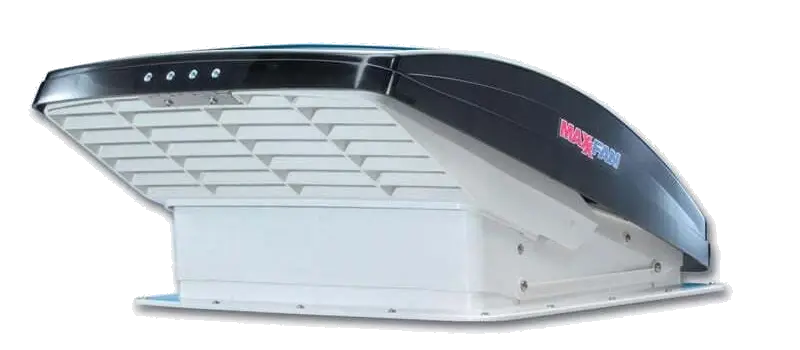
Get this one. It stays wide open through a downpour, and somewhere like Oregon or Washington you don't need maximum airflow. Ours has never let rain inside in eight years.
Get the 7500Hot summersTap for our answer
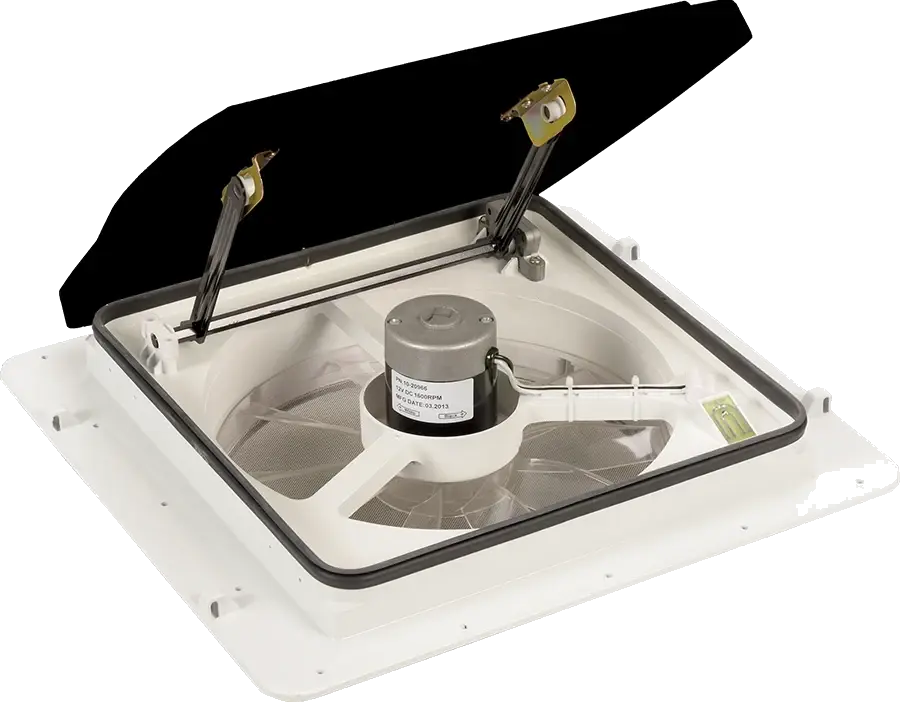
Get the 4500 first. The 7500's rain guard costs it airflow: in our van it feels like about half of what the 4500 moves. In the heat, airflow is the job. Add a 7500 later for rainy nights.
Get the 4500Read the full review
There’s been a MaxxFan Deluxe 7500K in our 2017 ProMaster’s roof for eight years. Two of them, actually, and that replacement story is part of this review. Paired with a MaxxAir 4500K on the other end of the van and T-vent windows on both sides, it’s the ventilation backbone of our build.
For most vans, buy the 4500K first. This one is the exception. If you mostly park where it rains a lot or the summers stay mild, buy this one: it keeps running wide open through a downpour, and in a cooler climate you don’t need every last bit of airflow. Anywhere the summers get hot, the 4500K comes first. The 7500’s rain guard trades away airflow, and in our van it feels like it moves about half what the 4500 does. That tradeoff doesn’t show up on the spec sheet, and it shows up most on the hottest nights.
MaxxAir MaxxFan Deluxe 7500
Check Current MaxxFan 7500 PricingQuick Verdict
Skip if: your summers are hot and this would be your only fan. The MaxxAir 4500K moves more air for the same 32W (more on that below).
Is the 7500K the right fan for your build?#
Tap the situation that sounds like you.
🌧️ Rainy or cool climate: Oregon, Washington. 7500K is right
The rain guard is the 7500's signature feature. You can leave the fan running wide open through a downpour without water entering the van. Where it rains often and the summers stay mild, that matters more than peak airflow, and this is the fan to buy, even as your only one.
It also suits the jobs that come with that weather. The lid can stay open while you drive. You can leave it running when you step away from the van without watching the sky. And on cold, wet nights, running it low on exhaust with a window cracked carries cooking steam and breathing moisture out before it turns into condensation on the walls. A fan that closes itself when it senses rain can't do that on the nights you need it most.
🛏️ Sleep-quality and remote control matter. Strong fit
The remote is one of those features that sounds gimmicky and turns out to be daily-use. Adjusting fan speed from bed at 3am (without getting up to reach the ceiling switch) meaningfully changes whether you fall back asleep. Variable speed lets you tune the sound to a level that masks road noise without becoming the noise itself.
🌴 Hot, humid summers: Florida, Gulf Coast, southern climates. Pair with a 4500
The 7500's dome restricts airflow. On the hottest Florida nights, you want maximum air movement. We run a MaxxAir 4500K in the back over the bed as the primary "pull" fan because it pulls more air in practice, and the 7500 up front as the rain-immune secondary. Two fans + T-vent windows beats one fan in this climate.
💵 Budget build: is the 7500 worth it over the 4500? Depends on rain
Price isn't the deciding factor: the two list within about ten dollars and street prices cross. Climate is. Both are rated 900 CFM and both draw 32W, but the rain guard means the 7500 feels like it moves about half the air of the 4500, and often you can barely feel it at the vent. Somewhere rainy or cool, that's a fair trade for a fan that never has to close. Somewhere hot, buy the 4500 first and add this one later. See the 4500K review for that side of the comparison.
What we learned running the 7500K for 8 years#
Rated 900 CFM vs real airflow: the dome tradeoff +
Both the MaxxFan 7500K and the MaxxAir 4500K are rated 900 CFM. Spec But that rating doesn't capture what the rain-proof dome actually does to airflow in real-world use.
The 7500's permanent dome cover restricts air flow paths even when the fan is fully open. The 4500 lacks the dome (it has a rain sensor that closes the lid when it senses water), so when the 4500 is open, it pulls more air than the 7500 in the same conditions.
That doesn't make the 7500 the wrong choice. It makes it a different choice. The 7500 trades some peak airflow for the ability to run continuously in rain. In a rainy or cool climate, that's worth it. For Florida-summer-heat optimizers, run both fans in opposite ends of the van and let them tag-team.
How to tell a 7500 from a 4500 once they're installed +
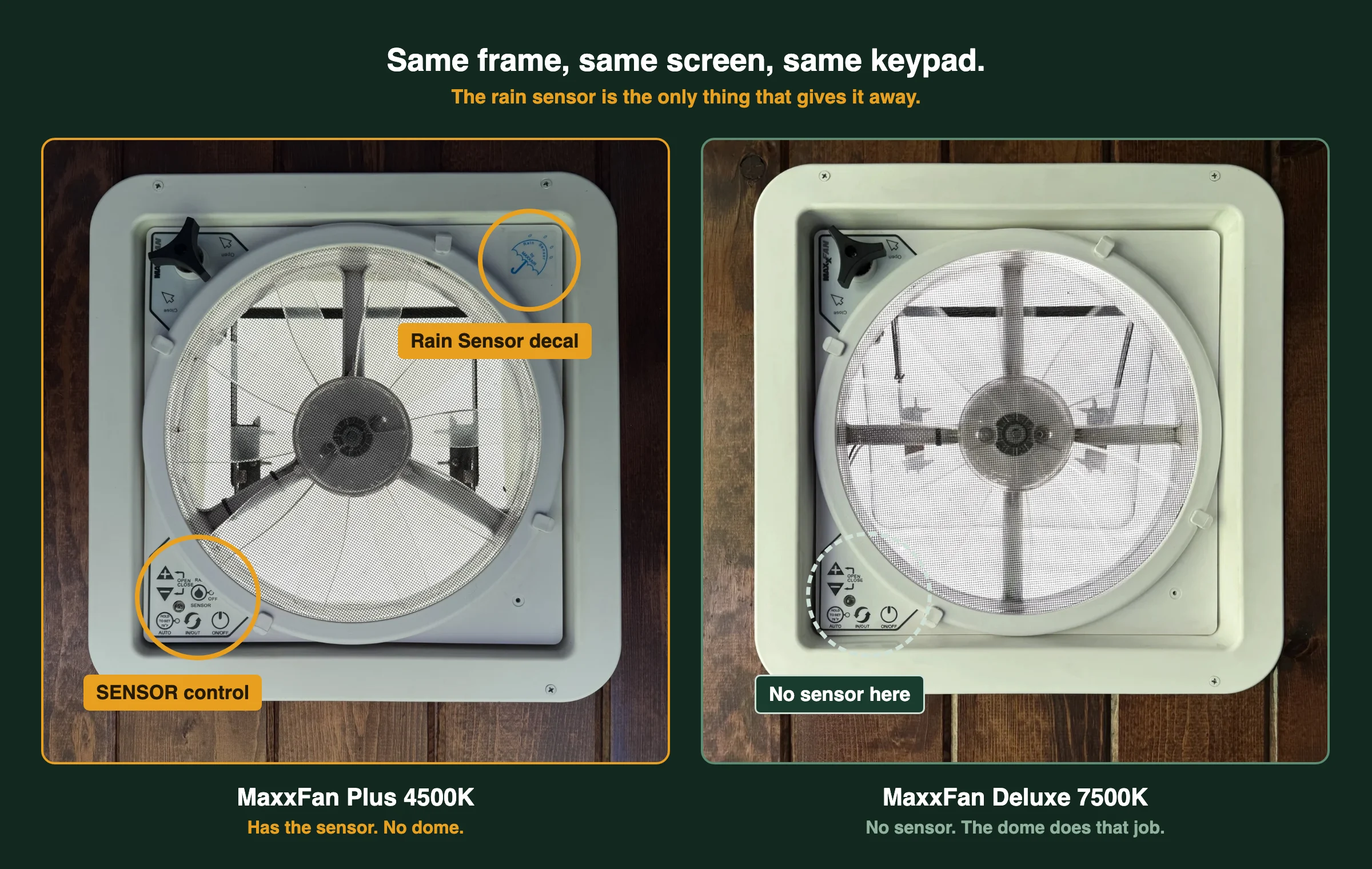
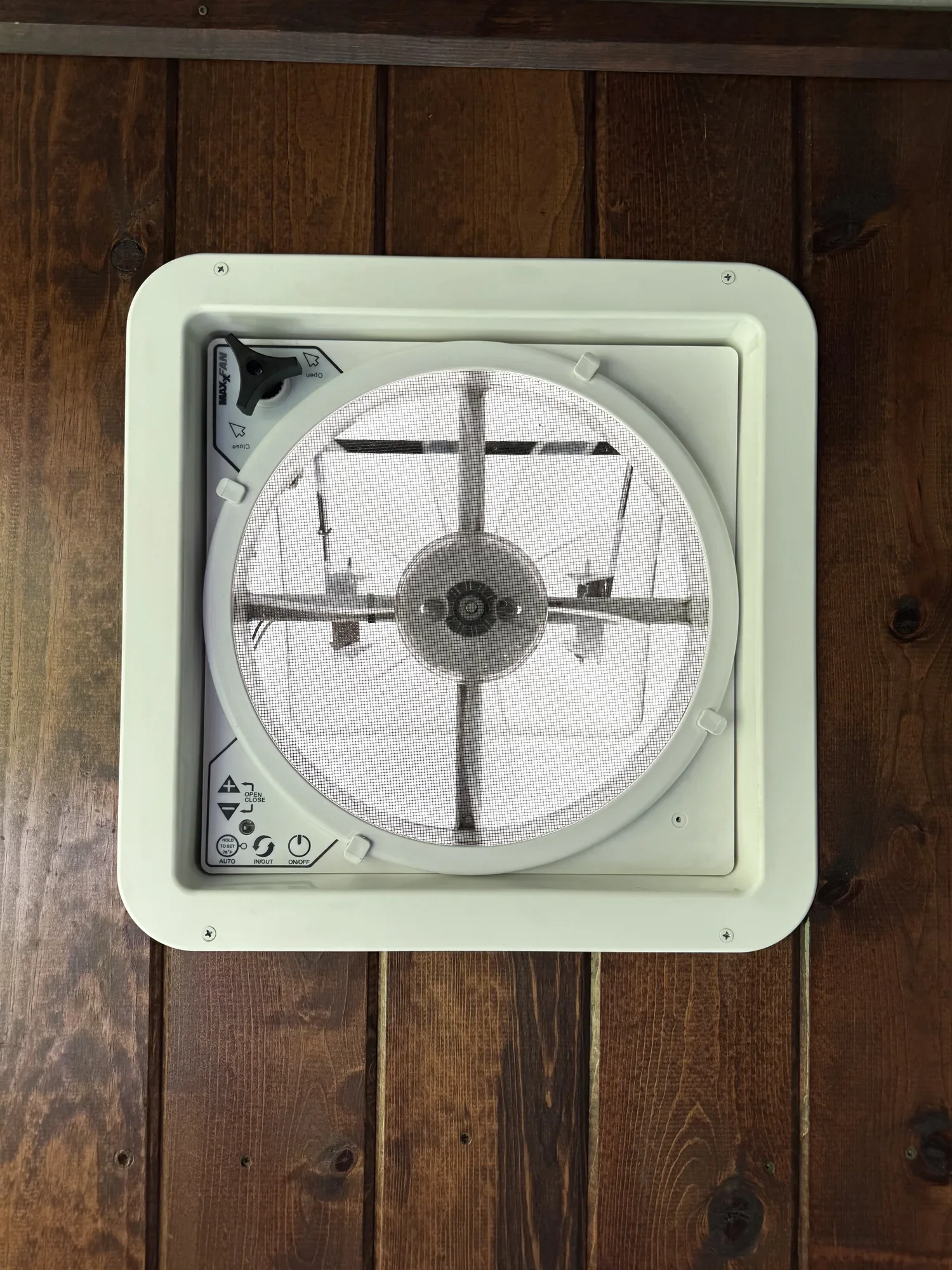
From inside the van, with the lid shut, these two look almost identical. Same square frame, same screen, same ten-speed keypad, same in/out reverse, same manual crank. We run one of each and still have to look twice.
The tell is the rain sensor. The 4500K has one, because it needs one: no dome, so the fan has to detect water and close its own lid. Spec The 7500K doesn't have one at all, because the permanent dome makes it unnecessary. Spec So the extra sensor on the ceiling panel means you're looking at the entry model, which is a little backwards from what people expect.
Worth knowing if you're buying used, or if you inherited a build and don't know what's in the roof. It also matters for the part numbers: the 00-04500K and the 00-07500K are one character apart in a listing, and the manual-lift 00-04000K is one digit off the 4500.
Durability: we're on our second one +
Eight years on the roof doesn't mean the original unit lasted eight years. Around year six we replaced both fans (the 7500 and the 4500), and this spring both keypads needed replacing too. My suspect is the winters we spend parked near the ocean in San Diego, and the mechanism is condensation rather than salt air on its own. Damp air moves through the fan all night and collects on and inside the housing where the electronics sit. The salt in that damp is what makes it corrosive instead of merely wet. Running it hard makes it worse, because that's more of it through the same path. Reported
Here's the part that matters: when the originals wore out, I bought the same fans again. Six years of daily full-time use across four climates is a real service life for a roof appliance, and nothing else on the market made me want to switch. That's the actual endorsement, not a fan that never breaks, but one worth re-buying when it does.
Isolation tape under every fixture mount +
Eight years of washboard and neither fan has ever developed a mounting squeak. That is not luck, it is the seal method, and it is two layers rather than one. Butyl tape underneath does double duty: primary water seal, and the cushion that keeps the housing from riding directly on roof metal. Dicor self-leveling lap sealant on top flows flat on a horizontal roof and covers the flange edge and every screw head. Reported
Skip the cushion layer and the fixture works itself loose on rough roads until it starts talking. That noise is hard to trace, because it arrives through the ceiling and you will check the cabinets, the doors and the rack before you look up. A few dollars of butyl at install is the cheapest insurance in the build, and the same logic applies to anything else you bolt to the van.
This is not the only squeak these fans make, and the fixes are unrelated. The other one comes from the motor, it means you have been running the fan against a sealed van, and it is fixable. That story is in the long-term review.
The 9-foot-clearance problem (ProMaster + ceiling rack) +
Our ProMaster runs a Vantech low-profile ceiling rack that keeps total height under 9 feet, important for parking garages, drive-throughs, low-clearance bridges. The MaxxFan in its open position pushes the height over 9 feet.
Always lower the fan before low-clearance areas. Build the muscle memory, because the fan does not know where the roof of the parking garage is. Worth knowing before you find out: the lid carries a lifetime limited warranty and the rest of the unit two years, Spec but that covers a lid that fails, not a lid you drive into a concrete beam. On a fan that lists at $476 it is not a cheap thing to be casual about.
Pair the fan with cross-flow ventilation +
One fan moves air, but it can only move air it can pull from somewhere. If your van is buttoned up tight and the fan is the only opening, you'll create negative pressure and limited circulation. Pair the fan with at least one cross-flow path (T-vent windows, screened door, awning window) so air enters as fast as the fan exhausts it.
We run T-vent windows on both sliding-door and driver's-side walls. We both wanted T-vents; the argument was how many, and I pushed for both sides when one seemed like enough. Both walls is what makes the ventilation system work.
Specs (for reference)#
On paper these two fans are nearly the same product. Same rated airflow, same ten speeds, same 14″ hole, same warranty, same measured draw, and list prices about ten dollars apart. Spec The dome is the difference, and it is the whole difference.
| Spec | MaxxFan Deluxe 00-07500K | MaxxAir MaxxFan Plus 00-04500K |
|---|---|---|
| Rated airflow | 900+ CFM | 900+ CFM |
| Speeds | 10, reversible in and out | 10, reversible in and out |
| Rain strategy | Permanent dome, runs fully open in rain | Sensor closes the lid, fan stops |
| Rain sensor on the keypad | No | Yes |
| Roof opening | 14″ × 14″ | 14″ × 14″ |
| Thermostat | Yes | Yes |
| Remote | Included | Included |
| Runs with the lid shut | Yes, recirculates | Yes, recirculates |
| Warranty | 2 years, lifetime on the lid | 2 years, lifetime on the lid |
| List price | $476.00 | $467.09 |
| Draw at speed 10 | 32W Measured | 32W Measured |
The 7500 is not reliably the expensive one. Prices for both move constantly and they cross, so on the wrong week the “budget” 4500 is the expensive one. Buy the 4500 first because it moves more air, not because it saves money, and check both prices before you order either.
MaxxAir publishes no amp draw for either fan. Retailers quote roughly 1A on low up to 4–5A at 12VDC. Reported Our BLUETTI’s DC readout says 32W at speed 10, which works out to about 2.7A at 12V.
Rated max, and the same rating the 4500 carries. Real airflow with the dome in place runs well below it: in our van this fan feels like it pulls about half what the 4500 does, for the same 32W. Reported The rating is honest about the motor and silent about the dome.
The defining feature: a permanent dome that lets the fan run fully open through active rain without water getting in. The lid does not sit cracked, it goes all the way up. The 4500K instead uses a sensor that auto-closes the lid and stops the fan. Different design, different tradeoff.
Ten speeds, reversible for intake or exhaust, thermostat, powered lift, and a remote that earns its place. Adjusting the fan from bed at 3am is a daily-use feature, not a luxury. It also runs with the lid shut to circulate air inside, which is the mode nobody mentions and the one you use in a parking lot.
Frequently asked#
7500K or 4500K: which should I buy? +
One fan: for most vans, the 4500K. It feels like it moves about twice the air, and moving air is the job. The exception is if you mostly park somewhere rainy or cool, like Oregon or Washington: then the 7500K, because it never has to close and you don't need maximum airflow. For full-time van life we run both: 4500K in back over the bed, 7500K up front. They tag-team across all conditions.
How much power does it draw? +
32W on speed 10, read off our BLUETTI's DC output. Measured MaxxAir publishes no amp draw for either fan, so this is ours rather than a spec sheet's. Speed 1 barely registers: about 1 to 2W for a single fan. Reported Eight hours wide open is about 256Wh, and both fans together read 58W rather than 64W, which we cannot fully explain and are reporting as measured rather than rounding into shape.
Worth sitting with: this fan and the 4500 draw the same 32W, and the 7500 moves noticeably less air for it. Reported The rain dome is not free, and what it costs you is efficiency rather than watts. That is why the 4500 is the first fan in hot climates.
Is the install hard? +
Cutting a 14"x14" hole in your van roof is a one-way decision: get it right the first time. The hardware itself is straightforward. The two things to nail: perfect sealing (any leak ruins the install long-term) and a cushion under the flange: butyl tape between the roof metal and the fan, lap sealant over the top. Metal riding on metal squeaks on rough roads. Plan a full day, work in dry weather, and don't rush the sealant.
Does the rain dome actually work? +
Yes, and running the fan through active rain is the primary reason this unit exists. Ours has been through every kind of weather in eight years and has never let rain inside. Worth being precise about this: the lid goes all the way up while it pours. Not cracked, not halfway. The shield over the opening is the entire point. The tradeoff is the airflow restriction even when it's dry, so you're paying for the rain capability with some peak throughput.
Eight years on our roof
Run-in-rain ventilation, remote, 8 years of validation
MaxxAir MaxxFan Deluxe 7500
Shop MaxxFan 7500 →
Compare with the 4500K