
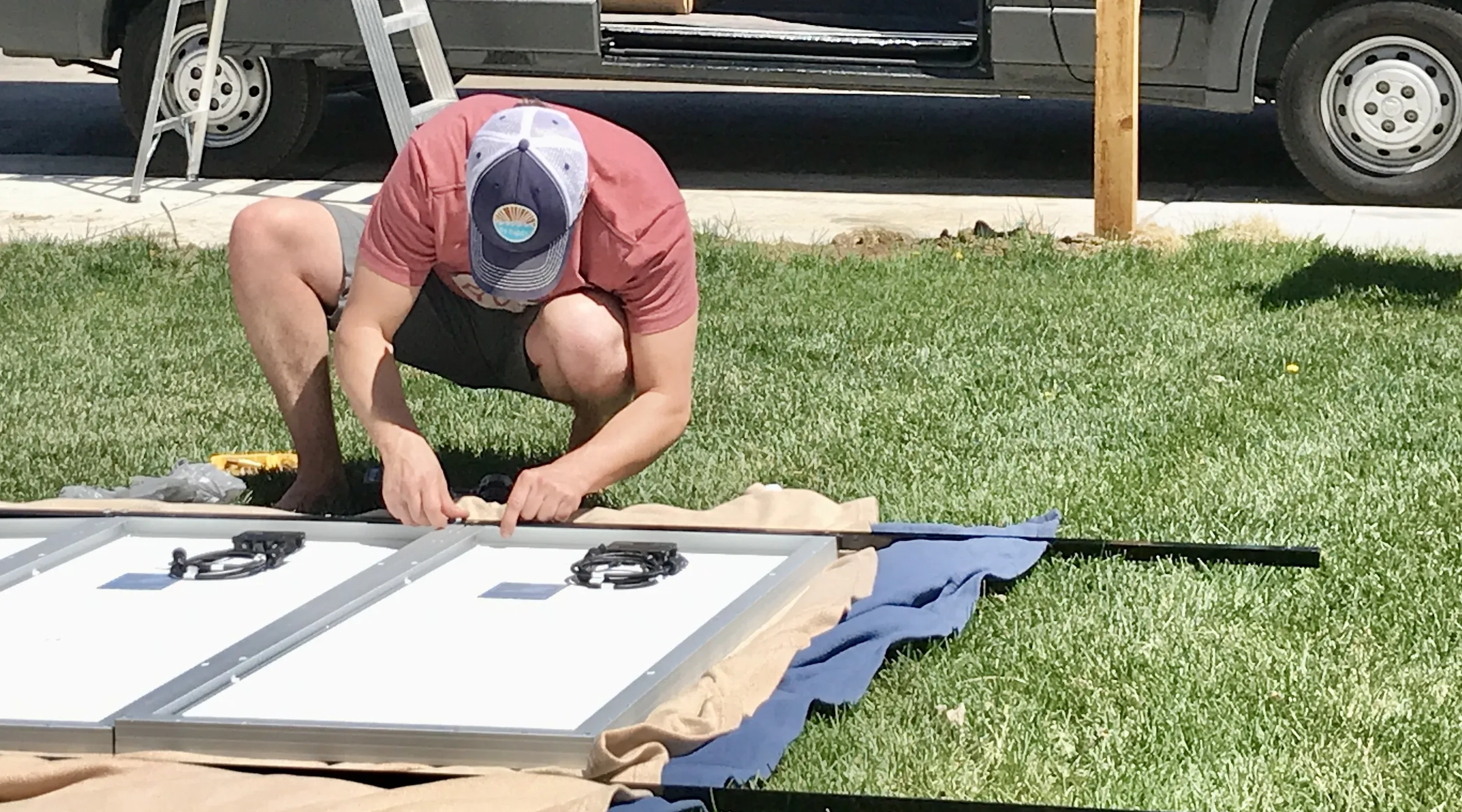
We’ve run three Renogy 100W slim panels on our ProMaster roof for 8 years. They sit under a Vantech low-profile ceiling rack, total height stays under 9 feet, the build still passes for a work van in most parking situations. The panels themselves have been bulletproof.
What I’d change isn’t the panel and it isn’t the count, it’s what I expected the array to do. I built 300W because that was the number being thrown around in 2018, and 300W is enough for sunny days and tight on overcast days. Then I measured the roof properly: with two Maxxair fans in place, three of these panels is what fits. The only path to four is deleting a fan, and in a Florida August that’s a trade I won’t make. This review covers both: why these panels are still the right pick for a stealth build, and why the roof itself is the constraint nobody warns you about.
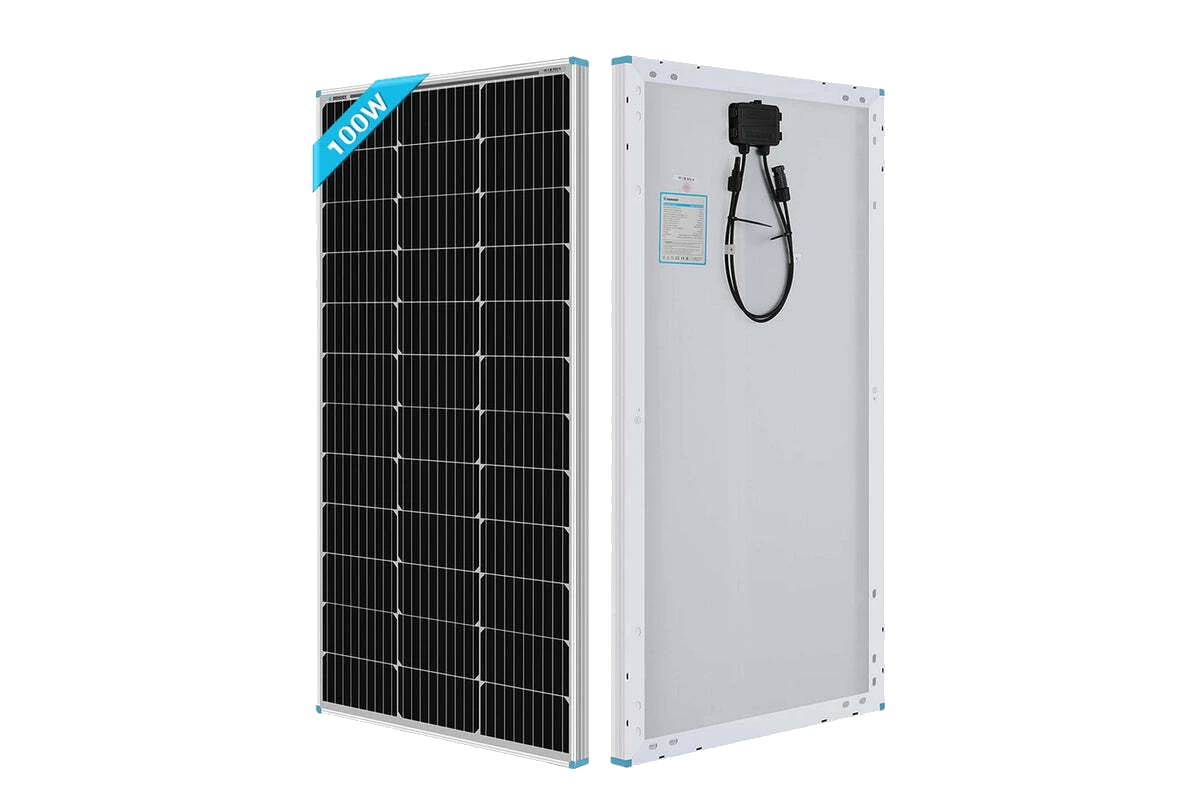 Renogy 100W Slim Panel
Check Current Price on Amazon
Renogy 100W Slim Panel
Check Current Price on AmazonQuick Verdict
Skip if: you’re optimizing pure dollars-per-watt and you don’t care about panel profile; there are cheaper panels that fit if your roof can take the bulk.
Are slim panels the right call for your build?#
Tap the situation that sounds like you.
🔒 Stealth ProMaster, silhouette matters. Slim is the point
This is exactly the use case. The slim profile lets the panel sit under a low-profile rack like the Vantech without pushing total height past 9 feet, the threshold for parking garages, drive-throughs, and a lot of low-clearance bridges. Bulkier panels add height that you'll feel every time you drive into a garage. For ProMaster builds where stealth and clearance both matter, the slim format earns its price-per-watt premium.
📈 Phased build, adding panels over time. Modular fit
The 100W slim is one of the most common van-life panels in use, which means availability and matching panels have stayed consistent year after year; panels matching our 2018 originals are still easy to find today. If your plan is "start at 200W, see how it goes, add later," this panel is a safe modular bet: buying matching units two years down the road is straightforward.
📚 First-time DIY, need install documentation. Strong fit
Renogy has the most-documented solar ecosystem in van life. Their wiring guides, charge-controller pairings, and parts-availability are first-class for new DIY builders. If this is your first solar install and you want to look up answers without piecing together forum threads, that ecosystem is worth paying for. Once you've done the wiring once, the brand premium matters less, but the first time, it matters.
💵 Pure dollars-per-watt optimizer. Look elsewhere
There are cheaper 100W panels per watt. HQST and other brands sell perfectly serviceable rigid panels that win on raw cost. If your roof has space for bulkier panels and you're not paying for the slim profile, the cost-per-watt math doesn't favor Renogy. The slim form factor is what you're paying the premium for. If you don't need it, you'll save buying somewhere else.
Living on 300W of flat solar for 8 years#
300W isn't enough for full-time, and the roof won't give me more +
Three 100W panels was my original build in 2018, and that number came from forum advice and YouTube builds at the time. It's enough for sunny days. It's tight on overcast days. It's not enough for cloudy stretches in CO winter or coastal summers when the fridge is working overtime.
Do the layout before you do the shopping. These panels are 42.2 x 19.6 inches and a Maxxair needs a 14 x 14 inch opening, but the number that decides your array isn't roof length, it's how those shapes pack around your fans, rack feet, and existing vents. Laid out full-size on our ProMaster the roof resolves two ways: three panels and two fans, or four panels and one fan. There is no 400W layout here that keeps both fans. A fourth panel is worth roughly 300Wh on a good day; a second fan is what makes a humid night survivable, on exactly the nights the fridge is drawing hardest. Keep the fan. The roof, not the budget, is what caps a van array, and almost nobody tells you that before you're up there with a drill.
Santa Rosa Beach 2019: when solar isn't the answer +
Summer 2019 in Santa Rosa Beach, FL: seven days of overcast sky, brutal heat and humidity, fridge working overtime, fans couldn't stop running, and almost nothing coming in from solar. Even with three panels rated for 300W, an overcast week produces a tiny fraction of that; single-digit percent days happen. We hauled the Yeti 1400 into coffee shops nearly every day that week to top off on shore power.
The lesson wasn't "buy better panels," and it wasn't "buy more" either, because there was nowhere to put them. The lesson was: solar is one input, not the input. An overcast week is a recovery problem, so plan for shore power and alternator charging as first-class inputs rather than backups.
Cold-weather solar: the Colorado winter trap +
Multiple full Colorado winters taught me something most solar reviews skip: panels can be producing power and the battery still won't accept it. Lithium battery cells refuse charge below freezing as a safety feature. Sunny CO winter morning, panels generating, charge controller can't push current into a cold battery, so the array sits idle and the battery dies overnight.
Solution back then was hauling our Yeti 1400 inside a Lakewood family or friends' house to warm up. Took 6–24 hours depending on how cold it had gotten. Today's power stations handle cold better than the Yeti did, and a Webasto or diesel heater that keeps the cabin warm overnight would make this a non-issue. But it's a lesson about systems thinking: the panels weren't the failure, the cold-temp battery behavior was, and no amount of solar fixes that.
Slim profile + Vantech rack: staying under 9 feet +
The slim format lets the panels sit under a Vantech low-profile ceiling rack with the total roof load staying below 9 feet of total height. That number matters: most parking garages, drive-throughs, and low-clearance bridges have warning signs at 9 feet or below. Bulkier panels would push the build over that threshold and turn every garage trip into a calculation.
Worth pairing with a habit: always check the MaxxFan position before low-clearance areas. The fan in its open position can push over 9 feet even with a low-profile panel layout. Build the muscle memory of lowering it before tight clearances.
Specs (for reference)#
The number that matters most here isn’t on any spec sheet, because it’s about how the panel is mounted rather than what the panel is.
| Figure | Ours |
|---|---|
| Panels | 3 × 100W, flat-mounted since 2018 |
| Array total | 300W rated |
| Panel footprint | 42.2″ × 19.6″ each |
| Real output, flat mount | 60–75% of rated in good sun Estimate |
| Fan opening they pack around | 14″ × 14″ per MaxxAir |
| Roof verdict | 3 panels + 2 fans, or 4 panels + 1 fan. No 400W layout keeps both fans. |
Flat is the tax nobody quotes you. A panel rated 100W is rated lying at an angle pointed at the sun, and a van roof is neither. Ours run flat because tilting brackets on a stealth build defeat the point of buying slim panels in the first place. Budget your array at 60 to 75% of the sticker and you’ll plan around the right number: 300W rated behaves like roughly 180 to 225W on a good day.
⚠️ Ours are eight years old and Renogy has moved on. The current lineup is N-Type, with different dimensions and better efficiency than what went on this roof in 2018. Take the layout lesson from this page, not the panel dimensions. Measure the panel you’re actually buying against your own roof, with the fan openings drawn in, before you order anything.
Standard 100W rated output. Real output depends on sun angle, temperature, and panel cleanliness. Expect a fraction of the rating on overcast days and during winter sun angles. Plan capacity around bad days, not rated peaks.
The reason to pay the brand premium. Sits under low-profile ceiling racks without pushing total height past 9 feet on a ProMaster; keeps parking garages and drive-throughs accessible.
Standard MC4 connectors and rigid frame mounts. Compatible with most charge controllers. Renogy's documentation makes the wiring approachable for first-time DIY builds; that's the ecosystem premium.
Frequently asked#
How much solar do I actually need on a ProMaster? +
Real talk: place your fans, then fit every panel that still fits, and accept that the number will be lower than the sizing calculators want. On this van it's 300W. Don't expect an array that size to carry a bad week, and put the money you were going to spend on a fourth panel into recharge speed instead. See the full sizing breakdown.
Are these worth the price premium over generic panels? +
If you need slim format for stealth or clearance: yes. If you don't, no: there are cheaper panels per watt. The Renogy ecosystem (documentation, accessories, matching panels for expansion) is worth real money for first-time DIY builders, and matters less once you've done your first install.
How do I mount them so they don't leak? +
We mounted under a Vantech low-profile rack with proper sealant on every penetration. Eight years of weather, no leaks. Same lesson as roof fans and windows: don't rush the sealant. Butyl tape behind any flange that contacts the roof, marine-grade sealant around perimeters, and a full cure before testing for leaks.
What charge controller pairs with these? +
Modern power stations with built-in solar input handle these directly via the standard solar input connectors. If you're running a separate charge controller for a custom 12V system, MPPT controllers from Renogy or Victron pair cleanly. Match the controller's input voltage range to your panel array configuration before buying.
Slim profile, full-time validated, modular by design
The right panel for ProMaster stealth builds, and the roof decides how many
Renogy 100W Slim Panel
Shop Renogy 100W Slim on Amazon →
How much solar do you need?