
The 30-second version
Do you live in the van full-time?
Full-timeTap for our answer
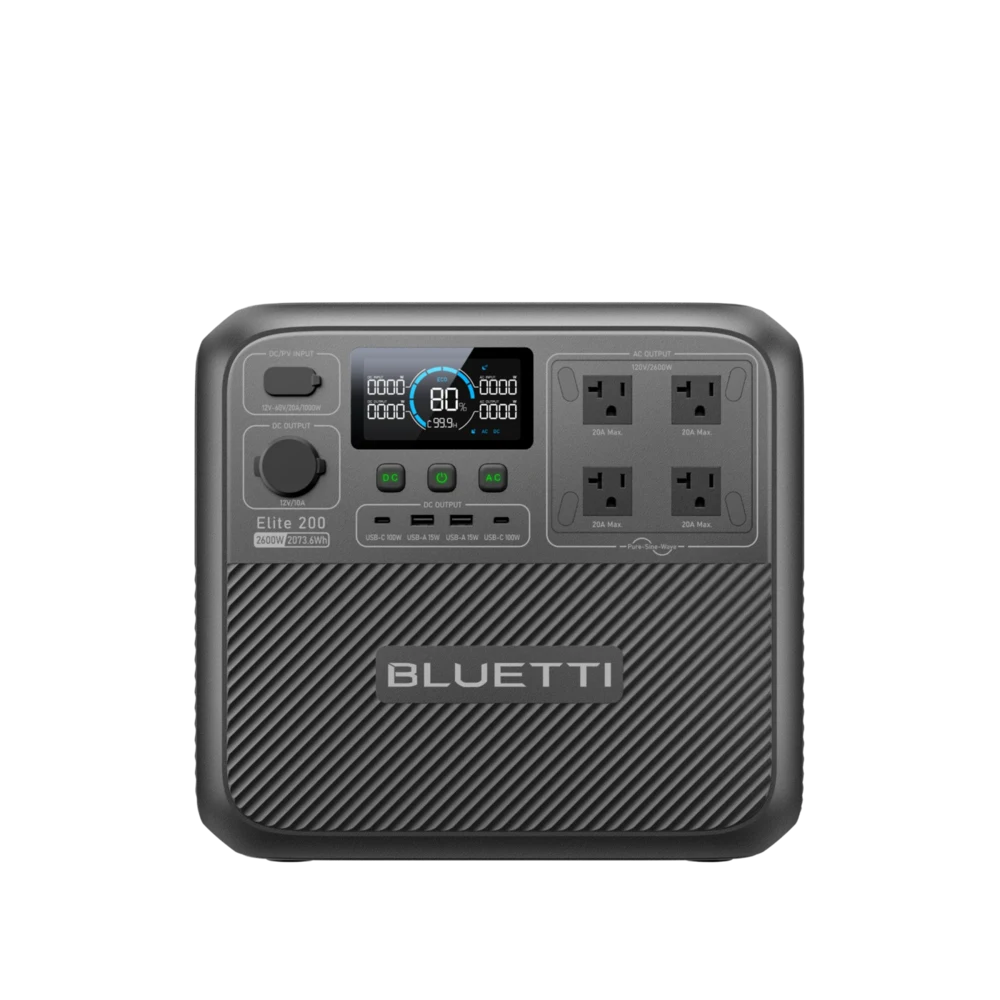
Get this one. It is what we run. The fridge around the clock, the fans on hot nights, laptops, the air fryer. About 1.5 hours from empty to full on a wall outlet.
Get the Elite 200 V2Shop at BLUETTIWeekends onlyTap for our answer
You don't need this much. It weighs 53 lb and holds more than a weekend uses. A smaller station saves you money and your back.
Read the full review
I bought my Bluetti Elite 200 V2 on Black Friday after running a Goal Zero Yeti 1400 for seven years.
Going from a 25-hour wall charge to roughly 1.5 hours felt like a different world. Not a small upgrade. A different world. The Ninja Crispi air fryer that wasn’t even possible on the Yeti now just runs. The seven-day Florida overcast week that nearly broke us in 2019 (Yeti era, hauling it into coffee shops every day for 8% per two hours) would not happen on this unit.
If you want one sentence: the Elite 200 V2 is a strong fit when your goal is stable daily power with fast recovery, not just a big number on the box.
For van life, that matters more than people expect. Weather, fridge cycles, and cooking spikes punish weak recovery plans fast.
BLUETTI Elite 200 V2
Check Current Elite 200 V2 PricingShop at BLUETTIQuick Verdict
Best for: part-time to full-time van lifers who want real breathing room and faster recovery from shore, solar, or driving.
Skip if: you only camp a few weekends a year with very low loads, or you need to carry a 53-lb station long distances regularly.
This unit sits well above our 700Wh non-negotiable floor and fits a recovery-first setup better than smaller “budget” units that feel fine on day one and force daily power management later.
Is this the right power station for your setup?#
Tap the situation that sounds like you.
🚐 Full-time or near-full-time, fridge + fans + devices daily. Strong fit
This is exactly what we run it for. Dometic CFX65DZ chest fridge cycling 24/7, MaxxAir fans on Florida nights, laptops and phones, occasional air fryer cooking. The 2,073Wh capacity gives real margin and the fast recharge means you stop babysitting power across mixed shore/solar/driving days.
🍳 I want to cook electric without a full house build. This unlocks it
The Crispi air fryer was the biggest thing the Bluetti unlocked, and one we never would have tried on the Yeti. The Power Lifting / Hercules mode hits ~3,900W for resistive loads, so most household electric cooking (air fryer, induction burner short cycles, kettle) is in range. Daily heavy electric cooking still wants system-level planning, but occasional bursts? Stop overthinking it.
⛅ My power problem is overcast stretches and weak solar. Recovery wins
This is exactly the problem the Elite 200 V2 solves. Slow chargers turn a three-day overcast stretch into a crisis: you can't refill faster than the fridge drains. ~1.5 hours full from a wall outlet means a 90-minute coffee shop stop refills the day. Florida summer 2019 on the Yeti needed multi-day coffee-shop visits to recover. This unit eliminates that math.
🎒 Weekend-only or backpack-portable use. Likely overkill
53.4 lb is heavy. If you're hiking it 100 yards from the car to a campsite, or only running a phone and a fan a few weekends a year, this is more unit than you need. Look at the under-$500 tier. It'll validate your real consumption pattern before you commit to a 2kWh class station.
Which three specs matter most?#
Two days of typical van loads with margin to spare. LiFePO4 chemistry. The cycle-life difference vs older NMC packs is enormous.
Real-world headroom for fridge + fan + cooking spikes simultaneously. Power Lifting mode pushes up to 3,900W for resistive loads (air fryer, kettle, induction).
Up to 1,800W AC input. Measured in our van: ~1 hour to 80%, ~1.5 hours full. Measured Coffee-shop refills become viable. This is the spec that changes how van life feels. See it next to the old Yeti's 25-hour charge on our real-world power data page.
The rest of the numbers (solar input, weight, cycle life) +
Solar input: Up to 1,000W, 12V–60V range, 20A. Spec Paired well with our 300W Renogy slim panel array, with far more headroom than our roof can actually use, since two Maxxair fans cap us at three panels. The input that matters more here is the alternator. Note the 20A: watts are volts times amps, so that 1,000W is only on offer near the top of the voltage range, and it is the current, not the wattage, that heats the connector.
The number on this screen is not your solar. Our alternator charger feeds the same DC/PV port, so whatever it sends arrives labeled PV. Across a few minutes one afternoon our station read 707W of "PV" while the charger's own screen showed the roof contributing 118 to 177W of it and the alternator doing the rest. Measured The port has one name and no way to tell you which source is on it. If you run an alternator charger into this input, read the charger's own screen for the split, and do not quote your station's PV figure as an array measurement.
Weight: 53.4 lb / 24.2 kg. Spec Not a "throw in the trunk" unit. Plan placement during the build (clean cable runs, airflow clearance) because you won't move it often.
Cycle life: Manufacturer claim of 6,000+ cycles to 80% capacity. Spec For comparison, my Yeti 1400 was rated ~500 cycles. It started slipping around year four or five, down to maybe 80% of what it started with. Estimate The sharp drop came after it sat out our eight months away: it still ran lights, fans, chargers and the fridge fine, but it would zero out a minute or two into anything high-draw like cooking. LiFePO4 is a different generation. This should outlast the next van.
What 7 years on a Yeti taught me before I bought this#
Santa Rosa Beach, FL: the week that rewired how I think about power +
Summer 2019. Seven straight days of Florida overcast. Brutal heat, brutal humidity. Fridge working overtime, fans couldn't stop, almost nothing from solar. I hauled the Yeti 1400 into coffee shops nearly every day that week. The charger they had back then needed most of a day to top off, and I was getting maybe 8% in the time I could reasonably sit in a coffee shop.
When you're out of power, comfort goes first. You sweat. You stop running fans. You sit still. The one thing you can't let fail is the fridge: losing the food costs more than being miserable.
That week is why every buyer guide on this site ranks recovery speed over raw watt-hours. And it's why a station that recharges in 1.5 hours instead of 25 isn't a luxury. It's the difference between living comfortably and rationing.
Why I waited until Black Friday to upgrade +
The Yeti 1400 served me for seven years. After eight months away from October 2024 to June 2025, seven of them in Southeast Asia, while the Yeti sat at a family member's house and family kept it between 30–80%, it came back with significant capacity loss. Toward the end it would zero out on the induction burner mid-cycle.
I waited for Black Friday on the Bluetti and pulled the trigger. The Elite 200 V2 was a meaningful sale. If you're considering this unit, holiday and seasonal sales matter. Direct from Bluetti often beats third-party for the major events.
The calibration trick worth running on day one +
Both the Yeti 1400 and the Bluetti Elite 200 V2 drifted on the percentage readout, and both drifted the same way: never above 50%. The display would read 30 to 40% when the pack was really down near 15%, and everything would shut off in the middle of the night. That is a bookkeeping error, not a worn pack, and BLUETTI publishes the fix.
Run the full round trip: 100% → 0% → 100%. Spec Three details do the work, and they're the ones the simplified "just charge it to 100%" advice online leaves out:
- Drain it under load, through the station's own outputs, so the BMS stops at its own reserve rather than at a number you picked.
- Start recharging the moment it reads 0%. Leaving it sitting switched on at zero digs into the reserve below the displayed floor.
- Recharge at a constant wattage. BLUETTI's wording is to start at 500W and hold 500W all the way to 100%. The steady rate is the actual requirement; keeping loads off the station during the charge is just the easiest way to get it.
Use wall power, not solar. Reported I've had calibration cycles fail on solar on both units before I understood why. Panels can't hold a constant rate, and passing clouds are exactly the wandering input the procedure warns about. I've rented a hotel room more than once to run this properly, for both stations.
The mechanism is worth knowing, because it explains why the error only ever showed up down low. The BMS gets hard reference points at two places only: a full charge, where voltage finally climbs off LiFePO4's flat curve and current tapers, and the discharge cutoff. Everything between is coulomb counting, which drifts. I charge to full constantly, so the top anchor stayed honest. Nobody deliberately runs a station to zero, so the bottom anchor almost never got set, and that is the only place the error had left to live.
It held. The Elite 200 V2 has read honestly since the cycle, including down in the range where it used to fail, which is the proof it was calibration rather than lost capacity. If the drift comes back within a few cycles, the pack really has degraded. Free fix, takes one day, and I run it on any new station.
What changed when I went from Yeti to Bluetti +
The Crispi air fryer. That was the big one. By the end, every high-output load was tripping the Yeti, which is a big part of why we bought the Bluetti, so we never owned an air fryer before it. A couple of months after the switch we bought the Crispi, and on the Bluetti it just runs. Power upgrade changed cooking. That wasn't on my upgrade reasons list, but it became one of the biggest day-to-day quality-of-life shifts.
The other change: most weeks I stopped doing power math. With the Yeti I was always tracking %. With the Bluetti I mostly don't think about it. The exception is a stretch where I'm not driving much and it's cloudy or raining days in a row, and then I'm watching it again. More capacity and faster recovery make power a background system most of the time instead of a constant decision.
Charging & recovery: the part that matters most#
Measured in our van +
From a standard wall outlet in Turbo mode: ~1 hour to 80%, ~1.5 hours to full. Measured That's the lived number across multiple charge cycles. Solar alone will not refill this from low in a day; our 300W array is a top-up, not a recovery plan. The wall charge is what makes the recovery fast, and on overcast or low-sun days it is the only thing that does.
For comparison, the Goal Zero Yeti 1400's stock charger took roughly 25 hours wall-to-full. Spec Twenty-five hours vs 1.5 hours is not a spec sheet difference. It's a different relationship with the van.
What BLUETTI documents +
BLUETTI markets the Elite 200 V2 with multiple AC charging modes (Turbo / Standard / Silent). In Turbo mode they document ~80% in about an hour and full in roughly 1.4 hours under specified conditions. Spec Solar input and vehicle/alternator paths depend on your accessories and setup.
BLUETTI Elite 200 V2
Compare Current Elite 200 V2 DealsLiving with it day to day#
Placement and airflow +
53.4 lb means you set it once and leave it. Pick a spot with clean cable runs, airflow clearance for thermal management, and proximity to where you use power. Ours lives in a cubby I built under a seat: two inches of foam on the bottom and two sides, one side left completely open, and a cutout in the front so I can see the unit without pulling it out. A station that pulls 1,800W on the way in makes real heat, so whatever you build it into, leave it a way to breathe.
Mine melted, and I still recommend it +
In April 2026, driving California to Colorado, the cord running from our Charger 2 into this station's DC/PV input cooked. The yellow connector charred, the plastic deformed, and the port on the station scorched around the opening. We heard clicking, pulled over, yanked the cord and shut it down. Nobody was hurt and there was no fire, but it was close enough.
My read on the cause: the DC input port isn't deep, the connector can back partway out under the weight of a heavy cable, and a loose high-current contact under roughly 800W turns into heat. I keep the cord weight off that connector now and it hasn't repeated.
A firmware update since then appears to agree with me. The replacement ran the old way for a while, pulling close to this station's rated 1,000W from the alternator and solar together. Then an update tightened it, and the combined input now hunts around 800W and drops solar entirely rather than blending it down. Measured I can't show you a release note saying why, and I'm not going to pretend I can. What I can say is that the number it settled on is the same number my cord cooked at, and that backing off a 20A port is the call I would have made too. The readings are here.
BLUETTI replaced the whole unit and the cord. Filing was straightforward if a little robotic, turnaround was about a week, and it cost me nothing beyond buying a shipping box on the road. That outcome is why this review still recommends the station. A brand that stands behind a failure is worth more than one that never fails on paper. The full account is here, including what I'd do differently.
Fan noise near the bed +
Under heavy charging or heavy load, the cooling fan is audible. In Turbo charge mode it's noticeable across a small van. Silent / Standard modes are quieter at the cost of slower charge speed. If you sleep light and charge overnight, charge in Standard or Silent mode and let it take the extra hour.
Ports & app +
The output mix covers daily van life cleanly: AC headroom for normal loads, USB-C and DC for device routines. The app is useful for monitoring but the system should still work with a simple repeatable charging routine. I check mine several times a day, which is habit more than need. The fundamentals hold up whether I look or not.
Frequently asked#
Is recharge speed really more important than watt-hours? +
For van life, yes. A unit that refills quickly feels more stable than a larger unit that recovers slowly. A 1,500Wh station that recharges in 1.5 hours beats a 3,000Wh station that takes 8 hours, on any week where you can't park in the sun all day. Watt-hours buy you margin; recharge speed buys you flexibility. You need both, but most buyers undervalue the second one.
Can it actually handle cooking? +
Occasional cooking spikes (air fryer, kettle, short induction cycles): yes. The 2,600W continuous + Power Lifting up to 3,900W headroom handles them. Daily high-draw electric cooking (induction as your primary stove every meal) still wants system-level planning and a realistic recharge infrastructure. For most van lifers running propane primary + electric supplement, this unit is plenty.
Is this overkill for a beginner? +
Not necessarily. If your routine includes fridge + fan + work devices and real weather exposure, extra margin often feels better than constant power management. The "right size" argument breaks once you've spent a week stressed about a battery percentage. Capacity that lets you stop thinking about it is its own form of value. That said, if you're still validating your power profile, start in the under-$500 tier and upgrade once you know your loads.
Is this a good first step before a full electrical build? +
Often yes. Portable-first reduces install risk and lets you collect real usage data before committing to a fixed system. I've run portable for eight years and never built a hardwired house bank. The recovery-first approach with a fast-charge station has been enough. If you eventually want a fully integrated system, you'll have months of measured data to size it correctly.
How does it handle cold weather? +
Better than my old Yeti, by a wide margin. The Yeti 1400 wouldn't accept charge below freezing. I spent multiple Colorado winters bringing it into family houses to thaw out. Newer LiFePO4 stations with battery heating handle cold much better. Still, in a deep freeze, plan on running a heat source (Webasto or similar) to keep your interior, and the station, above freezing during heavy charge cycles.
Recovery-first power, built for real climates
The upgrade that lets you stop doing power math
BLUETTI Elite 200 V2
Check Elite 200 V2 pricingShop at BLUETTI
Compare 2kWh+ tierHow I evaluate power stations#
- Climate stress behavior: heat, humidity, low-sun stretches
- Recovery speed across shore, solar, and driving
- Daily workflow stability, not lab-style capacity numbers
- Fit by user type: weekender, part-time, full-time
- Tradeoffs stated clearly, not hidden
See the full methodology: How We Test and Source Van Power.