
This site has one ranking rule: time-to-recover beats raw capacity. By that rule, the C1000 wins the mid-tier, and I say that as someone who has spent his own money on Bluetti twice.
I’ve never had a C1000 in the van. I run a Bluetti Elite 200 V2 daily and ran a Goal Zero Yeti 1400 for seven years before it, so my hands-on hours are with a competitor. Everything below is a Spec and Reported read, judged against the recovery-first method. No Measured claims appear on this page, because I haven’t earned any.
That cuts both ways, and it’s worth saying plainly: the unit I don’t own beats the brand I buy on the metric I care most about. If I were starting from zero today with charge speed as the constraint, this is the one I’d have a hard time arguing against.
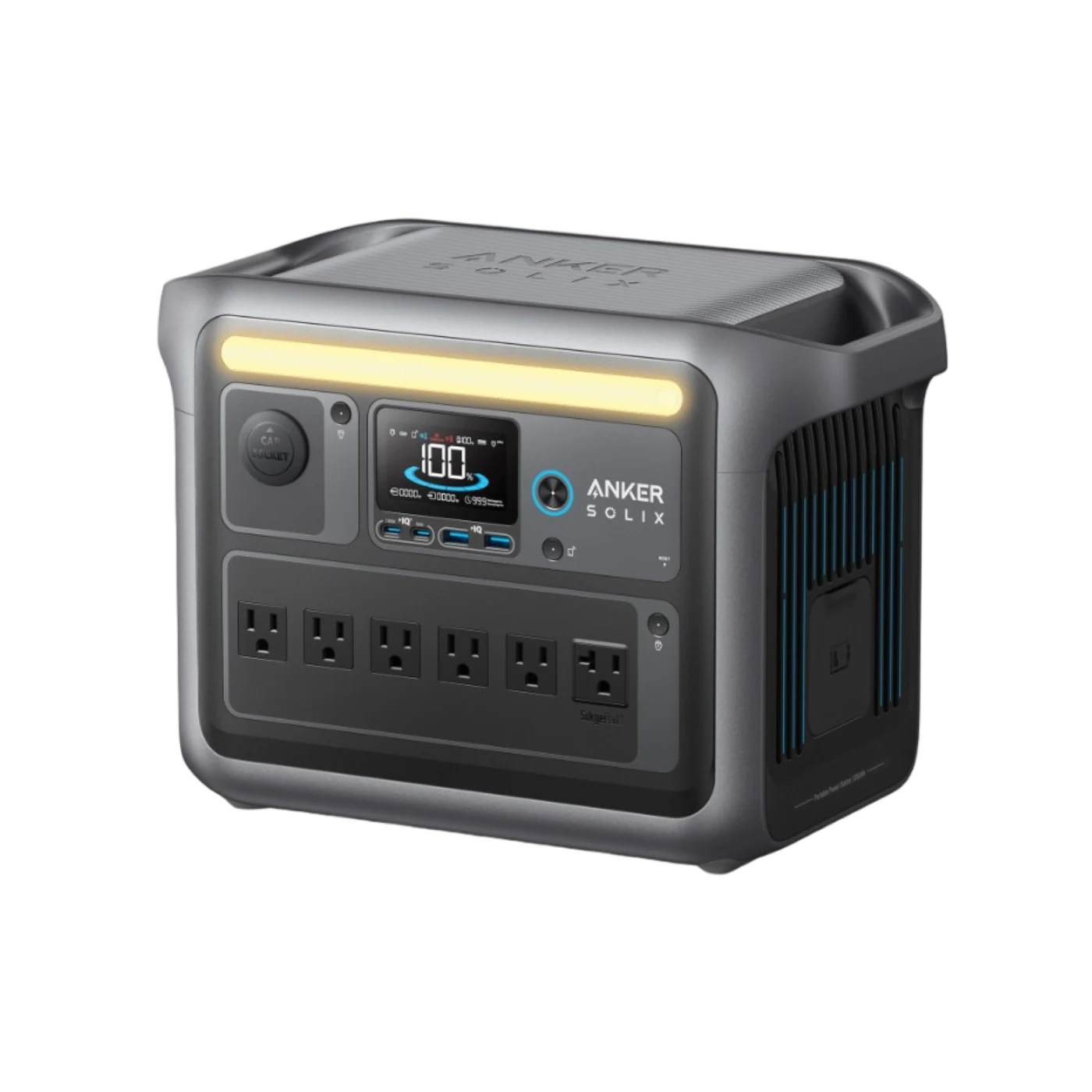 Anker SOLIX C1000
Check Current Anker C1000 PricingShop at Anker
Anker SOLIX C1000
Check Current Anker C1000 PricingShop at AnkerQuick Verdict
Skip if: you want maximum watt-hours per dollar. At 1,056Wh it’s below the BLUETTI AC180 (1,152Wh) and the Jackery 1000 Plus (1,264Wh), and capacity is what carries you through a bad week.
Size up instead if: your daily loads include induction cooking or a kettle. That’s a 2kWh-class conversation.
Is the SOLIX C1000 the right power station for your build?#
Tap the situation that sounds like you.
⚡ Mid-tier capacity: daily van loads, no flagship-class needs. Category fit
The 1000-class size is the sweet spot for builds that don't need a flagship 2kWh-plus unit. If your daily loads are laptop work, lights, fans, fridge support, and occasional small cooking, a credible 1000-class LiFePO4 unit covers you. The C1000 sits squarely in that category alongside the EcoFlow DELTA 2 and Jackery Explorer 1000 Plus: different ecosystems, similar use case.
🔌 Recharge speed matters: short shore-power windows. Strong fit
One of the C1000's published differentiators is fast AC recharge, designed to top up in roughly an hour from wall power. That profile is what flips a unit from "trickle overnight" to "top off during a coffee break." For van lifers who use shore-power opportunistically (campground stops, friends' driveways, rest areas with outdoor outlets), a fast-recharge unit reduces planning load. On our Bluetti Elite 200 V2 the equivalent fast-recharge profile is the single biggest day-to-day quality-of-life upgrade vs the old Yeti's 25-hour charge time; the same category of improvement applies here.
📱 App-driven monitoring: you'll actually use it. Anker ecosystem fit
Anker's app reputation is generally strong across their consumer products, which extends to the SOLIX line. If you've already bought into the Anker ecosystem (chargers, headphones, vacuums) and you open the apps, the C1000's monitoring will feel familiar. If you don't open monitoring apps, this is noise: a power station with a clear front-panel display covers the same need.
🏆 Want a brand we've personally validated. We can't help here
Real talk: we haven't lived with this unit. If first-person validation is important to your buying decision, we can't deliver that on the C1000. We can on the Bluetti Elite 200 V2 (current daily driver), the Goal Zero Yeti 1400 (7 years), and the Bluetti Charger 1. If you want our money-where-our-mouth-is recommendation, those are the units to read about.
Where the C1000 wins and loses#
One rule decides every ranking on this site: time-to-recover beats raw capacity. Here’s how the C1000 scores against it, and where it doesn’t.
Scored against the one ranking rule +
Recharge speed: best in class. 43 minutes to 80%, under an hour to full Spec. Every competitor in this tier is slower to 100%: the AC180 wants 1.3–1.8 hours, the Jackery 1000 Plus 1.7. Our old Yeti took 25 hours, which is why I don't treat this as a small difference.
Capacity: the weak spot. 1,056Wh is the smallest of the four mid-tier units on this site. Fast recovery is only an advantage when a recharge window exists. Through a bad stretch, overcast and hot with the fridge working, watt-hours in the box are what carry you, and the C1000 has the fewest.
Weight: easy to overlook. 28.4 lb Spec, the lightest here. If your station moves between the van and a table, seven pounds off the AC180 is a real difference you'll feel every day.
Cycle life: 3,000 to 80% Spec. The lowest of the group, though at one cycle a day it's still eight-plus years. Not a reason to rule it out, just not a selling point.
LiFePO4 chemistry: the right floor for full-time use +
The C1000 uses LiFePO4 cells, which is the right chemistry for full-time van use. Older NMC chemistries (what our Yeti 1400 used) hit their cycle limits faster and degrade more aggressively under heat. LiFePO4 cycle counts are typically several thousand cycles vs the Yeti's ~500, a different category of longevity. Any 2024-or-later mid-tier power station should be LiFePO4. The C1000 ticks that box.
The three questions I'd want answered before buying +
1. Does the 43-minute charge survive a real outlet? Fast charging means pulling a lot of amps. Campground pedestals and old café wiring often can't deliver it, and this unit's entire advantage rests on that number. I'd want to see it timed off a marginal circuit, not a bench.
2. What does 1,056Wh actually feel like on day four of an overcast week? This is the capacity question the spec sheet can't answer. Anyone running one full-time through a humid summer knows; a launch reviewer doesn't.
3. Does the state-of-charge percentage drift? Both stations we've owned, the Yeti and the Elite 200 V2, drifted over time. It's a tracking problem rather than a brand-specific bug, so I'd expect it here too, but I can't confirm it on this unit.
For all three, weight 12-month follow-ups over launch coverage. Someone who has had one through a summer knows things a spec sheet can't say.
When the C1000 is the right call vs when it isn't +
The C1000 is a credible buy when: mid-tier capacity matches your loads, you value the Anker ecosystem, you want fast AC recharge, and brand-validation isn't the deciding factor.
Look elsewhere when: daily loads call for 2kWh-plus capacity (look at flagship-tier picks like the overall best), brand-validation matters and you want first-person hours behind the recommendation (look at the units we own), or budget is the binding constraint and a sub-$500 unit covers your real loads (look at under-$500 picks).
The numbers, and how they compare#
Every figure below is a manufacturer claim Spec, pulled from Anker’s own product page and checked against the competition on 2026-08-07. Nothing here is measured by us.
Under an hour to full. The AC180 needs 1.3–1.8 hours, the Jackery 1000 Plus 1.7, the outgoing EcoFlow DELTA 2 80 minutes. This is the C1000's whole argument, and it's a good one.
The smallest of the mid-tier four. AC180: 1,152Wh. Jackery 1000 Plus: 1,264Wh. Roughly a 100–200Wh deficit, which on a fridge-plus-laptop van load is a few hours of margin, not a day.
Pure sine wave, 2,400W surge. Matches the AC180 on continuous output with less surge headroom (2,700W). UPS switchover under 20ms, which matters if you run anything that objects to a blink.
12.9 kg, the lightest mid-tier unit here and about seven pounds under the AC180. Still strap it down. Anything this heavy becomes a projectile in a hard stop.
3,000 cycles to 80% of original capacity, plus a 5-year warranty. The lowest cycle rating in the group, but at one cycle a day that's still eight-plus years, longer than most people keep a van build intact.
Frequently asked#
Why don't you own the C1000? +
We bought our Bluetti Elite 200 V2 on Black Friday after our Goal Zero Yeti 1400 wore out. The Elite 200 V2 covers our daily loads and we don't have a use case for a second unit at the C1000's tier. That doesn't mean the C1000 is worse. It means our hands-on hours are with Bluetti and Goal Zero.
C1000 or DELTA 2 or Bluetti AC180: which mid-tier is best? +
At this tier, ecosystem and brand preference do most of the deciding. All three are LiFePO4. All three have credible recharge profiles. All three are sized for daily van loads. Pick the brand whose app you're more likely to use, whose customer service you trust to handle a warranty claim, and whose long-term reputation you're betting on. We bet on Bluetti. That's a personal preference, not a knock against Anker or EcoFlow.
Is 1000-class enough for full-time van life? +
Depends on loads. Laptop work, lights, fans, and fridge support: yes, 1000-class is plenty as long as you can recharge regularly. Daily induction cooking, electric kettle, hairdryer, or any heavy heating element: no, you'll want flagship 2kWh-plus tier. Run the power calculator with your real loads before deciding.
Where can I find first-person C1000 reviews from full-time van lifers? +
YouTube channels run by full-time van lifers tend to publish 6-month and 12-month follow-up videos that are more valuable than launch reviews. Weight long-term reports heavier than first-month reactions. r/vandwellers occasionally has C1000 threads with multi-month observations. Both are better signal than launch coverage for a unit you'll live with.
Mid-tier read: credible spec, not tested in our van
If the C1000 fits your loads and ecosystem, it's a credible buy
Anker SOLIX C1000
Check Anker SOLIX C1000Shop at Anker
See the unit we actually run