
Every other unit in this tier is the size you bought. The Explorer 1000 Plus is the only one that grows: 1,264Wh out of the box, up to 5kWh with three add-on battery packs. If you don’t yet know how much power your build needs, that’s worth more than any single spec on the page.
I’ve never had a 1000 Plus in the van. I run a Bluetti Elite 200 V2 daily, so my hands-on hours are with a competitor. Everything below is a Spec and Reported read, judged against the recovery-first method. No Measured claims appear on this page, because I haven’t earned any.
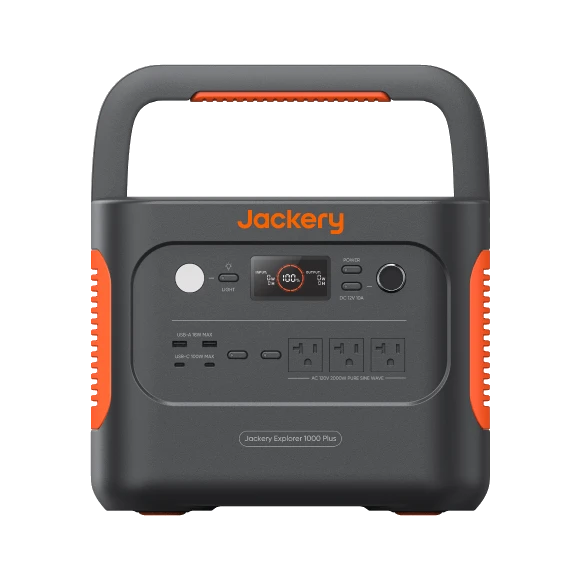 Jackery Explorer 1000 Plus
Check Current Explorer 1000 Plus Pricing
Jackery Explorer 1000 Plus
Check Current Explorer 1000 Plus PricingQuick Verdict
Skip if: recharge speed is your constraint. At 1.7 hours to full it’s the slowest unit in the tier, where the Anker C1000 does it in under one.
Also worth knowing: the 4,000W surge is the highest here by a wide margin, which is what you want if you run a tool or an appliance that spikes hard on startup.
Is the Jackery 1000 Plus the right power station for your build?#
Tap the situation that sounds like you.
🏷️ Brand recognition matters: easier resale, more support visibility. Jackery's strength
Jackery is the most consumer-recognized brand in the category. If you might resell down the line, Jackery units typically hold the strongest aftermarket value in this tier. If you want a brand that non-van-life family members have heard of (matters for gift situations, lending, troubleshooting help), Jackery is the safest bet. None of this makes the unit better in absolute terms; it's a real consideration for some buyers.
⚡ Mid-tier capacity: daily van loads, not flagship. Category fit
The Jackery 1000 Plus sits in the same capacity tier as the Bluetti AC180, Anker SOLIX C1000, and EcoFlow DELTA 2. Sized for daily van loads: laptop work, lights, fans, fridge support, occasional small cooking. Below flagship 2kWh-plus tier; above sub-$500 weekend-class units. The cross-brand decision at this tier is mostly ecosystem and brand preference.
🔌 Fast recharge matters: short shore-power windows. Strong fit
Jackery publishes a fast AC recharge profile on the 1000 Plus. The category-wide shift to fast recharge is the single biggest day-to-day quality-of-life upgrade. On our Elite 200 V2, going from the old Yeti's 25-hour wall charge to the Bluetti's much faster profile changed how we use shore power entirely. Same category of improvement applies to mid-tier LiFePO4 units across brands.
🏆 Want a brand we've personally validated. Different ecosystem
Real talk: we run Bluetti, not Jackery. Our personally-validated picks are Bluetti Elite 200 V2 (current daily), Goal Zero Yeti 1400 (7 years prior), and Bluetti Charger 1. If first-person validation is your deciding factor, those are the units to read about.
Where the 1000 Plus wins and loses#
One rule decides every ranking on this site: time-to-recover beats raw capacity. The 1000 Plus is the most interesting case in the tier, because it loses on that rule and still has the best argument for some buyers.
Scored against the one ranking rule +
Recharge speed: last place. 1.7 hours to full Spec, against the C1000's sub-hour and the AC180's 1.3–1.8. On the rule this site ranks by, that's a real mark against it. If your charging happens in short opportunistic windows, buy the C1000.
Capacity: best in the tier. 1,264Wh, roughly 200Wh clear of the C1000. Slower to refill, but you need to refill less often, which partly answers the point above and completely answers it if you charge overnight rather than in snatched hours.
Expandability: the actual reason to buy it. Three add-on packs take it to 5kWh. Nothing else in this tier does that. Under-buying and over-buying are both expensive mistakes, and this is the only unit here that lets you defer the decision until you have real data on your own loads.
Surge: 4,000W Spec, versus 2,700W on the AC180 and 2,400W on the C1000. That's the headroom that decides whether a compressor or a power tool starts or trips.
Brand recognition is real: but it's not the same as quality +
Jackery is the most-recognized brand in this category. That recognition delivers some real benefits: stronger aftermarket value, easier troubleshooting help, more long-term YouTube reviews to cross-reference, more accessory availability. Those are legitimate factors in the buying decision.
What recognition isn't: a guarantee that the unit is better than less-famous competitors. At this tier, all the major brands (Bluetti, EcoFlow, Anker, Jackery) ship credible LiFePO4 units with similar spec mixes. The differentiation is ecosystem (apps, accessories, customer service style), not chemistry or core spec. We picked Bluetti based on the specific spec mix and pricing at the time of our purchase, not on brand recognition. Different buyers reasonably weigh recognition higher.
1000 Plus vs Bluetti AC180 vs DELTA 2 vs Anker C1000: the cross-shop +
The specs separate these four more cleanly than the marketing does:
- Fastest recovery: Anker SOLIX C1000, 43 min to 80%, under an hour to full.
- Most watt-hours per dollar: BLUETTI AC180, 1,152Wh at $499.
- Most capacity and the only expandable one: Jackery 1000 Plus, 1,264Wh, 5kWh ceiling.
- EcoFlow shoppers: the DELTA 2 is outgoing. Look at the DELTA 3 Classic instead: 1,024Wh, 60 min to full, from $499.
My own money went to Bluetti, twice. That's purchase history, not a spec argument, and I'd rather you decide on the four lines above.
The three questions I'd want answered before buying +
1. Are the battery packs still available in two years? Expandability is this unit's whole case, and it's worthless if the add-on packs get discontinued before you need one. This is not hypothetical: EcoFlow's own DELTA 2 expansion batteries became a stock question this year. Check the pack's availability before you buy the base unit.
2. How much does a full stack weigh, and where does it live? The base unit is manageable. Three packs is a different vehicle-loading conversation, and nobody reviewing this on a workbench will raise it.
3. Does the state-of-charge percentage drift? Both stations we've owned drifted over time. It's a tracking problem rather than a brand-specific bug, so I'd expect it here too, but I can't confirm it on this unit.
Jackery's brand reach does mean more long-term reviews exist than for less-famous competitors, which is a real research advantage. Weight 12-month reports over launch coverage.
The numbers, and how they compare#
Every figure below is a manufacturer claim Spec, checked against the competition on 2026-08-07. Nothing here is measured by us.
1,264Wh base, up to 5kWh with three add-on battery packs. The AC180, C1000, and DELTA 3 Classic are all fixed-capacity. This is the only lever in the tier for fixing a sizing mistake without reselling the unit.
The most in the mid-tier before any expansion. AC180: 1,152Wh. C1000: 1,056Wh. DELTA 3 Classic: 1,024Wh. On a fridge-plus-laptop load that's most of an extra day of margin over the C1000.
2,000W continuous across three AC outlets, 4,000W peak. Both figures lead the tier: the others run 1,800W continuous with 2,400–2,700W surge. If something in your build spikes hard on startup, this is the unit with room for it.
The slowest in the tier. 7 hours on a 12V car adapter, 18 on solar. Fine if you charge overnight or drive most days; a real drawback if you refill in snatched hour-long windows.
Read this one carefully: 4,000 cycles is rated to 70% of original capacity, where BLUETTI and Anker quote to 80%. Higher number, softer threshold. The two aren't directly comparable, and marketing rarely says so.
Frequently asked#
Why don't you own a Jackery? +
When our Yeti 1400 wore out we cross-shopped the major brands and picked Bluetti for our 2kWh-class replacement. Jackery was a defensible alternative. We just made a different ecosystem call based on the specific spec mix and pricing at the time. We don't run a second mid-tier unit, so Jackery never made it into our build.
Is Jackery's brand recognition worth the price premium? +
Depends on what you value. Easier resale, more support visibility, more long-term reviews to cross-reference, more accessory availability. All real benefits. If those matter to you, the recognition premium is defensible. If you don't care about resale and you do care about app ecosystem, EcoFlow might be the better mid-tier pick. If you've already bought into Anker's hardware, that ecosystem extends. Brand recognition is one factor; it's not the only factor.
Is 1000-class enough for full-time van life? +
Depends on loads. Laptop work, lights, fans, fridge support, light cooking: yes, as long as you can recharge regularly. Daily induction cooking, electric kettle, hairdryer, or any heavy heating element: no, push to 2kWh-plus tier. Run the power calculator with your real loads first.
Where can I find first-person 1000 Plus reviews from full-time van lifers? +
Jackery's brand recognition means there are more long-term YouTube reviews from full-time van lifers than for less-famous competitors, a research advantage. Weight 12-month and 18-month follow-up videos heavier than launch coverage. r/vandwellers occasionally has multi-month 1000 Plus threads.
Mid-tier Jackery: strongest brand recognition, credible spec mix
If brand recognition and resale value matter, the 1000 Plus is a credible buy
Jackery Explorer 1000 Plus
Check Jackery 1000 Plus →
See the unit we actually run