
At $499 the AC180 holds more watt-hours than any other unit in the sub-$1,000 mid-tier, and it hits 80% charge in 45 minutes. On a site that ranks recovery speed over raw capacity, that combination is hard to argue with.
I’ve never had an AC180 in the van. I run a Bluetti Elite 200 V2 daily, and a Goal Zero Yeti 1400 for seven years before that, so the brand is one I’ve put my own money behind twice over. But the hours are on a different unit. Everything below is a Spec and Reported read, judged against the recovery-first method I built over eight years full-time. No Measured claims appear on this page, because I haven’t earned any.
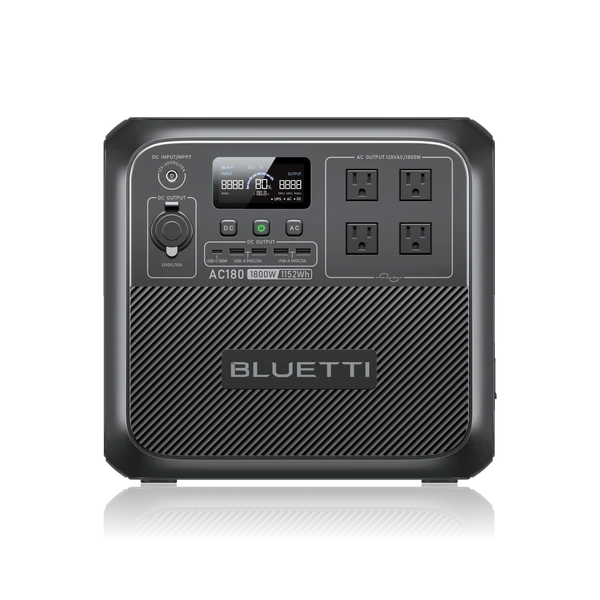 BLUETTI AC180
Check Current AC180 PricingShop at BLUETTI
BLUETTI AC180
Check Current AC180 PricingShop at BLUETTIQuick Verdict
Skip if: you need the last 20% of a charge in a hurry. The AC180 takes 1.3–1.8 hours to full where the C1000 does it in under one; to 80% they’re a coin flip (45 vs 43 minutes).
Size up instead if: your daily loads include induction cooking, a kettle, or a hairdryer. That’s AC200L or flagship territory, not this.
Is the AC180 the right Bluetti for your build?#
Tap the situation that sounds like you.
🏷️ You trust Bluetti and want a mid-tier unit. Brand fit
This is where our brand-trust extends without first-person hours on this exact unit. We run a Bluetti Elite 200 V2 daily and we'd buy from Bluetti again: the apps, the build quality, and the customer-service reputation are credible. The AC180 is the smaller sibling in the same family. If you'd already settled on Bluetti and you want something smaller than the Elite tier, the AC180 is the in-family choice.
⚡ Mid-tier capacity: daily van loads, not flagship. Category fit
The AC180 sits in the same capacity tier as the Anker SOLIX C1000, EcoFlow DELTA 2, and Jackery Explorer 1000 Plus. Sized for daily van loads: laptop work, lights, fans, fridge support, occasional small cooking. Below flagship 2kWh-plus tier; above sub-$500 weekend-class units. The cross-brand decision at this tier is mostly ecosystem.
🔌 Fast recharge matters: short shore-power windows. Strong fit
Bluetti publishes a fast AC recharge profile on the AC180, the kind of profile that flips a unit from "trickle overnight" to "top off during a coffee break." On our Elite 200 V2 the equivalent fast-recharge profile is the single biggest day-to-day quality-of-life upgrade vs the old Yeti's 25-hour charge time. That same category of improvement carries down the Bluetti line.
📈 Heavy daily loads: flagship tier conversation. Step up
If your daily loads include induction cooking, electric kettle, hairdryer, or any heavy heating element, the AC180 will feel undersized fast. Look at the AC200L (the bigger Bluetti in the same family) or the flagship 2kWh-plus picks instead. The AC180 is sized for moderate daily van loads. It's not a flagship.
Where the AC180 wins and loses#
One rule decides every ranking on this site: time-to-recover beats raw capacity. Here’s how the AC180 scores against it, and where it doesn’t.
Why we trust the Bluetti brand (and why that matters here) +
After 7 years on a Goal Zero Yeti 1400 (an NMC unit that wore out roughly on schedule, with a 25-hour charge time we lived with the whole way), we picked Bluetti for our replacement based on the LiFePO4 chemistry, the published cycle ratings, and the fast-recharge profile. The Elite 200 V2 has held up the way we hoped, and the brand's ecosystem (apps, accessories, replacement parts) has been credible to deal with.
That doesn't transfer 1:1 to the AC180: different unit, different production batch, different size class. But it means when we evaluate Bluetti units we don't own, we're not starting from "is this brand legit." We're starting from "is this size and configuration right for the use case." That's a different question and a more useful one.
Scored against the one ranking rule +
Recharge speed: strong. 45 minutes to 80% on a 1,440W input Spec. That's the number that matters, because 80% is where you stop caring: a coffee-shop stop or a laundromat hour refills this unit. Our old Yeti took 25 hours to full, so I have a sharp sense of what this buys you.
Full charge: middling. 1.3–1.8 hours to 100% Spec. The last 20% crawls, which is normal for LiFePO4 and only matters if you're topping off before a known bad stretch.
Capacity: the best argument for it. 1,152Wh is more than the C1000, the DELTA 2, or anything else near $499. In a cloudy week, headroom is recovery: every extra watt-hour is one you don't have to go find.
Cycle life: 3,500+ to 80% Spec. At one cycle a day that's roughly a decade before you'd notice. Chemistry is not the differentiator at this tier; everything here is LiFePO4.
The three questions I'd want answered before buying +
1. Does 1,440W turbo charging stay available on a weak circuit? The 45-minute figure assumes the AC180 can actually pull 1,440W. Campground pedestals, older coffee-shop wiring, and anything on a shared 15A breaker may not deliver it. I'd want a real-world number off a marginal outlet, because that's where a van charges.
2. How does 35 lb behave in a moving van? It's light enough to lift and heavy enough to hurt something if it shifts. Our Yeti lived strapped down for seven years for exactly this reason. Anyone reviewing it parked in a garage won't tell you.
3. Does the state-of-charge percentage drift? Both stations we've owned, the Yeti and the Elite 200 V2, drifted over time. That's a tracking problem, not a brand-specific bug, so I'd expect it here too, but I can't confirm it on this unit.
For all three, weight 12-month follow-ups over launch coverage. A reviewer who has had one through a summer knows things a spec sheet can't say.
AC180 vs AC200L: which Bluetti is right? +
The AC200L is the larger sibling, closer to our Elite 200 V2 capacity tier. The decision between AC180 and AC200L is mostly load-driven: if your daily draw fits inside what a mid-tier unit can run for a day with one good recharge window, AC180. If you regularly stretch past that, push for AC200L's headroom. We'd build a flagship 2kWh-plus unit ourselves rather than running an AC180 at the edge of its envelope through a cloudy week.
The numbers, and how they compare#
Every figure below is a manufacturer claim Spec, pulled from BLUETTI’s own product page and checked against the competition on 2026-08-07. Nothing here is measured by us.
The most in its price class. C1000: 1,056Wh. DELTA 2: 1,024Wh. Only the Jackery 1000 Plus carries more (1,264Wh), and it costs more to get it. For a fridge-plus-laptop van load, that gap is worth roughly an extra half-day of cloudy-weather margin.
1,440W turbo AC input; 1.3–1.8 hours to 100%. The C1000 is a hair quicker to 80% (43 min) and clearly quicker to full (under an hour). The Jackery is the slow one at 1.7 hours. Assumes an outlet that can actually deliver 1,440W.
1,800W continuous across four outlets, 2,700W in Power Lifting mode. Enough for a microwave or an induction burner in short bursts, not enough to cook on daily. The Jackery's 4,000W surge is the outlier if surge headroom is what you're after.
Rated 3,500+ cycles to 80% of original capacity, about a decade at one cycle a day. Better than the C1000 (3,000) and the DELTA 2 (3,000+); the Jackery claims 4,000, but to a softer 70% threshold, so the two aren't directly comparable.
16 kg. One-person liftable, but strap it down. A 35-pound object that slides during a hard stop is a real hazard, and it's the detail garage reviews never mention.
Frequently asked#
Why don't you own the AC180 if you trust Bluetti? +
We bought the Elite 200 V2 on Black Friday after our Yeti wore out. The Elite covers our daily loads and we don't have a use case for a smaller second unit at the AC180 tier. So our brand-confidence is real, our hands-on hours are on a different Bluetti unit.
AC180, Anker C1000, or EcoFlow: which mid-tier is best? +
They're close enough that the numbers, not the brands, should decide it:
- Most watt-hours for the money: AC180. 1,152Wh at $499.
- Fastest to a full charge: Anker SOLIX C1000. Under an hour, vs 1.3–1.8 for the AC180. To 80% they're tied (43 vs 45 min), so this only matters if you routinely need the top of the pack.
- Most surge headroom: Jackery Explorer 1000 Plus. 4,000W peak and 1,264Wh, at the cost of the slowest recharge in the group (1.7 hours).
- EcoFlow shoppers: skip the DELTA 2 and look at the DELTA 3 Classic. Same 1,024Wh as the outgoing DELTA 2 but 60 minutes to full instead of 80, and from $499.
My own money is on Bluetti, twice now, but that's brand history rather than a spec argument. If you're starting fresh and charge speed is your constraint, the C1000 is the more defensible buy.
Is the AC180 enough for full-time van life? +
Depends on loads. Laptop work, lights, fans, fridge support, light cooking: yes, the AC180 covers it as long as you can recharge regularly. Daily induction cooking, electric kettle, hairdryer, or any heavy heating element: no, you'll want flagship 2kWh-plus tier or the AC200L. Run the power calculator with your real loads first.
Where can I find first-person AC180 reviews from full-time van lifers? +
YouTube full-time van life channels publish 6-month and 12-month follow-up videos that are far more valuable than launch reviews. Weight long-term reports heavier. r/vandwellers occasionally has AC180 threads with multi-month observations. Both beat launch coverage for a unit you'll live with.
BLUETTI family, mid-tier sibling to our daily driver