
I bought a Goal Zero Yeti 1400 in October 2018 when Karlee and I started living full-time in our 2017 ProMaster. It was a reasonable buy at the time, and the category has moved a long way since.
Seven years of daily van life, and all 48 continental states. Every one of them, with this unit bolted to nothing and riding in the back. Desert heat, Colorado winters, Florida humidity, New York cold. Mission Beach coffee-shop charging sessions. Mountain power failures. The seven-day Florida overcast week that rewired how I think about power. Eventually, capacity loss after our 8-month Southeast Asia trip and a final induction-burner zero-out that ended the era.
Here’s what those seven years looked like, and what they taught me about what matters in a van power station.
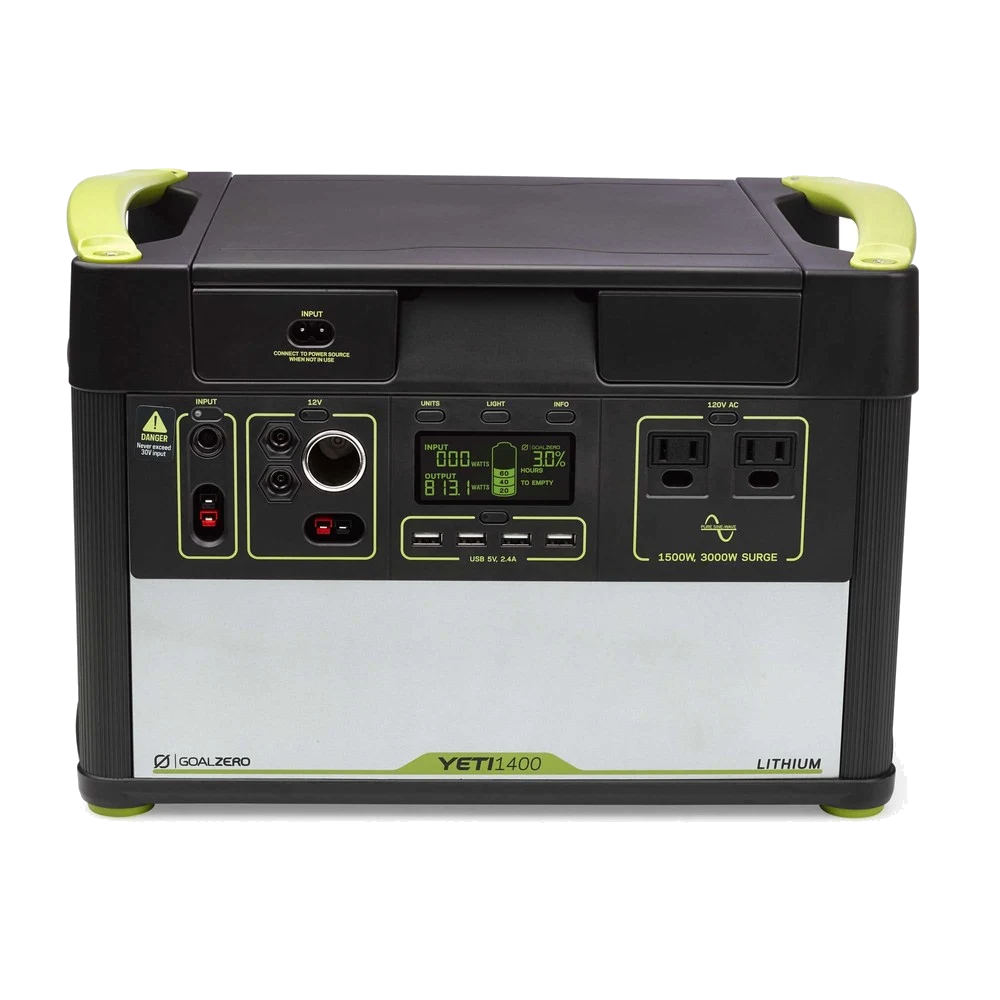 Goal Zero Yeti 1400 (Legacy)
Check Yeti 1400 Used Pricing
Goal Zero Yeti 1400 (Legacy)
Check Yeti 1400 Used PricingQuick Verdict (2026)
Buy used at the right price ($300–400, verified history) for a backup or secondary unit: the build quality is real and a healthy battery still runs loads.
Don’t buy new equivalent in 2026: modern LiFePO4 stations charge faster, last longer, weigh less, and cost less per Wh.
The Yeti 1400 earned its keep across seven years. The technology that replaced it earns more.
Want to stay with Goal Zero? The Yeti 1500 is the fix
The 6th-gen Goal Zero Yeti 1500 answers both complaints I log below. Same ~1.5 kWh capacity as my old 1400, but LiFePO4 instead of NMC, so it charges 0–100% in about 1.1 hours off the wall (mine took 25) and it won’t lock up in the cold the way the 1400 did on the hard Colorado cold snaps. 2,000W inverter, IPX4, rated 4,000+ cycles.
The tradeoff: it isn’t expandable, so what you buy is what you have. And I won’t tell you whether the Goal Zero build outlasts the value brands. Seven years with the 1400 says something, but my Bluetti hasn’t been in the van long enough for me to call that a finding instead of a hunch. If you want the name-brand build I trusted for seven years, now without the slow-charge and cold-weather flaws, this is the one.
Should you still consider one in 2026?#
Tap the situation that sounds like you.
💵 Found a used one cheap and need a backup unit. Probably a good buy
If the cells are healthy and the seller can show verifiable purchase history, this is a reasonable secondary or backup unit. I am not going to give you a number to pay: used prices move constantly and I would be making it up. The test that stays true is whether it undercuts a new LiFePO4 station in the same capacity tier by enough to be worth a seven-year-old NMC pack and a 25-hour charger. The chassis is built like a small safe. Mine survived seven years of daily cycling and still rides in the back as our backup: it runs low-draw loads fine, and it can't cook anymore. That was enough to get us to Colorado when our main unit went back for a warranty replacement. Just verify the cycle count and ask about how it was stored.
🆕 Considering it as a primary station, new pricing. Buy the new one instead
Don't buy a new 1400. The market moved on. Modern LiFePO4 stations in the same capacity tier charge in 1–2 hours instead of 25, weigh less, last 10× the cycles, and cost less per Wh. If you specifically want to stay with Goal Zero, the 6th-gen Yeti 1500 is the modern fix (1.1-hour recharge, LiFePO4, cold-tolerant). See the box up top. Cross-shopping on value, look at the 2kWh+ tier or the under-$500 entry tier.
🥶 Cold-climate van life: Colorado winters, mountain travel. Hard pass on the Yeti
This is where the Yeti 1400 punished me hardest. NMC cells refuse to accept charge once the pack itself is below freezing, and the pack has enough mass that one cold night will not get it there. What did was a run of days around 20°F: after a few of those the Yeti was dead until I brought it inside a family member's house in Lakewood to thaw. That cycle took 6–24 hours depending on how cold it got. Modern LiFePO4 stations with battery heating handle cold dramatically better.
🏕️ Weekend camper, occasional use, low loads. Used Yeti is fine
If your loads are modest and you're not chasing recharge speed, a used Yeti 1400 with healthy cells will run them for years. The cold-weather and slow-recharge issues only become daily problems for full-timers. Weekend use rarely hits the ceiling that drove my upgrade.
How the Yeti 1400 held up over 7 years#
Mission Beach coffee shops, and the slow-charge era +
The stock Yeti 1400 charger pulled roughly 25 hours wall-to-full. That's not a typo. Spec At that rate a standard coffee-shop session (two hours of working in there with the unit plugged in) netted me about 8% capacity. Spec
We had a winter spot in San Diego where I'd lug the 45-lb Yeti from the parking lot into a Mission Beach coffee shop, plug it in, work for two hours, and walk back out with that 8% gain. It was normal practice during bad solar stretches. The math made sense at the time: that 8% was the difference between running fans through a hot night and rationing.
Now? Modern stations refill that same coffee-shop session at 60–80%. The Yeti taught me how much the recharge spec matters by being the unit I had to work around.
Santa Rosa Beach, FL 2019: the week that built CAVL +
Summer 2019. Seven straight days of Florida overcast. Brutal heat, brutal humidity. Fridge running constantly, fans couldn't stop, almost nothing from solar. I hauled the Yeti 1400 into coffee shops nearly every day that week. 20+ hours to top off on the charger they had. I was getting maybe 8% per session.
When you're out of power, comfort goes first. You sweat. You stop running fans. You sit still. The one thing you can't let fail is the fridge: losing the food costs more than being miserable.
That week is why every buyer guide on this site ranks recovery speed over raw watt-hours. It's the entire framing of CAVL. The Yeti 1400 taught me that lesson by being the unit I was rationing through it.
The Goal Zero mountain failure, and survival mode +
Somewhere in the mountains, the Yeti hit a battery percentage crash issue I'd never seen before. The displayed % dropped erratically and the unit started behaving like a near-dead battery while I knew it had real capacity left.
I couldn't get a replacement out there. We had to manage every single watt in survival mode until we made it back to civilization: fridge running, fans only when we needed them, no lighting beyond a flashlight, no laptop.
Lesson: the calibration trick (below) probably would have prevented this. I didn't know about it yet. Run that calibration on any new station before you trust the readout in the field.
The calibration trick worth running on day one +
Both my Yeti 1400 and the Bluetti Elite 200 V2 that replaced it had a battery percentage calibration issue out of the box: the displayed % drifted from actual capacity over time. The fix:
Run a full 100% → 0% → 100% cycle. Drain it under load, running your normal stuff off the station so it stops at its own reserve. Then start the refill as soon as it reads zero, at a steady wattage, with nothing pulling from it until it hits a true 100%. That last part matters more than it sounds: a wandering input is what spoils the recharge leg, so use wall power rather than solar. The BMS gets a fresh reference at both ends of the range and the % display becomes accurate.
I do this on any new station now. Free fix, takes one day.
Cold weather: the Lakewood thaw cycles +
The Yeti 1400 won't accept charge when the battery's internal temperature drops below freezing. That's a safety feature: lithium NMC cells get damaged by cold charging, but it became a real problem during 2–3 Colorado winters.
The pattern: cold overnight → van interior below freezing → Yeti dead until it warms up. Solar panels outputting nothing even in the sun because the charge controller just sat there refusing input.
Solution: bring the Yeti inside a family member's house in Lakewood to warm to room temperature. Took 6–24 hours depending on how cold it got. I wish we'd had a Webasto or diesel heater back then: runs off the gas tank, keeps the interior warm, battery stays warm. We didn't have one.
Capacity loss after the 8-month Asia trip: the end +
From October 2024 to June 2025 we were away for 8 months, seven of them in Southeast Asia. The van stayed at a family member's house. Family rotated keeping the Yeti charged between 30–80%, proper storage practice for NMC chemistry.
It still came back with significant capacity loss. The unit had been running daily cycles for seven years and the storage period accelerated whatever decline was already happening. Toward the end, the Yeti would zero out on the induction burner mid-cook: capacity that the readout said was there, but wasn't.
That's when I knew. I waited for Black Friday and pulled the trigger on the Bluetti Elite 200 V2. The Yeti is now the backup unit on the shelf. It earned that retirement.
Specs (for reference)#
Lithium NMC chemistry, ~500 cycle rating. Spec Solid in 2018, generation behind LiFePO4 standard in 2026. Cold-weather charging restricted below freezing.
Stock charger gets you ~25 hours wall-to-full. Spec Faster Goal Zero chargers existed but the stock unit is what most owners ran. This is the spec that aged the worst.
Built like a small safe. Heavy for the capacity by 2026 standards but the chassis quality was a real differentiator in 2018: seven years of road vibration and mountain bumps and nothing rattled loose.
Frequently asked#
Did the battery actually hold up over 7 years? +
Yes, until it didn't. It held up for about four or five years of daily van life cycling (including desert heat and Colorado cold) before I started seeing a slow drop, down to maybe 80% of what it started with. Estimate The 8-month storage period during our Asia trip seemed to accelerate the decline. By the time we got back in 2025 it was zeroing out on the induction burner, a load it used to handle. That's roughly the rated cycle life (~500 cycles) playing out as expected. It still runs small loads, which is why it stayed in the van as a backup rather than going to the curb.
Was the slow charge speed actually a problem day to day? +
Most weeks, no. Multi-day overcast stretches, yes. The Yeti was workable for routine van life: solar plus driving plus occasional shore power kept it topped off in normal conditions. The slow charge mattered when conditions stacked against you: hot weather + cloudy days + heavy fridge load + no shore. That's when 25-hour wall recharge became unworkable.
Why Bluetti Elite 200 V2 specifically as the upgrade? +
Recharge speed (1.5 hrs full vs 25 hrs), LiFePO4 chemistry (6,000+ cycles vs ~500), Power Lifting mode for the kind of high-draw cooking that had started tripping the Yeti, and a Black Friday price that made the math work. See the Elite 200 V2 review for the full upgrade story, or the side-by-side numbers on our real-world power data page.
Should I keep my Yeti 1400 if I already own one? +
Yes. Run it until it stops being useful. If it's still meeting your loads, there's no reason to upgrade for the sake of upgrading. When daily loads outgrow it or the recharge speed becomes a bottleneck on your travel pattern, that's when the upgrade math changes.
The unit that taught me what matters