
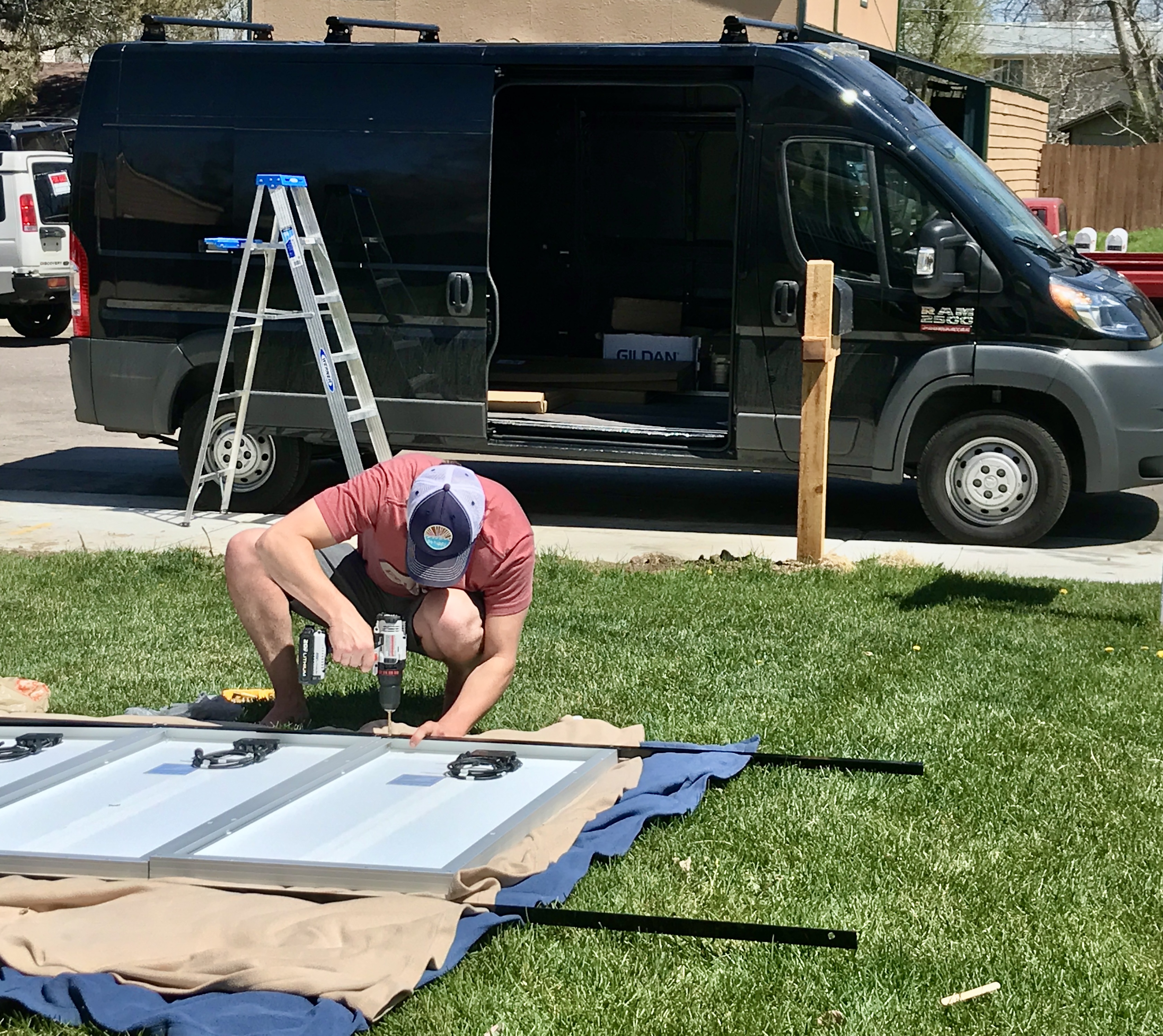
I put three 100W Renogy slim panels on my ProMaster roof in 2018. They’re still up there. Flat, bolted down, never tilted a single time in eight years.
That last detail is the one nobody puts on a spec sheet, and it changes every number in this article.
The biggest problem with solar in van life isn’t the technology. It’s expectations. People read “400W solar input” on a power station and picture it charging at 400W all day. Here’s what shows up.
How Solar Input Works#
Portable power stations have a rated maximum solar input in watts. That’s the ceiling: the most the station’s built-in MPPT controller will accept at once.
The panel delivers up to its rated wattage, but only at Standard Test Conditions. Direct sun, no shade, panel square to the light, cell temperature at 25°C. That last one is worth sitting with. Panels lose roughly 0.3–0.5% of output for every degree Celsius above 25. A dark van roof in July is nowhere near 25°C, and the panel is bolted flat to it.
The MPPT controller (Maximum Power Point Tracking) constantly hunts for the panel’s best operating point. It’s a real improvement over older PWM controllers, especially in patchy light. Most current power stations use MPPT.
What “Rated” Turns Into on a Roof#
A clean, well-sited, properly angled array lands around 78–82% of nameplate, with 75–90% being the normal range in good conditions. Hot, dusty, or partly shaded arrays fall below 70%.
Then van life adds its own tax on top of that:
The flat-mount tax. Panels laid flat instead of tilted to your latitude give up roughly 10% of annual harvest in southern states and around 15% in northern ones. Some installs lose more. That penalty stacks on top of the standard derate, which is why I plan my roof around 60–75% of rated, not 75–90%.
I don’t tilt, and I’m not going to. On a van you’re parked in a different orientation every night, pointed wherever the pull-in happened to face. A tilt mount you’d have to climb up and set each time is a chore you will stop doing by week three. Flat is the practical choice for a vehicle that moves. You just have to budget for what it costs you.
Heat. Same reason. Flat against a hot roof means the panel runs hotter than a rack-mounted one with air under it.
What doesn’t cost me anything: shade and dirt. My Vantech low-profile rack doesn’t throw a shadow on any of the three panels, and the panels get washed every time the van gets washed. Those are the two derate factors you control, and they’re worth controlling. Soiling alone is a couple of percent in NREL’s default loss model, and a partial shadow across a panel costs far more than its area suggests.
Panel Matching: Voltage and Current Limits#
Beyond wattage, each station has a maximum input voltage (VOC) and input current (A). Both matter, and the voltage one is what actually bites people.
- Max VOC (open-circuit voltage): if your panel’s open-circuit voltage exceeds the station’s limit, the station refuses the input or trips protection. Check this first when buying third-party panels. Note that VOC climbs as temperature drops, so a cold clear morning is when you’d exceed it.
- Max input current: caps what the controller can take. Two lower-voltage panels in series can stay inside spec while raising voltage. The same two in parallel may hit the current ceiling instead.
Verify the wattage ceiling and the voltage/current window in the actual spec sheet. The listing headline won’t tell you.
How Much Solar You’ll Harvest in a Day#
Plan around peak sun hours, not clock hours. A “4 sun-hour” day means four hours of full-intensity equivalent exposure, which is far fewer than the hours the sun is up: a flat panel never sees its own rating, so the equivalent hours are always well short of the daylight ones. Much of the US averages 4–6 peak sun hours in summer and 2–4 in winter at northern latitudes. Those are monthly averages with the cloudy days already in them; a clear midsummer day runs nearer 8.5.
Daily harvest estimate (Estimate):
Panel wattage × peak sun hours × 0.75 = realistic daily Wh
For my 300W flat on the roof at 4 peak sun hours, which is a deliberately conservative planning day rather than a good one:
300W × 4h × 0.75 ≈ 900Wh/day
A clear midsummer day puts roughly double that off the roof, near 1,850Wh, and a clear midwinter day in San Diego a little under 900Wh. Estimate Then the charge controller takes about 9% on the way into the cells, which lands those at roughly 1,680Wh and 780Wh stored. Plan on the 900 anyway: it is close to a real winter day after conversion, and planning short is the expensive mistake.
That 0.75 is deliberately conservative. NREL’s PVWatts calculator defaults to 14% system losses, so about 0.86, but that assumes a properly angled rooftop array. For flat-mounted van panels I’d rather be pleasantly surprised.
The same 300W on a partly cloudy day is more like 300–450Wh. In heavy overcast it’s 75–150Wh, which is to say functionally nothing. Plan for the overcast day, not the ideal one.
Where the Math Broke for Me#
Two situations, and they fail for opposite reasons.
Winter is a supply problem. Low sun angle is exactly what flat panels are worst at. A panel lying flat sees a December sun raking across it at a shallow angle and produces almost nothing, no matter how clear the sky is. My load in winter is ordinary. What I can make of it isn’t. Northeast winters are the least I have ever harvested. They are still not the ones that beat me, because the cold takes my load away at the same time it takes my sun.
Summer overcast is a demand problem, and it is the one that wins. The fridge pulls 20–25 Wh/hr in humid heat versus 10–12 in mild weather (Measured), so draw peaks on exactly the days the panels can’t refill. Santa Rosa Beach in summer 2019 was seven straight days of Gulf overcast. The fridge ran hard the whole time and the roof gave me close to nothing. I hauled the Yeti into coffee shops nearly every day that week. Runs like that are a normal part of a Gulf-coast summer, not a one-off.
Both come back to the same thing, and it isn’t temperature. It’s high load meeting low sun.
Portable vs. Rooftop Panels#
Portable/foldable: you can angle them, chase the sun, move them out of a shadow. That flexibility is worth real watts, and it’s the one setup where the 75–90% number applies to you. The cost is that it’s a setup-and-teardown task every stop, and you can’t leave them out when you leave the van.
Rooftop: passive. It works while you drive, while you sleep, while you’re at the trailhead. That’s the entire argument, and after eight years I still think it’s the right one. You pay the flat-mount tax for it.
For most people starting with a portable power station, a foldable in the 100–200W range is the practical entry point. Rooftop earns its keep once solar is a primary source rather than a top-up.
Solar in a Mixed Charging Strategy#
Solar works best as one of three sources: solar when there’s sun, alternator when driving, shore power when you’re near a plug.
No single source covers every condition. Overcast kills solar. Short drives limit alternator recovery. Shore access is luck. The combination is what makes a system reliable, and it’s what I’d tell anyone sizing an array: if the alternator handles drive days and shore power handles plug nights, solar only has to cover long stationary stretches in decent sun. That’s a much smaller panel requirement than a solar-only design.
Common Mistakes#
Buying panels that outpace the station’s input limit. Feeding a 400W array into a station capped at 200W input doesn’t hurt anything, but you paid for watts you can’t use.
Planning around rated wattage. A 200W panel makes 200W at STC and never on your roof. Budget with the derate baked in.
Ignoring the MPPT voltage window. Budget stations sometimes have narrow ranges. A panel outside that window underdelivers even in full sun. Read the operating range, not just the max voltage.
Treating solar as complete coverage for winter or the Pacific Northwest. Two peak sun hours a day caps what any array can do. If your travel includes long cloudy stretches, solar supplements. It doesn’t carry the load alone.
Skipping the wash. It’s the cheapest watts you’ll ever recover.
Product Connections#
Where the Numbers Come From#
The lived numbers here are mine: three 100W Renogy slims, flat on a ProMaster roof since 2018, washed with the van, unshaded. The industry figures come from published sources so you can check them yourself.
- Derate and system-loss defaults: NREL PVWatts Calculator
- Flat vs. tilted annual output: Solar Choice, horizontal vs. tilted arrays
- STC vs. real-world nameplate output: Intermountain Wind & Solar, STC and PTC ratings