

One of the least-understood buying decisions in van power is whether a station can grow with you.
“Start small, expand later” is reasonable advice, but only if the station you start with actually supports it. Many don’t. Buy a non-expandable station and outgrow it, and you’re selling it and starting over. Buy an expandable platform and you can add capacity for less than the cost of a second full unit.
There’s a third path most buyers skip, and it’s the one we actually took: instead of expanding one big unit, run two separate units. More on that below, because it changes the whole calculation.
Here’s how to tell the difference, using current stations, not the discontinued ones most articles still list.
How Expansion Works#
Expandable power stations use a dedicated expansion battery port: a separate DC connection that links an external battery pack to the main station. The main unit handles the inverter, BMS, display, and charging inputs. The expansion battery just adds raw watt-hours without duplicating all that electronics.
That’s different from daisy-chaining two separate power stations (possible with some brands, but it means separate management, separate charge cycles, and no true integration). True expansion is integrated: the station manages its internal cells and the expansion pack as one system, with unified state-of-charge and balanced discharge.
Current Platforms That Expand#
EcoFlow DELTA 3 Ultra Plus (3,072Wh), expandable to ~11kWh. Spec This is the modern expandable all-rounder: quiet (around 25dB), strong solar input, and it scales with add-on batteries as your loads grow. If you want one platform that can start at 3kWh and climb toward whole-rig territory, this is the cleanest current path.
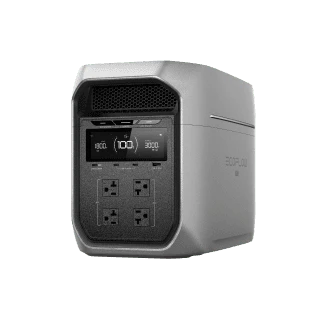
3,072Wh to start, quiet enough to sleep next to, and it scales with add-on batteries when your loads grow.
EcoFlow DELTA 3 Ultra Plus
Check DELTA 3 Ultra Plus PriceShop at EcoFlowBLUETTI Apex 300 (2,765Wh), expandable to ~20kWh. Spec Built for solar-heavy, semi-permanent builds. Huge solar input (around 2,400W), 0ms UPS switchover, and it stacks with B300K battery packs into serious capacity. It’s heavier and needs a separate fast-charge cable, but for a build where power is the backbone, it’s the one with the most headroom. This is what replaced BLUETTI’s older modular units (the discontinued AC300 and AC500).
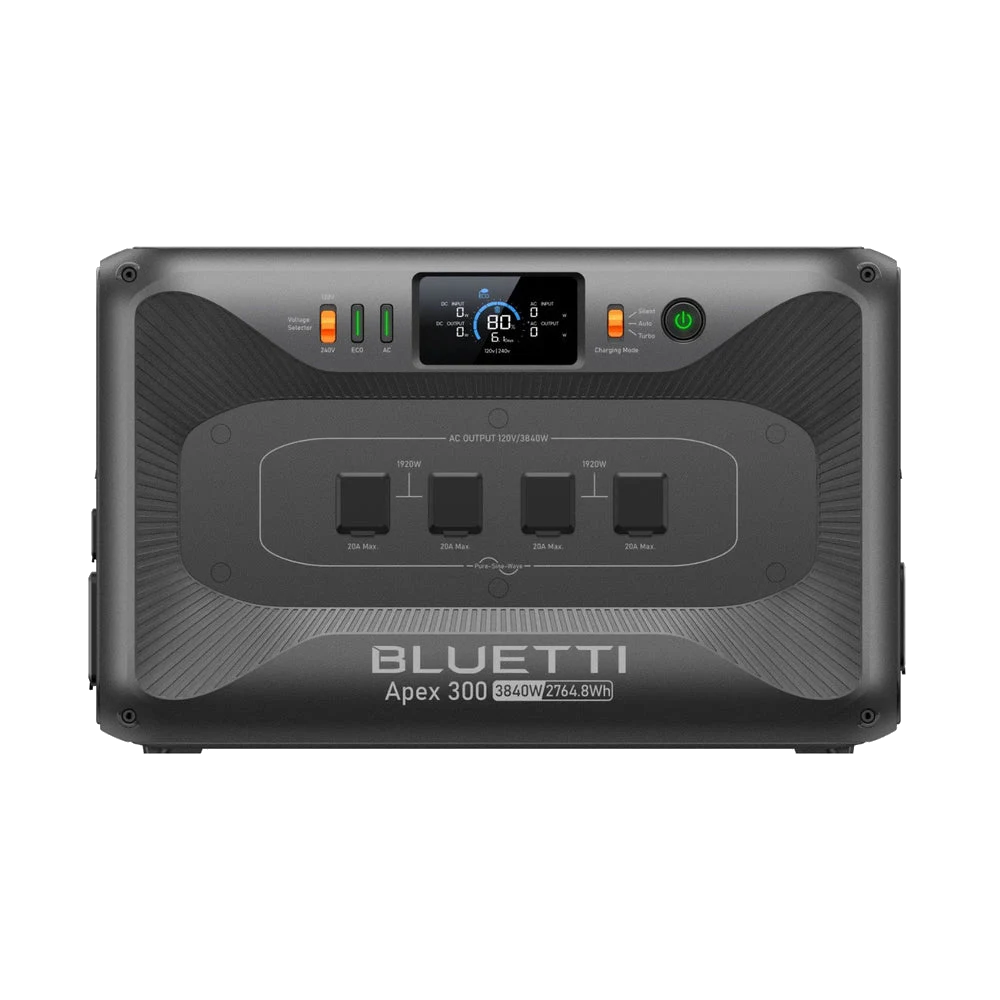
The most headroom of any current platform. Stacks with B300K packs, and takes about 2,400W of solar.
BLUETTI Apex 300
Check Apex 300 PriceShop at BLUETTIBLUETTI AC200L (2,048Wh), expandable to ~8,192Wh. Spec Older than the Elite line but still sold and still a real expandable option: it takes up to two B300-series packs. If you find one at a good price, it’s a legitimate budget route into an expandable platform.
Goal Zero Yeti (Tank packs), some models. Goal Zero sells “Tank” expansion batteries for select Yeti models. Check the exact model, because support has changed across generations and not every Yeti takes one.
Current Platforms That Are Fixed#
Fixed doesn’t mean bad. It usually means simpler, lighter, and cheaper per watt-hour at a given size. It just means what you buy is what you get.
- BLUETTI Elite 300 (3,014Wh), fixed. The best energy density in the 3kWh class (about 58 lbs), fast AC recovery. No expansion, but 3kWh covers most full-time van builds outright.
- BLUETTI Elite 200 V2 (2,073Wh), fixed. This is what we run. It’s a standalone unit with no expansion port, and for our loads it hasn’t needed one.
- BLUETTI AC180 (1,152Wh), fixed.
- EcoFlow DELTA 3 (base, ~1,024Wh), fixed. (The Plus, Max, and Ultra variants are the ones that expand.)
- Jackery Explorer 1000 Plus (1,264Wh), fixed.
- EcoFlow RIVER 2 Pro (768Wh), fixed.

Best energy density in the 3kWh class at about 58 lbs. No expansion port, but 3kWh covers most full-time builds outright.
BLUETTI Elite 300
Check Elite 300 PriceShop at BLUETTIThe Path Most Articles Skip: Just Run Two Units#
Here’s the take you won’t get from a spec sheet, and it’s the one we live by. Expansion adds capacity to one unit. That’s more watt-hours behind a single inverter, a single set of electronics, a single point of failure.
We learned why that matters the hard way. Our main station’s input cord melted on the road, and for a stretch that unit was dead. If all our capacity had been expansion batteries bolted to it, all of it would have been dead too. What saved us was a second, independent unit (our old Goal Zero Yeti) that kept the fridge cold while we sorted out the warranty.
So before you buy expansion capacity, ask what you want:
- More runtime for one big system? Expansion is cheaper per kWh and cleaner than a second full station.
- Insurance against a failure far from home? A second unit is the answer, not expansion. Two smaller stations beat one big expandable one when the thing you fear is downtime, not running low.
We wrote a whole post on that trade: why we carry a backup unit instead of just more batteries. For most van lifers, the better answer is a comfortable fixed station now, plus keeping your old unit as the backup.
When Expansion Makes Sense#
You’ve already proven your daily load. Expansion pays off most when you’ve lived with a system for a season and know exactly where it falls short. Buying an expandable platform speculatively, before you know your real usage, usually means overspending on capacity you don’t need.
You want to avoid replacing your inverter and BMS. An expansion battery adds watt-hours for less than a full second station, because you’re only buying cells, not another inverter, controller, display, and chassis.
Your use is growing. Adding a CPAP, an induction cooktop, or a second person changes the math. If you know the load is climbing, starting on an expandable platform gives you a clear upgrade path.
When Expansion Doesn’t Make Sense#
Your daily load is stable. If 2 to 3kWh is enough and always will be, a fixed station like the Elite 300 is simpler and often cheaper than a modular stack.
You want failure protection, not more runtime. That’s a second unit, not an expansion pack (see above).
Weight and space are tight. Expansion packs are heavy. A BLUETTI B300-series pack is about 84 lbs (38 kg). In a space-constrained build, a single larger standalone station is often more practical than an integrated stack.
The Cost Math#
Expansion batteries cost less per kWh than standalone stations because they skip the inverter electronics. Rough ranges (estimate, check current pricing):
Decision Framework#
Buy a fixed station if: you’ve done your load math, your daily use fits inside ~3kWh, and it isn’t likely to change much. The Elite 300 or Elite 200 V2 are the easy calls here.
Buy an expandable platform if: your load is growing, you want to avoid a full replacement in 12 to 18 months, or you’re building a permanent rig where modular scaling is part of the plan. The DELTA 3 Ultra Plus and Apex 300 are the current picks.
Buy a second unit if: what you actually want is protection against downtime, not more runtime. Redundancy is a different problem than capacity, and expansion doesn’t solve it.