
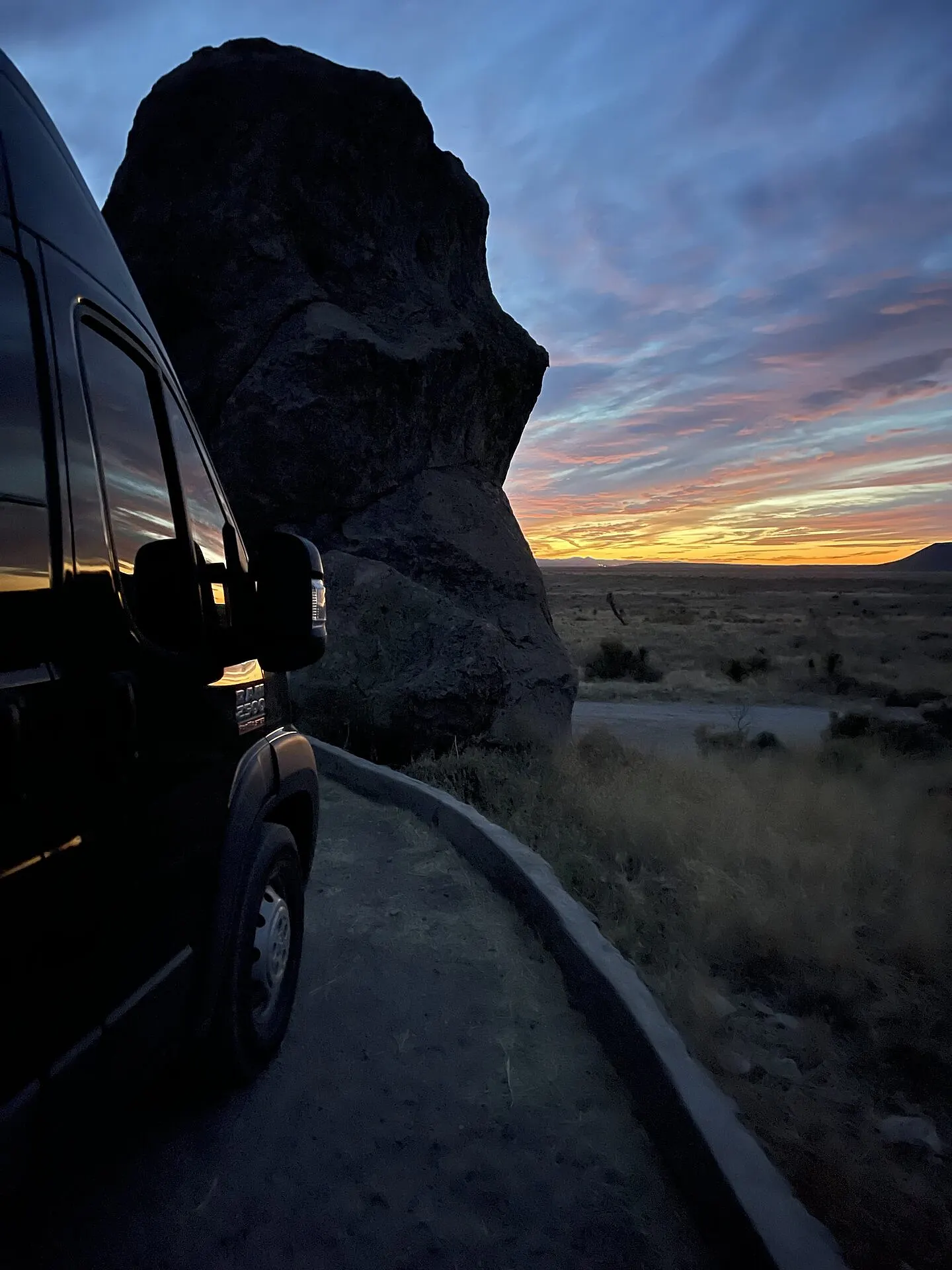
Let’s start with the hard part: a van in summer without rooftop AC gets hot. Clever gear doesn’t fully solve that. The toolkit below helps a lot, but anyone who tells you a couple of MaxxAir fans and some Reflectix makes a van as cool as air conditioning isn’t being straight with you.
That said, we’ve done summer van life without AC for years, from dry desert passes to brutal humid Gulf-coast stretches, and it’s completely manageable with the right approach. Here’s what works for us, and where the limits are.
Roof Fan Strategy#
A quality roof fan is the highest-impact tool you have. We run two MaxxAir fans, and they’re the single thing that makes summer bearable in our van.
Our two-fan setup. The MaxxFan 4500 sits over the bed, blowing down and in. The MaxxFan Deluxe 7500 runs outward on exhaust. Lay on the bed with the 4500 pushing air over you and the 7500 pulling the hot air out, and it’s a strong, nice breeze. When we want to cool off up front, we crack the T-vent window and put the 7500 on max exhaust. It pulls so hard that air comes rushing in through the T-vent, like a fan blowing straight in from the window.
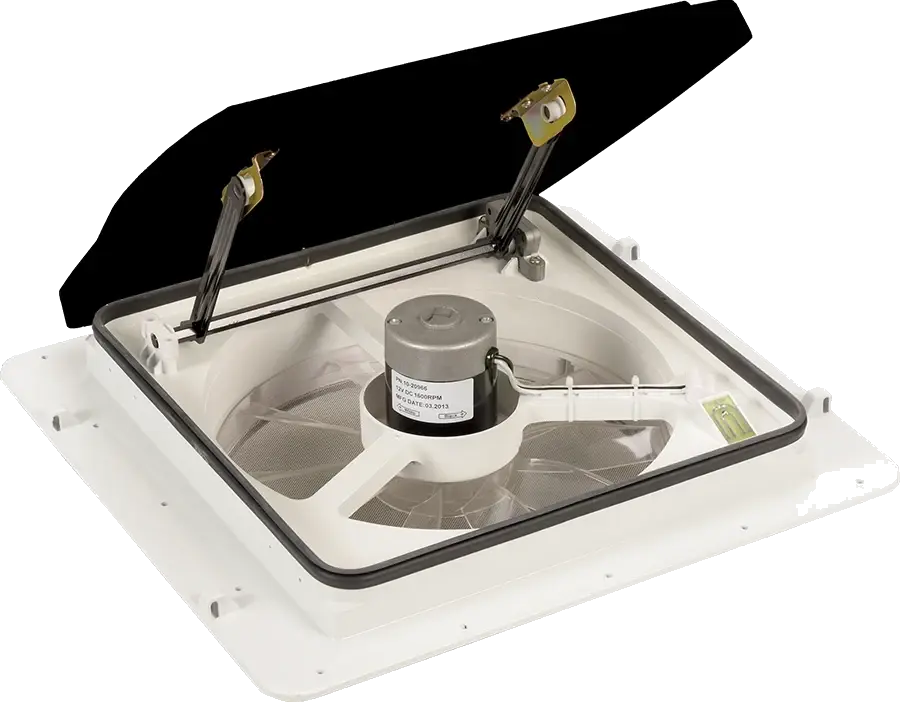
Why one of each. The 4500 actually has better airflow than the pricier 7500, because it isn’t rain-proof. The 7500’s weather cover costs it some air. So our recommendation is to get one of each: put the 4500 over the bed where airflow matters most, and keep the 7500 for when the weather turns and you still need to run a fan without letting rain in.
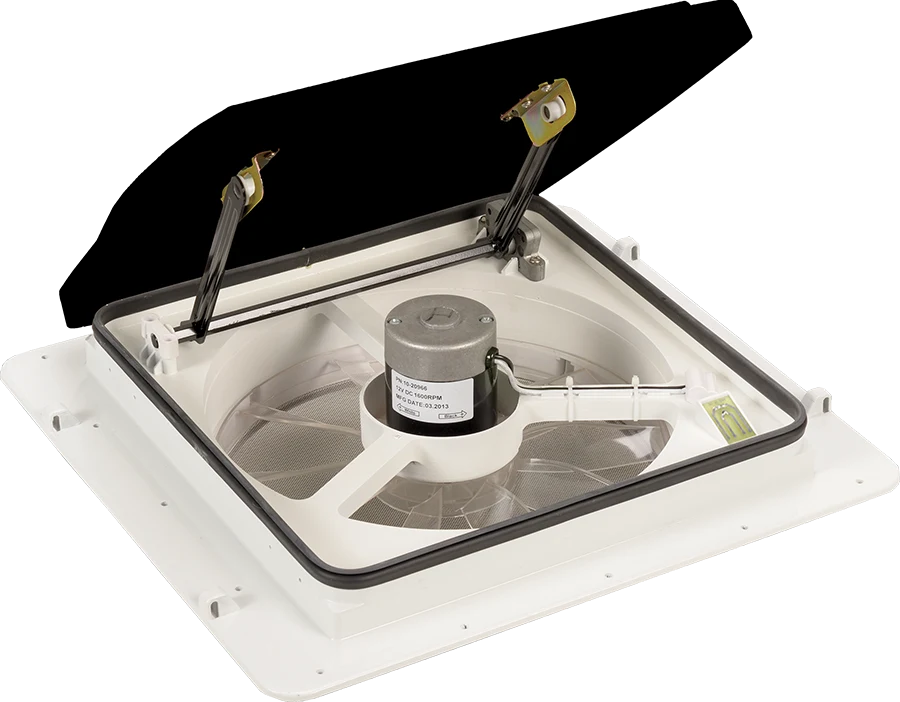
More air than the pricier 7500 because it skips the rain dome. This is the one we sleep under.
 MaxxAir 4500
Check MaxxFan 4500 on Amazon →
MaxxAir 4500
Check MaxxFan 4500 on Amazon →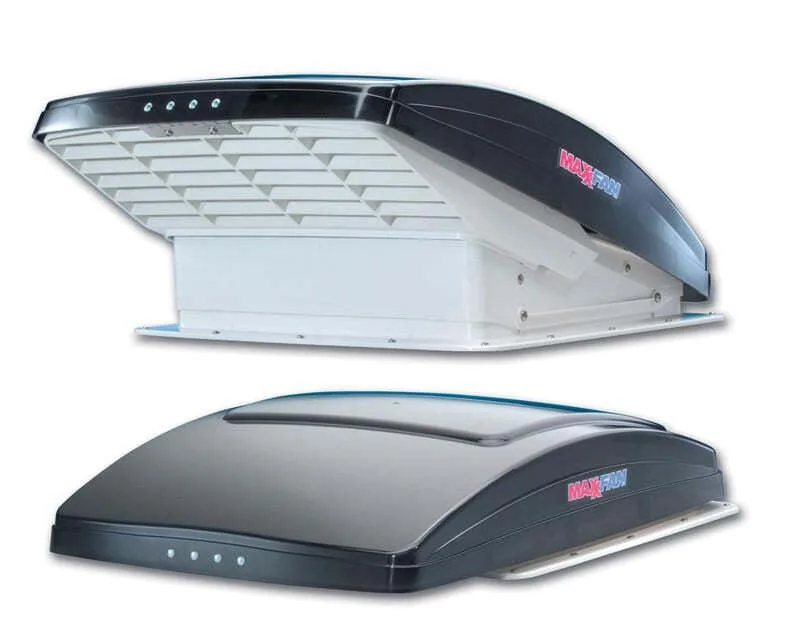
Its cover lets you run it on exhaust even in the rain. We pair it with a cracked T-vent for a strong cross-breeze.
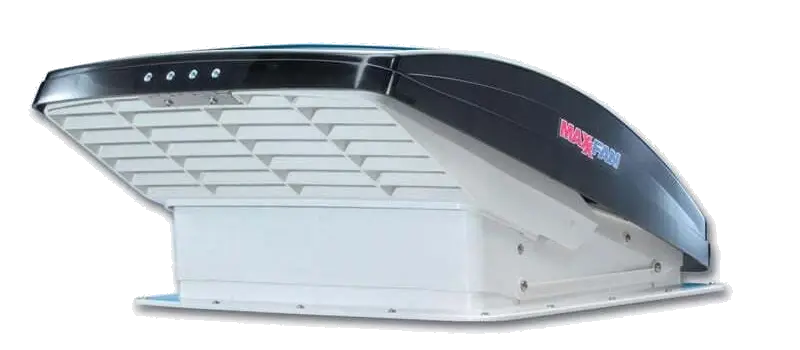 MaxxAir MaxxFan Deluxe 7500
Check MaxxFan 7500 on Amazon →
MaxxAir MaxxFan Deluxe 7500
Check MaxxFan 7500 on Amazon →Run them on exhaust, with a crossflow path. Hot air rises, so a fan exhausting from the roof pulls the hottest air out and draws cooler air in through any lower opening. But a roof fan with no intake path just recirculates hot air. Crack a window or vent on the opposite side of the van so the fan has somewhere to pull from. Without that crossflow, you get noise and a fraction of the cooling.
Power draw. We measured our own MaxxAir at 32W wide open, and 58W with both fans running. Measured Eight hours of that is about 256Wh for one fan, 464Wh for two: meaningful but manageable. Most of a night sits mid-range, nearer 15W, which is what our power calculator budgets. Add a fridge on top and it climbs fast, so plan your recharge around it. Full numbers on the real-world power data page.
Pre-cool before the peak. Before the heat peaks (usually 2 to 4 PM), park in shade and run the fan on high while the van is still relatively cool. You’re trying to dump as much hot air as possible before you close up for the evening. It makes a real difference to your starting temperature at bedtime.
Window Covers and Reflectix#
Reflectix is a double-foil insulating material that reflects radiant heat. Cut to fit your windows and placed shiny-side out, it blocks a significant portion of solar heat gain through glass.
What it does: In testing reported by van lifers, Reflectix in windows reduces interior temperature by 5–15°F compared to uncovered glass in direct sun. Reported The shiny exterior also reduces the visible indication of interior activity.
Limitations: Reflectix does not cool a van that is already hot. It slows heat gain while you are parked in sun. Once the van interior has heated up, covering the windows does not help much. Use covers proactively before the sun reaches those windows.
Cab windows: The windshield and front side windows are large glass surfaces. A reflective windshield shade ($15–25) makes a meaningful difference in cab temperature, which connects to the cargo area through the bulkhead.
Parking Strategy#
Where you park matters more than most gear decisions on a hot day.
Shade: Direct sun exposure is the primary driver of van interior temperature. Shade from trees or buildings reduces solar heat gain dramatically. A van in full shade may be 20–30°F cooler than the same van in direct afternoon sun. Estimate
Elevation: Higher elevation is cooler. In a van without AC, driving to 5,000–8,000 feet on a hot summer day isn’t just scenery, it’s temperature management. We plan a lot of our summer routes around elevation for exactly this reason.
Coastal and lakeside locations: Water bodies moderate temperature. Coastal spots and lakeside campgrounds can be 10–20°F cooler than inland areas at the same latitude in summer. Estimate
North-facing parking: Parking with the van oriented so the rear doors face south means the afternoon sun hits the doors rather than the windows. Combined with crossflow ventilation through the back doors cracked open in the evening, this positioning helps.
Timing your parked hours: During the hottest part of the afternoon (2–5 PM), being in motion beats being parked. You’re in AC-cooled cab air instead of a heating cargo area. Plan errands, driving, and cafes for this window.
Evaporative Cooling#
Small evaporative coolers (sometimes called swamp coolers) blow air over a wet pad. The evaporation absorbs heat and lowers the air temperature, in the right conditions.
When they help: Low-humidity environments (desert Southwest, interior mountain regions, anywhere the air feels dry). In low-humidity conditions, a small evaporative cooler can lower the air temperature in a van by 10–20°F and add enough moisture to feel comfortable. Reported
When they fail: High humidity. If you are in Florida, coastal Southeast, Gulf Coast, or anywhere that feels muggy in summer, an evaporative cooler does almost nothing. The air is already too saturated with moisture to allow effective evaporation. In high humidity, evaporative cooling adds moisture to an already humid environment and makes things worse, not better.
Water and power draw: Small 12V evaporative coolers draw 3–8A and use 1–3 gallons of water per day depending on run time. Spec The water use is significant, so you need a plan for filling the reservoir regularly.
The cheapest version: wet your own skin. You don’t need a swamp cooler to use evaporative cooling on yourself. Spray or wipe water on your skin and sit in front of a fan. As the fan evaporates the water, it pulls heat directly off your body, and that actually lowers your temperature. It’s the real thing, not just the feeling of moving air. A fan on dry skin mostly speeds up sweat evaporation, and in air hotter than your skin it can even add heat, so it feels cooling without doing as much. Wetting your skin and sitting in front of a fan is one of the fastest ways to shed heat there is, second only to sitting in cold water. Reported Same catch as any evaporative trick, though: it works great in dry heat and much less in humidity, where the water can’t evaporate off you fast enough.
Lifestyle Shifts#
Some of the most effective summer van life adaptations are behavioral, not gear-based.
Shift active hours: Do work and exercise in the morning before peak heat. Rest during the hottest hours. Evenings are for everything requiring movement. This schedule matches the rhythm of people in hot climates everywhere and requires no gear at all.
Use the cab AC while driving: If your van has working cab AC, use it strategically. A 30-minute drive to an errand at 3 PM cools the cab and gives you a break from the cargo area heat. Return when the sun angle has lowered.
Duck into the AC. This is a big one for us. Libraries, coffee shops, and grocery stores are all free air conditioning. On the hottest days we’ll spend the peak hours in a climate-controlled space and save the van for morning and evening.
Sometimes the coolest spot isn’t the van. If we can find shade and a breeze outside, and we’ve got the energy for it, we’d rather be out in it during the worst of the heat than bake in the cargo area. A metal box in the sun is often hotter than a shady spot with moving air.
Expect some hot nights: Even with everything above, there will be nights in certain locations and climates that are uncomfortable. This is a real constraint of van life without AC. Some people handle this by renting a motel room once every week or two during the worst heat. Some people pick routes that avoid extreme heat. Some people just tolerate it. All of these are valid choices.
The Connecting Power Note#
Roof fan use in summer is one of your larger ongoing power draws. At mid-speed, call it 15W, a fan over 10 to 12 hours costs 150 to 180Wh. Wide open at the 32W we measured it is 320 to 384Wh, and two fans wide open is nearer 580 to 700Wh. Measured If you are also running a fridge, that may push a 1kWh power station to near-empty by morning. Planning your power setup for summer means accounting for the fan load specifically, and prioritizing recharge windows that give you enough recovery before the next night.
For power recovery in summer heat conditions, the same recharge-speed framework applies: how quickly can you get back to stable matters more than how large the battery is on paper.