
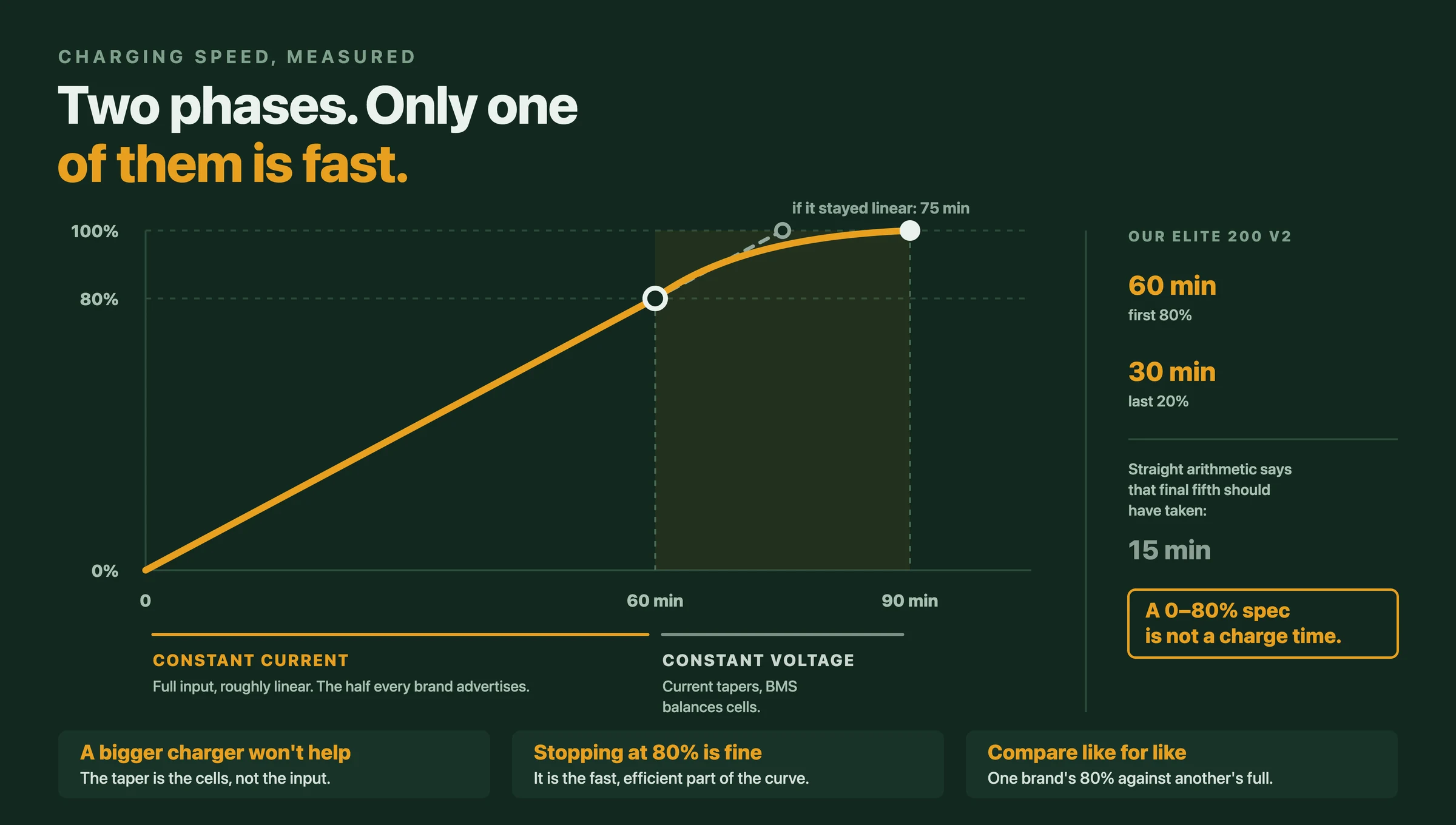
Our BLUETTI Elite 200 V2 reaches 80% in about an hour, and full in about an hour and a half. So the first 80% took 60 minutes and the last 20% took 30.
Straight arithmetic says that final fifth should have taken 15.
That gap is the whole subject of this post. Every charge-time number you will read on a spec sheet is written around it, and once you know why, the specs stop being confusing and start being useful.
Why Every Brand Advertises 0-80%#
A LiFePO4 battery does not charge at one speed. It charges in two phases, and they behave nothing alike.
Constant current, roughly 0 to 80%. The station pulls everything the input will give it and holds that rate steady. This phase is close to linear, which means simple division predicts it well.
Constant voltage, roughly 80 to 100%. Voltage is held at the ceiling and current tapers off steeply as the cells fill. On top of that, the BMS starts balancing individual cells against each other, which is slow by design and has nothing to do with how much power you are feeding it. A bigger charger does not shorten this part.
So the last 20% commonly takes as long as, or longer than, a large chunk of the first 80%. On our own unit it cost 30 minutes to add what the first-phase rate would have added in 15.
That is the entire reason manufacturers quote a 0-80% figure. It is the half of the curve that behaves, and it is the flattering half. A 0-80% spec is not a charge time. Comparing one brand’s 80% number against another’s full-charge number is the most common apples-to-oranges error on a power station spec sheet.
For van life this is less bad news than it sounds. Charging to 80% is the fast, efficient part of the curve, it is easier on the cells long-term, and it covers most daily loads. The mistake is not stopping at 80%. The mistake is planning your day around an 80% number while thinking it means full.
The Formula for Time to 80%#
Because the first phase is near-linear, you can predict the 80% mark with division:
Minutes to roughly 80% = capacity (Wh) x 0.8 x 1.15 ÷ AC input (W) x 60
The 1.15 covers AC-to-DC conversion losses, which run about 10–15% in modern stations. Applied to the 80% mark rather than to a full charge, it holds up well against the manufacturers’ own published figures:
| Station | Formula says | Brand publishes |
|---|---|---|
| BLUETTI AC180 | 44 min | 45 min |
| EcoFlow DELTA 2 | 47 min | 50 min |
| BLUETTI Elite 200 V2 | 64 min | ~60 min, measured on ours |
Three brands, three near-misses inside a few minutes. Now run the same formula out to 100% on our Elite 200 V2 and it returns 79 minutes against a measured 90. The formula does not break because the arithmetic is wrong. It breaks because after 80% the battery stops taking the power you are offering it.
Spec capacities and AC input ratings from each manufacturer. Measured Elite 200 V2 times are from our own unit across multiple cycles.
How Long Each Station Takes to Reach 80%#
Same formula, run across the stations we track, from an ordinary wall outlet:
Look at the bottom two rows. The AC200L is rated for 2,400W of AC input and the DELTA 2 Max for 1,800W, and they land on the same 63 minutes, because a standard wall outlet cannot deliver 2,400W to anything. That is the next trap, and it is the one nobody puts on a spec sheet.
The Three Specs That Don’t Happen in a Van#
1. The 0-80% figure, read as a full charge. Covered above. It is real, it is just not the number you think it is.
2. The combined AC-plus-solar figure. EcoFlow advertises the DELTA 2 Max at 80% in 43 minutes. That number adds up to 600W of solar on top of 1,800W of AC. It is achievable, but only when you are simultaneously plugged into a wall and harvesting near-peak sun. In a parking lot at 8pm you have the AC half, which is the 63 minutes above. Always check whether a headline charge time is wall-only or combined.
3. The outlet, not the station. A standard US 15A, 120V circuit tops out at 1,800W, and electrical code derates continuous loads to 80% of that, or 1,440W. Any station rated above 1,800W of AC input, like the AC200L’s 2,400W, needs a 20A circuit to reach its rating. Coffee shops, campground pedestals, older houses, and anything sharing a breaker with a fridge or an espresso machine will give you less than the full 1,800W, not more.
Capacity is the other half of all of this, and the Jackery on the chart above is the clearest case. It takes the same 1,200W as the DELTA 2, but it has 1,264Wh sitting behind that input instead of 1,024Wh, so it needs 58 minutes to reach 80% where the DELTA 2 needs 47.
Then Jackery publishes 1.7 hours to full Spec. Set their number against our estimate for the 80% mark and the final fifth of that battery is absorbing another 44 minutes, roughly three times what the constant-current rate would suggest Estimate. That is why it recharges slowest in its tier despite a perfectly respectable input rating. Input and capacity only mean anything together.
Why the Number Matters for Van Life#
In van life, outlet access is a window, not a constant. You have 45 minutes at a coffee shop. Two hours at a gym. An overnight hookup at a campground. The question is never “can I charge?”, it is “can I meaningfully recover in the time I have?”
A 1,000Wh station charging at 200W needs 6+ hours to refill. If your window is two hours, you have recovered 400Wh: maybe enough, maybe not. The same station at 1,200W recovers nearly fully in that same two hours. The window is identical. The outcome is not.
Our old Goal Zero Yeti 1400 charged at 60W, which is 25 hours to full Spec. Hauling it into a coffee shop at Mission Beach bought us about 8% in two hours Spec. That is the same two-hour window that fills most of a modern 1kWh station. Nothing about our routine changed between those two units except the input rating, and it changed everything about how we plan a week of bad weather.
The Other Limit: Heat#
High AC input generates heat in the battery and the BMS, and most stations quietly reduce their charge rate when internal temperature climbs. It shows up in warm weather, after a deep discharge, and during repeated fast cycles. Manufacturers rarely publish the trigger thresholds, so a summer charge in a hot van can run past the estimate even before the 80% taper starts. Treat every number on this page as a good-conditions figure.
Decoding the Rest of the Marketing#
“X2 fast charging” or “turbo mode” usually means the station will accept max input from a single outlet and prioritize charging over pass-through. Generally genuine, and generally louder, since the fan works harder.
“Bidirectional charging” means the station can both draw from and feed the grid. Relevant if you are pairing with a home EV charger or a grid-tie system. Ignore it for van use.
“Simultaneous charge and use” is supported by most modern stations. Net recovery is input minus active load: at 1,200W in with 200W of running loads, you are recovering at about 1,000W. Worth knowing if the fridge and laptop stay on while you are plugged in.
Practical Decision Framework#
For van life, here is what the input tiers mean once you read them as time-to-80%:
Under 500W input. Slow recovery. Plan around overnight hookups and long sessions with outlet access. Hard to make progress in a short window.
500–1,000W input. Moderate. A 1–2 hour window gets you a meaningful top-up. Workable with some planning discipline.
1,000–1,600W input. Fast. Most core van life stations sit here, and a 45-minute stop is worth making.
1,600W and up. As fast as an ordinary outlet allows. Worth paying for on a large-capacity station, where the extra input is what keeps the 80% mark inside a realistic stop. Above 1,800W you are buying headroom you can only use on a 20A circuit.
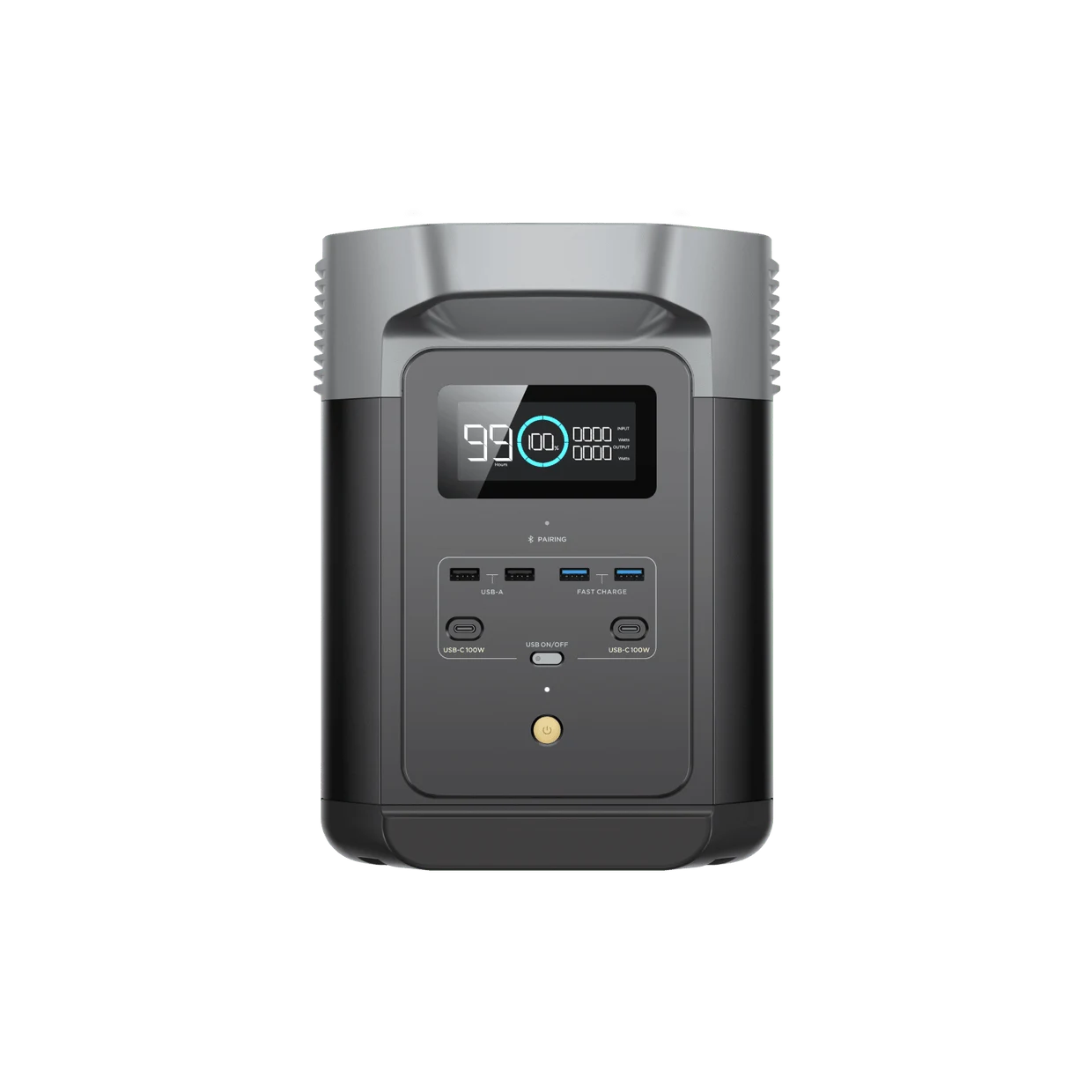
EcoFlow DELTA 2 (1024Wh)
1,200W AC input at the 1kWh sweet spot: 47 minutes to 80% from an ordinary wall outlet, no solar required to hit it.
Check Amazon Price → Shop at EcoFlowWhen Charging Speed Isn’t the Bottleneck#
If your primary source is solar, AC input rate is largely irrelevant, because your harvest is the ceiling. If you charge mainly off the alternator, your station’s DC input spec matters more than its AC. AC input rate is the critical variable specifically when you are working with outlet windows.
For a mixed strategy of solar first with outlet backup, size the solar and DC path first. AC rate is what rescues the bad weeks, not what runs the good ones.