
When I bought my first power station in 2018, I looked at one number: watt-hours. More was better. That was the whole framework.
After eight years of full-time van life, I can tell you that watt-hours is the second thing to look at. The first thing is input wattage: how fast the station charges. Most buyers never check it. It’s buried in the spec sheet, not on the front of the box.
That’s a problem, because a slow-charging station with plenty of capacity can strand you just as surely as a fast-charging station with too little.
The Week That Changed How I Think About This#
Santa Rosa Beach, Florida, summer 2019. Seven days of overcast sky, brutal heat, and the kind of humidity that never lets go. The fridge ran overtime. The fans couldn’t stop. Our 300W array delivered almost nothing for a week.
We hauled the Goal Zero Yeti 1400 into coffee shops nearly every day that week. Its stock charger was rated at 60W, which is 25 hours from empty to full Spec. A two-hour sit next to an outlet returned about 8% Spec. That is roughly 115Wh for two hours of sitting in a coffee shop with a 45-pound battery at your feet.
Here is the part that matters: the problem was never capacity. 1,425Wh is a serious battery, and on a normal week it covered us fine. The problem was that once it drained, nothing I could do in a day would meaningfully refill it. Capacity buys you time. Input is what buys the time back.
When you run out of power, comfort goes first. You sweat. You stop running the fans. You sit still. The one thing you cannot let fail is the fridge, because losing the food costs more than being miserable. A week of that rewired how I rank every power decision on this site.
The Math Most Reviews Skip#
Input wattage determines how fast your station refills, and you can predict it:
Minutes to roughly 80% = capacity (Wh) x 0.8 x 1.15 ÷ AC input (W) x 60
Aim it at 80% rather than at full, because that is the part of the charge that behaves linearly. The last 20% takes about twice as long as the arithmetic predicts, so any estimate of a full charge is optimistic.
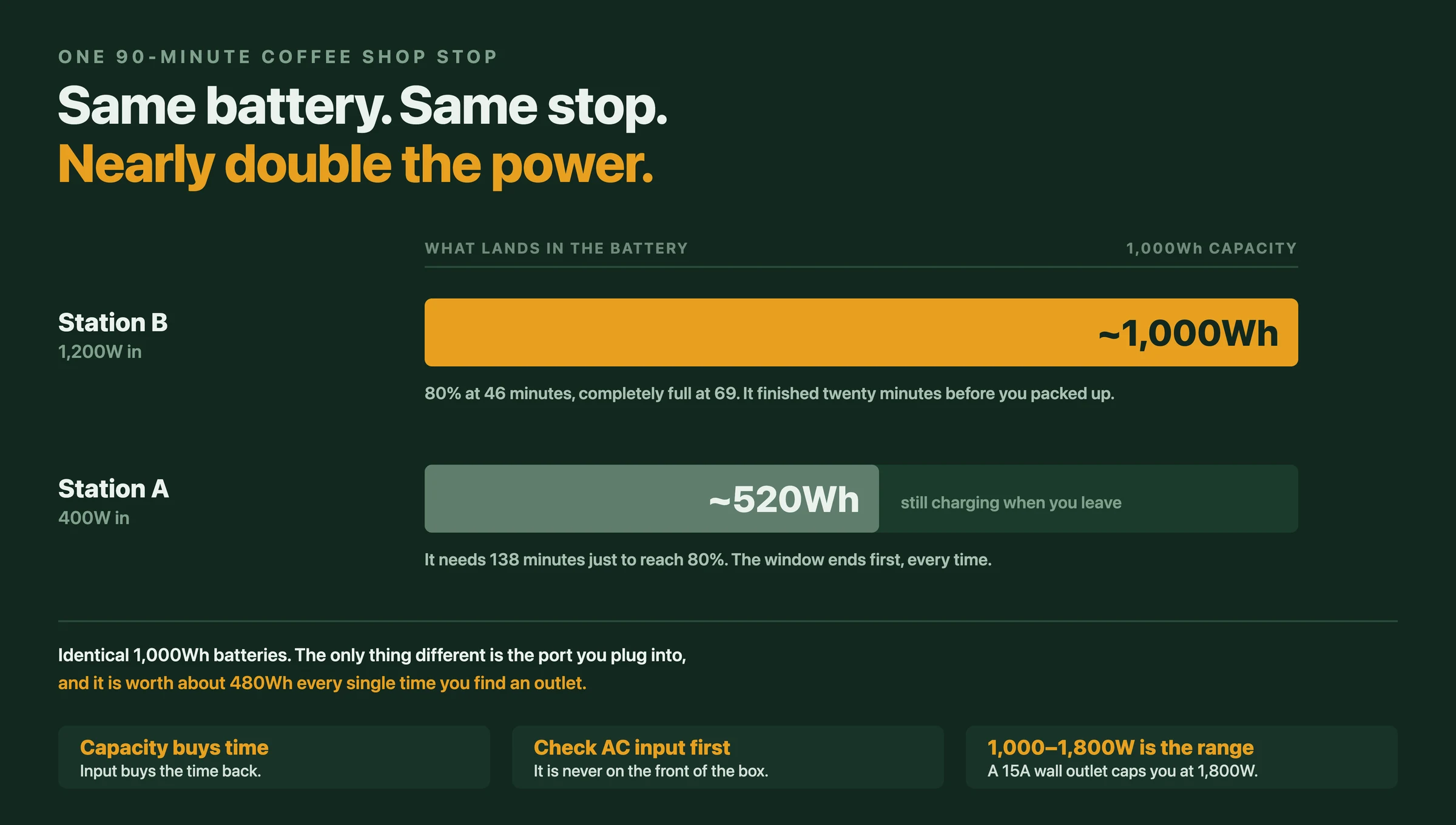
Two stations, both 1,000Wh:
- Station A, 400W AC input: 138 minutes to 80%
- Station B, 1,200W AC input: 46 minutes to 80%
Same capacity, same battery, nothing different but the port you plug into.
Now put both in a real 90-minute coffee shop stop, starting near empty. Station A takes on about 520Wh, a little over half a tank. Station B hits 80% before you finish your first coffee and is completely full around the 69-minute mark. It finished twenty minutes before you packed up.
Three of those windows a week, a coffee shop, a laundromat, a friend’s driveway, and Station A has returned about 1,560Wh across the week where Station B returned roughly 3,000Wh. Same battery on the shelf. Nearly double the power actually delivered into your van.
When Watt-Hours Do Matter More#
I’m not saying capacity doesn’t matter. There are situations where more watt-hours is the right priority:
Extended off-grid stays. If you’re parked somewhere with no outlet access for multiple days and solar is your only recovery source, larger capacity gives you more buffer for overcast stretches.
High-draw loads. Running a compressor fridge in Florida summer, with a CPAP at night and a laptop all day, adds up. Larger capacity handles heavy load days without forcing you into conservation mode.
Infrequent outlet access. If you’re getting to an outlet once a week or less, a larger bank matters more than refill speed; you’re refilling from empty regardless, and a bigger tank means fewer close calls.
In most van life patterns, though (regular short moves, occasional outlet access, mixed solar and drive charging), input wattage determines daily useability more reliably than raw capacity.
What I’d Tell Myself in 2018#
Check the AC input wattage before you buy anything. It’s on the spec sheet; look for “AC charging input” or “AC adapter input.” If it’s under 600W on a 1,000Wh station, the math on short outlet windows is going to work against you every time you need it most.
Look for at least 1,000W input at the 1kWh capacity range. Faster is better: 1,200W and above is the range that makes short outlet stops worth it.
There is a ceiling on that advice, though, and it is not set by the battery. A standard 15A wall outlet delivers 1,800W at absolute best, and code derates a continuous load to 1,440W. A station rated above 1,800W of AC input cannot reach its own rating from an ordinary plug, so past that point you are buying a number for RV pedestals and 20A circuits, not for coffee shops. Somewhere between 1,000W and 1,800W is the whole useful range.
The station that keeps you stable isn’t the one with the most watt-hours. It’s the one you can actually recover in the time you have.