
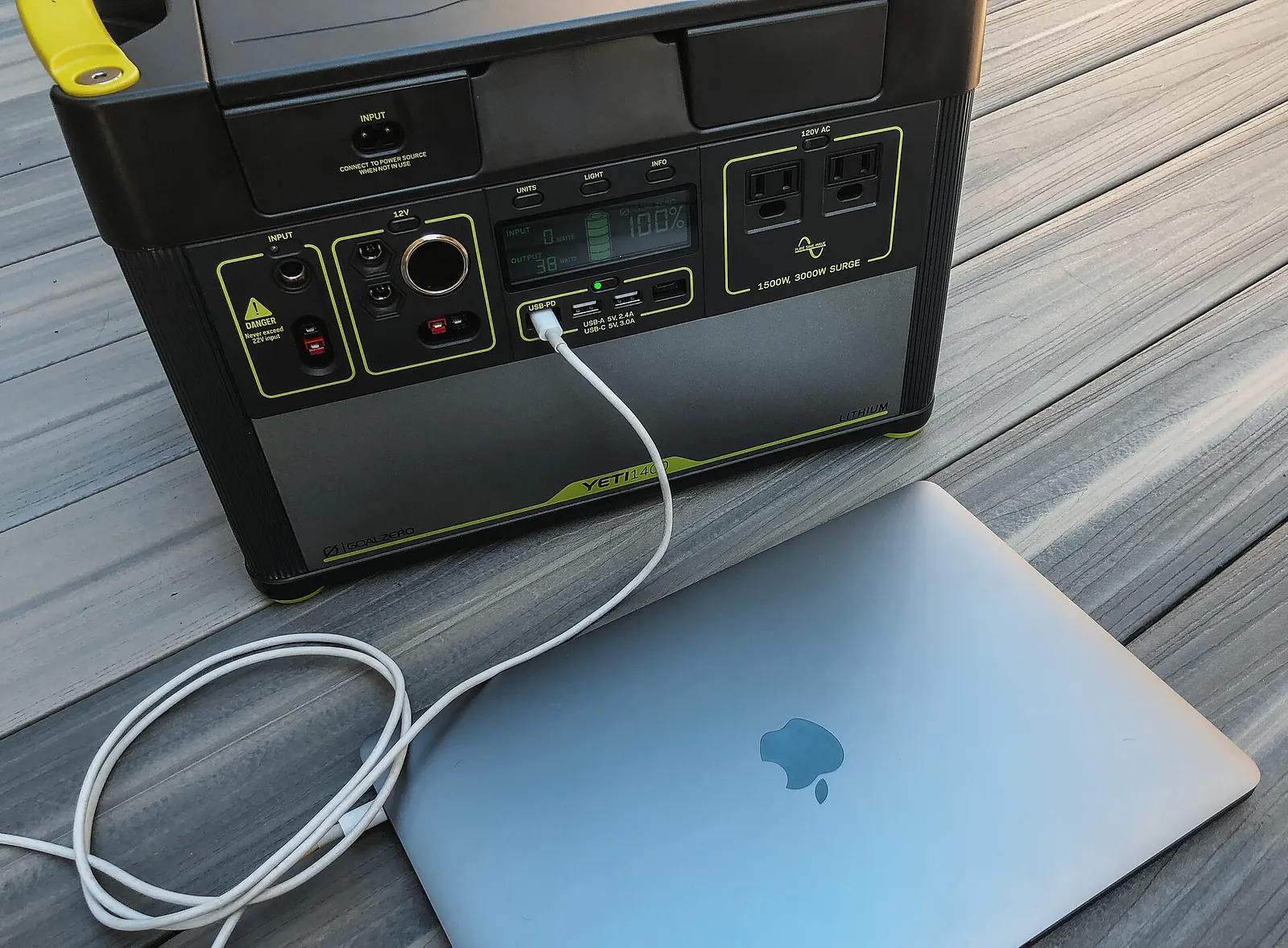
I stopped counting how many times I picked up my power station, carried it into a coffee shop, and plugged it into the wall. Through the Yeti years it was just the move during a bad solar stretch.
You cannot do that with a hardwired lithium system.
That’s the whole argument, really. But let me give you the situations, because they’re the kind of situations that don’t show up in gear guides, they show up in real van life.
What "portable" actually looks like
Eight years, and there is still no battery bank in this van. Two charging sources meet at one charger, that charger feeds one station, and every 12V circuit in the living space hangs off that station’s DC port.
This is our layout, not an install guide. The splitter and the block are not decoration: the station has one 12V DC port, so every circuit in the van has to be funneled into it, and that single constraint is why the bottom half of this drawing looks the way it does. All of that side is connectors and fuses. The alternator side is not. The Charger 2 takes up to 800W off the vehicle’s 12V system while you drive Spec, and it runs on its own heavy cable from the engine bay (a separate, thicker cord than the short one joining the charger to the station). BLUETTI supplies it. Use what comes in the box, fuse it, and if routing heavy cable from an engine bay is not something you have done before, that is the part to hand to a qualified installer. If you take one thing from this drawing, take that. We don’t publish wiring procedures. For the alternator side, follow manufacturer guidance or work with a qualified installer.
Situation 1: The Coffee Shop Charge#
The Yeti 1400 weighs about 45 pounds. You don’t really think about that until you’re carrying it across a parking lot into a coffee shop near Mission Beach because you need every percentage point you can get.
People look. But honestly, nobody cares that much. People do weirder things in coffee shops than bring in a big battery. You find an outlet, plug in, and sit there for a couple hours knowing you’re getting maybe 8% back. That’s it. That’s what a 25-hour wall charger gives you in two hours.
Just make sure you’re actually buying something. Get a coffee, get a sandwich, tip well. Don’t just walk in and claim an outlet for three hours. These places are giving you power whether they know it or not. Be a good customer and nobody has a reason to care about the big black box under your table.
But you could carry it. That was always the thing. Whatever was happening (rain, dead solar day, nowhere to park in the sun), you could just grab the station and take it to power. A fixed battery system doesn’t give you that. You’re stuck with whatever your van can collect.
Situation 2: Cold Colorado and the Yeti#
We spent two or three full winters in Colorado, and the Yeti and cold weather were a recurring problem. When the internal temperature of the battery drops below freezing, the unit won’t accept a charge. It’s a safety feature: lithium cells can be damaged by charging in the cold. But knowing why it happens doesn’t fix the problem when you’re sitting in a van with a dead battery and sun on your panels doing nothing.
Solar panels are out, sun is hitting them, and the charge controller just sits there. Nothing coming in. The first time it happened, I had to do some research to figure out what was going on. After that, I knew the pattern: if it got cold enough overnight for the van interior to drop below freezing, the Yeti was done until it warmed back up.
We were lucky: I grew up in Lakewood, so we had family and friends around. I’d bring the Yeti inside someone’s house and let it warm up at room temperature. Depending on how cold it had gotten, that could take anywhere from 6 to 24 hours before it would start accepting charge again.
A Webasto heater would’ve changed everything. It runs off your gas tank and keeps the interior warm, which means the battery stays warm too. We didn’t have one, and I wish we had. It would’ve solved this problem on those cold Colorado mornings instead of hauling the Yeti to someone’s living room.
The newer power stations handle cold much better than the Yeti did. But if you’re in a van without a diesel or gas heater and you’re somewhere that drops below freezing, this is something you need to plan for.
Situation 3: Eight Years and a Black Friday Deal#
The Yeti 1400 was a good unit. We bought it around 2018 and it did its job for years. But lithium batteries have a cycle life, and the Yeti’s was rated around 500 cycles. After seven years of full-time use, it had been through a lot. Toward the end, it was zeroing out every time we used the induction burner. The capacity had been declining slowly for years, then it got noticeably worse after we came back from an eight-month trip to Asia. We had family keeping it maintained while we were gone (cycling it lightly, keeping it between 30 and 80 percent), but it still lost a lot of capacity sitting mostly idle for that long.
We probably held onto it longer than we should have. But the timing worked out: we waited for Black Friday and got a good deal on the BLUETTI Elite 200 V2. Going from a 25-hour wall charge to about an hour and a half felt like a different world. And the cycle life on the BLUETTI is 6,000+ cycles to 80%. Things have changed a lot since 2018. The technology isn’t even close to what it was.
What a Fixed System Gets You#
I’m not dismissing fixed systems. They make sense for specific use cases:
- Daily loads that consistently exceed 1,500–2,000Wh
- Setups where solar is the primary source and you want maximum panel input capacity
- Long-term stationary use where portability doesn’t matter
- Builders who are certain their system will never need to move
If your use pattern demands what a fixed system offers, build one. But make sure it’s your use pattern demanding it, not just the idea that a “real build” has hardwired lithium.
Why I Stay Portable#
I’ve been living in a van for eight years. The primary thing I’ve learned is that flexibility has compounding value. The more constrained your setup is, the more each problem costs you. A system that can move, be temporarily disconnected, be charged anywhere with an outlet, that’s a system that stays useful through conditions you didn’t plan for.
The situations above weren’t disasters. In a fixed system, each of those situations requires a different kind of problem-solving.
Eight years in, I’ll take the portability.