
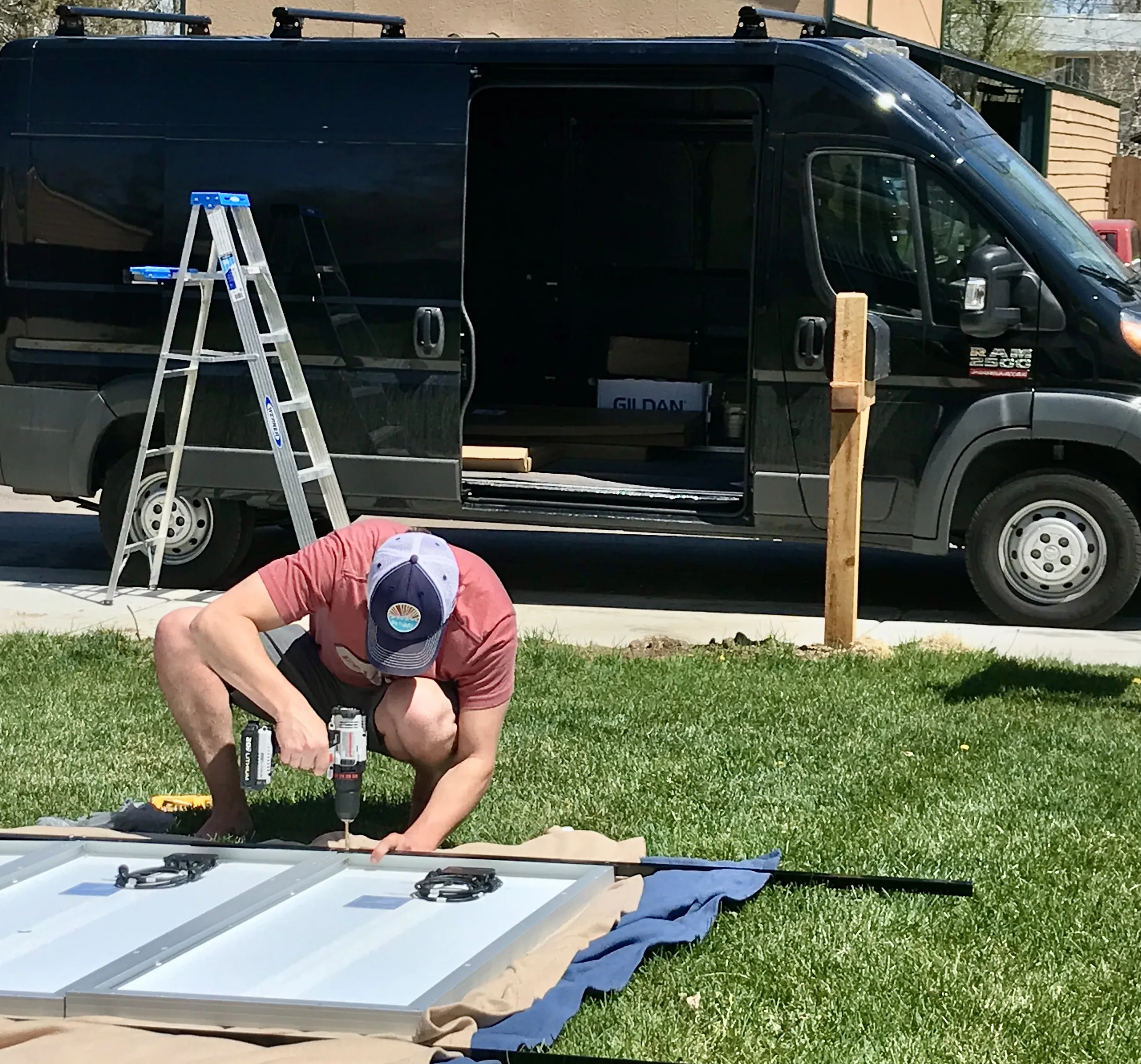
In eight years our 300W array has never once produced 300W. The most I have ever watched come in is 270W, and that was a reading on a display, not a day. The other reading I trust the same way: 183W at 1:43pm on a clear September 11th in Watkins Glen, NY. Measured Between those two anchors the shape comes from the sun’s height, not from my memory of it, and it peaks mid-afternoon rather than at noon. Across the four hours of usable peak sun that works out to about 210W on a clear midsummer day, 175W in a shoulder season and 130W in midwinter. Estimate It is a flat system, so I am never getting a good angle on anything.
That gap is why most solar sizing advice sends people shopping for the wrong number. The figure printed on a panel is what it makes in a lab, at 25°C, aimed square at the sun. A panel bolted flat to a van roof in August is none of those things.
So the useful question is not “how many panels do I need?” It is “how many watt-hours do I burn in a day, and how much of a flat roof’s rating actually shows up?” Panel count falls out of those two. Here is how to work it.
Step 1: Build Your Daily Load List#
Write down every device you run on a typical day and estimate how long you run it. Multiply wattage by hours for each item. That gives you watt-hours per day.
A realistic moderate-use day might look like this:
| Device | Draw | Hours/Day | Wh/Day |
|---|---|---|---|
| Laptop | 45W | 6 hrs | 270 Wh |
| Roof fan | 15W | 8 hrs | 120 Wh |
| LED lights | 10W | 4 hrs | 40 Wh |
| Phone charging | 10W | 2 hrs | 20 Wh |
| Total | 450 Wh |
Add a mini fridge and the math changes significantly:
| Device | Draw | Hours/Day | Wh/Day |
|---|---|---|---|
| Compressor fridge | 10–25 Wh/hr Measured | 24 hrs | 240–600 Wh |
| Laptop | 45W | 6 hrs | 270 Wh |
| Roof fan | 15W | 8 hrs | 120 Wh |
| LED lights | 10W | 4 hrs | 40 Wh |
| Total | 670–1,030 Wh |
The fridge is a range rather than one number because the climate, not the appliance, is what moves it. Those are our own figures off a Dometic CFX65DZ: 10–12 Wh/hr in mild weather, 20–25 Wh/hr in Florida heat and humidity. Measured The rest of the table is Estimate and depends on your specific devices and usage.
Size against the top of that range, not the middle. A fridge-equipped build that pencils out at 670 Wh in spring is the same build asking for 1,030 Wh in August, and August is when your panels are fighting overcast. Full breakdown in the fridge power draw post.
Step 2: Apply the Solar Sizing Formula#
Once you have a daily watt-hour number, the sizing formula is:
Daily Wh ÷ (Peak Sun Hours × 0.75) = Minimum Panel Wattage Estimate
That 0.75 is the harvest factor, and it is the number most guides leave out. A flat-mounted van panel realistically returns 60 to 75% of its rating once you account for wire resistance, the fact that a van roof is flat and the sun is not overhead, panel temperature (silicon loses 0.3 to 0.5% of its output per °C above 25°C, and a black roof in Florida is well above 25°C), and charge controller conversion losses. Spec We plan every number on this site at 0.75, and our own eight-year-old array meets it.
One thing the formula hides: the array does not clock off outside the peak window. In summer ours is putting something in from about 7am to 7pm, at much lower wattage on either side of midday. Measured Only the longest nights of the year push that to 8pm or before 7am. The four-hour figure is the block that does the heavy lifting, which is why peak sun hours, and not daylight hours, is the right input above.
What that adds up to on our roof. Two readings are measured off the display: the most this array has ever made, 270W, and 183W at 1:43pm on a clear September 11th in Watkins Glen, NY. Measured The rest is modeled from the sun’s height, and the model earns that job by reproducing the second one: fed nothing but a latitude and a date, it returns 181W for that hour. Everything below is the same geometry run forward. Filling in the rest of the day, a clear midsummer day comes to roughly 1,850Wh off the roof, about 6.2 hours of full-sun-equivalent production from 300W of panel. Estimate A clear midwinter day in San Diego is under half of that, near 855Wh, and not because of weather. A December sun never climbs far enough for a flat panel to do much with it.
⭐ Then the charge controller takes its cut, and it is bigger than most people expect. We read 148W arriving at the controller against 134W reaching the station, at the same moment. Measured That is 91%, and solar sits at the poor end of a converter’s efficiency curve for a structural reason: 300W of panel feeding a charger built for 800W never leaves low load, and converters are worst there. So the numbers that matter, the ones that reach the battery, are nearer 1,680Wh in midsummer and 780Wh in a San Diego winter. Estimate Every figure below is battery-side unless it says otherwise.
⚠️ That is a clear day and nothing else. The spread is the part worth respecting: hazy, semi-cloudy and solidly overcast are three completely different numbers, and the distance between them is far bigger than the distance between a good day and a great one. It is why I will not quote you a single “daily harvest” figure. Never size a system on your best day.
A clear midsummer day drops about 8.5 peak sun hours onto a flat surface where we spend it, and a clear San Diego midwinter day about 3.7. Estimate Measured against those, our harvest factor lands between 0.71 and 0.77 in every climate we have lived, summer and winter alike. That is the 0.75 this site plans with, and it holds in all four seasons.
⚠️ Note which side of the controller that is. The harvest factor is a fact about the array: sun in, DC out at the controller. It does not move when you change chargers. The 91% conversion is a fact about the charger, and it does very much move. Multiply them and a flat roof in real use returns about 0.68 of the sun that falls on it, into the cells.
Which is worth saying plainly, because we had it wrong for a while and in an instructive direction: the harvest factor was never the shaky number. The peak-sun-hour figure people multiply it by is. Our own simulator ran Colorado summer at 5.5 peak sun hours when a clear Colorado June day is nearer 8.5, and that single input, not the derate, is what made its estimates read low. If a solar estimate feels wrong, check the sun hours before you blame the panels.
⚠️ Do not confuse the two 75s on this page. 60 to 75% of rating is what the panel makes at a single moment against its nameplate. 0.75 is what the whole day returns against the sun that fell on it. They are different measurements that happen to land on a similar number.
Plan at 0.75, and put your margin into the weather rather than into the panels. The panels are not where the variance lives.
Peak sun hours vary significantly by location and season. These are long-run monthly averages, which is what published sun-hour tables give you, and they already have the region’s cloudy days averaged into them:
- Southwest desert in summer: 5–6 peak sun hours per day
Estimate - Pacific Northwest in summer: 4–5 peak sun hours per day
Estimate - Midwest in winter: 2–3 peak sun hours per day
Estimate - Southeast in winter: 3–4 peak sun hours per day
Estimate
⚠️ Do not read those as clear-day numbers, and do not then dock them again for cloud. An average already contains the cloud. A genuinely clear midsummer day runs well above the summer figures here, nearer 8.5, which is why the clear-day total further up this page is so much larger than these rows would suggest. Sizing is the one job the averages are right for: plan on the average, and treat the clear day as the upside.
Using the no-fridge moderate example above (450 Wh/day) in a good summer climate (5 peak sun hours):
450 ÷ (5 × 0.75) = 120W minimum panel wattage Estimate
That is why many basic van setups start with 100–200W of panels and do fine in sunny conditions during summer. Now run it for a fridge-equipped setup in a winter location, at 2.5 peak sun hours. Cold is the one break you get: when ambient is near the target temp the compressor barely runs, so the fridge sits at the floor of its range and the day lands around 670 Wh.
670 ÷ (2.5 × 0.75) = 357W minimum panel wattage Estimate
But winter is not your worst case, and this is the part most sizing guides get backwards. The day that breaks you is hot and overcast at the same time, because the fridge is at the top of its range on exactly the day the panels give back the least. Same 2.5 peak sun hours, 1,030 Wh of load:
1,030 ÷ (2.5 × 0.75) = 549W minimum panel wattage Estimate
Cold weather takes load off you while it takes away sun. A humid overcast summer week takes the sun and adds load. Size for that one. It is the week that sent me into coffee shops in Santa Rosa Beach.
Hold onto that 549W. It fits on some van roofs. It does not fit on mine, and no amount of correct math changes that, which is the part of this we get to below.
Step 3: Account for Cloud Cover and Battery Reserve#
Solar does not produce at full output every day. A realistic design accounts for multiple consecutive cloudy days. Your battery bank needs to cover the gap.
How many reserve days you need depends on your climate and risk tolerance:
- Sunny climates (desert southwest): 1–2 days of reserve capacity is typically sufficient
Estimate - Mixed climates (most of the US): 2–3 days is a more comfortable buffer
Estimate - Cloudy climates (Pacific Northwest, New England winter): 3–4 days if you want to rely primarily on solar
Estimate
Multiply your daily load by your reserve days to get minimum battery capacity. For the 450 Wh/day setup with a 2-day reserve, you need 900 Wh of usable battery capacity. If you are using lithium (which you can discharge to around 80% depth), that means roughly a 1,125 Wh bank. If you are using AGM (typically limited to 50% depth), you need roughly a 1,800 Wh bank for the same usable capacity.
This is also why solar works differently in different climates. In Arizona in July, a 200W panel system with a 1,000 Wh lithium battery is self-sufficient for moderate loads. In Oregon in January, the same system falls short without shore power backup or an alternator charge strategy.
The Roof Gets a Veto#
Every sizing guide ends at the formula. Your roof does not care about the formula.
I cannot tell you what fits on your van, and neither can anyone else who has not been on it with a tape measure. Total roof length is the number people plan with, and it is the one that misleads them. What decides the layout is panel orientation, the flat width between your roof rails, where your fans have to sit for airflow, and whatever your rack feet and vents already occupy. A wheelbase figure predicts none of that.
Here is what ours resolved to. On a 2017 ProMaster high roof, with a Vantech low-profile rack and two Maxxair fans, there are exactly two layouts:
- Three panels and two fans (300W)
- Four panels and one fan (400W)
That is measured on our roof, not calculated from the wheelbase. I keep both fans, so 300W is this van’s permanent ceiling. A fourth panel is worth roughly 300Wh on a good day; the second fan is what makes a humid Florida night survivable, on exactly the nights the fridge draws hardest. Deleting a fan to add a panel makes the good days slightly better and the worst days meaningfully worse. The full version of that trade is in the van roof math.
You cannot buy your way out with denser panels#
This is the first question everyone asks, and I asked it again while writing this. If panels got better, can I put 600W where my 300W sits?
No, and it is not close. My three panels cover 1.60 m². Getting 600W out of that area requires 37.5% module efficiency. The best commercial module in the world right now is a back-contact panel at 25.0 to 25.6%, and single-junction silicon has a hard physical ceiling near 29%. Spec Even building my array out of the best modules on Earth tops it out around 400W, and those are not sold as 12V van panels.
What you can actually buy is closer to home. My 2018 Renogy slims are 18.7% at the module. Renogy’s current 16BB N-type is 19.9%, and the maker spent eight years of progress shrinking the panel rather than raising the watts: it is still rated 100W, in a rectangle 6% smaller than mine. Spec So swapping all three buys me back a little roof space and not one extra watt. That is not a roof job.
⚠️ One trap worth carrying to the store: when a listing advertises “up to 25% efficiency,” that is almost always the cell rating. Divide watts by area yourself. Renogy’s 200W N-type, the one carrying that 25% claim, works out to 20.7% at the module, and it is physically larger than one of my panels in both directions. Spec
The practical implication: if the formula says 549W and your roof holds 300W, solar is not your answer, and no panel you can buy will make it your answer. Alternator charging or shore power fills that gap. That is not a compromise, it is the design.
Solar as a Supplement vs. Standalone Charging#
Here is the framing most van life content avoids: solar is a supplement for most van lifers, not the primary charging source.
The math explains why, though the spread is enormous and it depends entirely on which path you use. A stock 12V socket might return 100Wh in an hour of driving. A real alternator charger like our BLUETTI Charger 2, which draws a measured 760W, returns closer to 646Wh in that same hour once you account for efficiency losses. Measured At the top of that range, one hour of highway driving delivers as much energy as two to three hours of good solar production, and it does it on the overcast days when the panels are giving you nothing.
Solar earns its value in specific situations:
- Parked days where you are not driving
- Extended off-grid stays in good sun
- Supplementing alternator charging to reduce engine-on time
If you drive regularly, solar extends your off-grid capability rather than fully replacing other charging sources. Plan your system understanding this hierarchy: shore power is most reliable, alternator charging is consistent when you drive, and solar fills the rest.
For a full comparison of charging approaches and when each makes sense, see Alternator Charging for Power Stations.
Decision Shortcuts by Daily Load#
If you have done the math and want a quick reality check:
Under 300 Wh/day (minimal use, no fridge, light laptop):
100–200W of panels with a 500–700 Wh lithium battery handles most days in moderate climates with reasonable driving. Estimate
300–600 Wh/day (moderate use, laptop, fan, some cooking, no fridge):
200–400W of panels with a 700–1,200 Wh lithium battery works well in most US climates with occasional driving. Estimate
600–1,200 Wh/day (heavy use, fridge, full-time remote work, climate control):
400–600W of panels plus reliable alternator charging or shore power backup. Solar alone is insufficient in many climates for this load. Estimate
Over 1,200 Wh/day (fridge + air conditioning or heavy electric cooking):
Solar is a secondary system here. You need a large lithium battery bank, serious alternator charging, and regular access to shore power or a generator. Estimate
The Number to Get Right First#
If you take one thing from this: size your battery bank before your panels. The battery determines how much energy you can store and use overnight. Panels are only useful if there is somewhere for that energy to go.
A common mistake is buying panels first and discovering the battery bank is too small to absorb a full day of production. The battery is the foundation. Right-size it for your daily load and reserve days, then size your panels to fill it in the sunlight hours you actually get.
Frequently Asked Questions
- How much solar do I need for van life?
- For light use without a fridge (200–400 Wh/day), 100–200W of panels works in most US climates. For a compressor fridge plus remote work (600–1,200 Wh/day), you need 400–600W and likely alternator charging to supplement. Use the daily load formula: daily Wh ÷ (peak sun hours × 0.75) = minimum panel wattage (Estimate). The 0.75 is the harvest factor: a flat-mounted van panel returns roughly 60–75% of its rating, never 100%.
- What size battery do I need for van solar?
- Size your battery to cover your daily load plus a 1–2 day reserve for cloudy weather, then divide by the depth you can actually use. For two days of coverage on lithium (80% usable depth): daily Wh × 2.5 = minimum battery capacity (Estimate). On AGM (50% usable depth): daily Wh × 4 (Estimate). A 450 Wh/day build works out to a 1,125 Wh lithium bank or an 1,800 Wh AGM bank.
- How many solar panels fit on a van roof?
- Fewer than the wheelbase suggests, because panels compete with your vent fans for the same space. On our 2017 ProMaster high roof with a low-profile rack, the layout resolves two ways only: three panels and two fans (300W), or four panels and one fan (400W). That is measured on our roof, not calculated from the wheelbase (Measured). Panel orientation, the flat width between your rails, and where your fans need to sit for airflow decide your own answer. Lay it out full-size with a tape measure before buying a single panel.
- Do solar panels actually produce their rated wattage?
- No. In eight years our 300W array has never produced 300W. The highest input we have ever seen is 270W, and on a clear September afternoon in upstate New York it read 183W (Measured). Modeled from the sun’s height, the four peak hours average about 210W on a clear midsummer day, about 175W in a shoulder season and about 130W in midwinter (Estimate). That window is the heavy lifting, not the whole working day: in summer the array is putting something in from about 7am to 7pm, just at much lower wattage outside the peak (Measured). Rated wattage is a lab number at 25°C with the panel square to the sun, and a panel bolted flat to a van roof is none of those things. Plan on 60–75% of rating.
- Is solar enough to power a van full-time?
- In most climates and with moderate loads, solar covers most days but not all days. A recovery-first system combines solar, alternator charging while driving, and shore power access at campgrounds. Solar alone is rarely sufficient for high-load full-time use in winter or cloudy climates.