
How CAVL works
We test in a van, not a garage.
Every number here comes from eight years of full-time living in one black ProMaster, or from a source we name out loud. Tested through Florida panhandle summers, where the fridge draws hardest on exactly the overcast days solar can't refill.
- 8 years full-time · 100,000 miles across all 48 states
- No paid placements · measured, not marketed
The receipts
Methodology is easy to claim. These are the places you can go check it.
The cord that melted
In April 2026 the input cord on our own BLUETTI melted. We wrote it up.
- What failed, and what it looked like
- How the warranty claim went
- Still a recommended unit, and here's why
Measured, not modeled
Fridge draw by season, charge times, real solar harvest. All of it on one page.
- Observed averages, not spec claims
- Conditions stated alongside every figure
- Updated as the rig changes
Measured · Spec · Reported · Estimate
You can always tell which kind of claim you're reading.
- Manufacturer figures linked to source
- Third-party tests linked too
- Planning math flagged as planning math
The four labels
Four labels. Different evidence, different weight. Order of trust: measured, then spec, then reported, then estimate. If you find a watt-hour figure on this site without one, that's an error, and we want to hear about it.
Tested firsthand
Real numbers from our unit, in our rig, in real climates.
- Strongest evidence we publish
- Multi-climate field use, not bench tests
- Individual results may vary slightly
Manufacturer claim
From the spec sheet or product page. Cited and linked.
- Useful for comparison
- Not a real-world guarantee
- Always linked to source
Third-party
Cited from a credible reviewer, independent test, or community pattern.
- Source identified
- Used when we haven't tested it
- Quality of source noted
Modeled assumption
A planning figure modeled from real-world experience, clearly flagged.
- For planning, not promises
- Always shown with its inputs
- A flagged guess beats a hidden one
Where the spec sheet gets it wrong
Three cases where living with the gear gave a different answer than the box did. This is the whole reason the method exists.
1. Two fans, identical on paper
Both MaxxAir roof fans are rated at 900 CFM, Spec and both have ten speeds and a remote. Both also draw the same 32W on speed 10. Measured On paper and on the meter they are the same fan at two prices. In practice the 7500's built-in rain dome restricts the airflow path enough that it moves noticeably less air than the 4500, even at full speed. Reported The dome costs you efficiency rather than watts, and no spec sheet shows you that. Eight years of sleeping under both is the only thing that can.
2. One fridge, two very different numbers
The Dometic CFX65DZ has run 24/7 in our van for eight years. Its draw is not one number, it's a range that doubles with the weather:
3. 300W of panels is not 300 watts
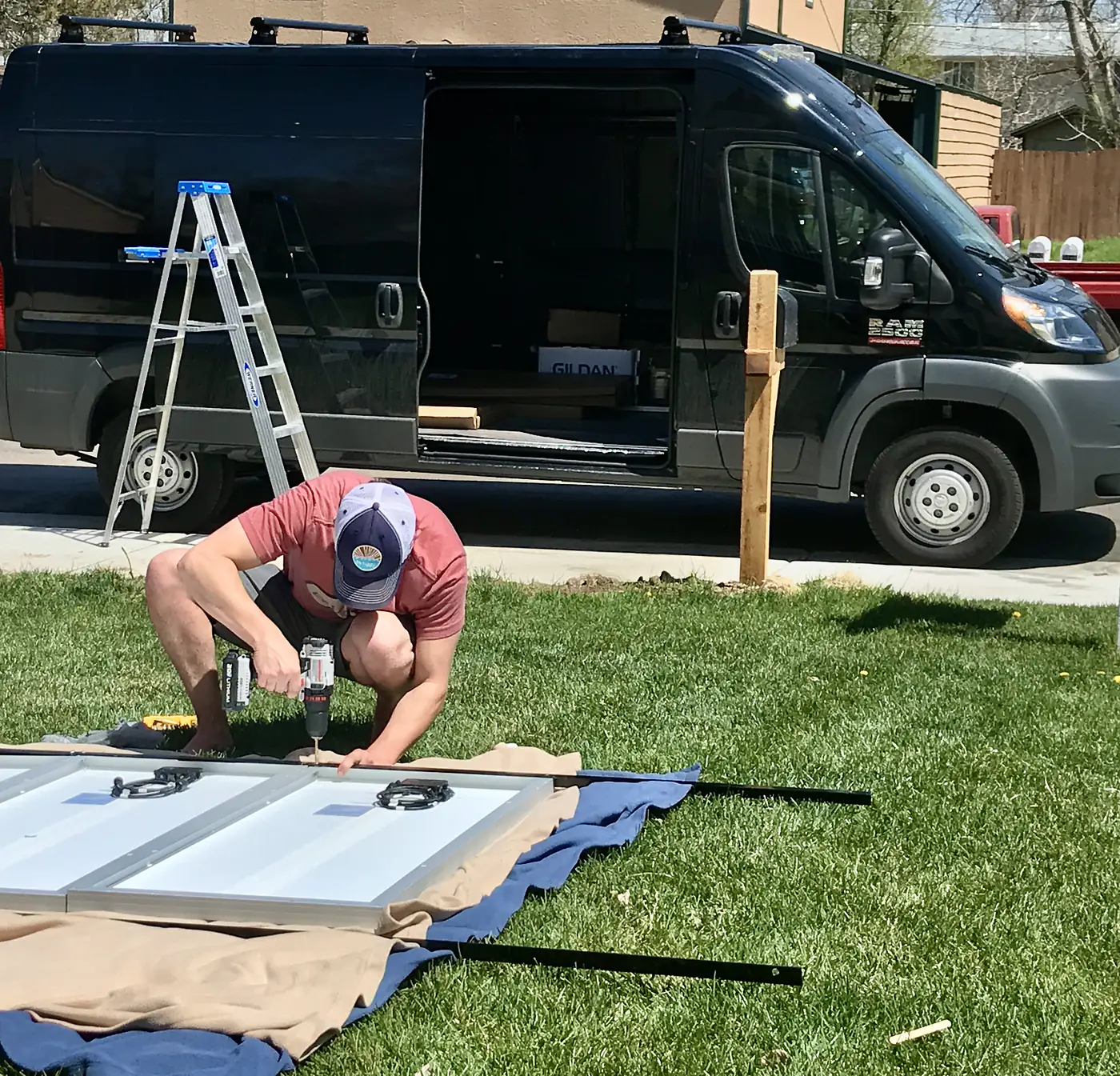
Three 100W Renogy slim panels have been flat on our ProMaster roof since 2018, never tilted, never shaded, washed whenever the van gets washed. That is close to a best case for a flat mount, and it still doesn't deliver the number on the label:
None of these are gotchas. They're the ordinary gap between a lab figure and a van, and closing that gap is the only thing this site is for.
The test rig
What "measured" means here, in specifics.
- Vehicle
- 2017 Ram ProMaster 2500, black exterior
- Where
- Florida panhandle humidity, Colorado winter cold, an Arizona winter, the California coast, New York in fall
- Duration
- Eight years of full-time daily use
- Power
- Goal Zero Yeti 1400 (2018 to Nov 2025), then BLUETTI Elite 200 V2
- Solar
- 3 × 100W Renogy slim panels, flat-mounted since 2018, never tilted
- Daily loads
- Dometic CFX65DZ fridge (24/7), MaxxAir 7500 + 4500 fans, LED lighting, water pump, laptops, phones, iPad
The black paint matters. A dark van in summer sun runs hotter inside than most people expect, which pushes the fridge harder than a spec sheet assumes. Results from the hottest stretches are noted wherever they differ meaningfully.
What we won't publish
The line between honest evaluation and review-mill noise.
- No charge times we haven't observed or can't source to a credible test. Manufacturer wattage used for planning math is labeled as exactly that.
- No combined spec numbers implying real-world performance. A 1,200W AC input charges faster than a 400W one, but real time-to-full depends on thermal conditions, outlet quality, and battery state.
- No step-by-step electrical wiring procedures. Vehicle electrical carries real safety stakes. Follow manufacturer guidance, or work with a qualified installer. We do publish diagrams of our own layout (what is connected to what, and what each part draws) because that is a description of our van, not an instruction for yours. You will not find wire gauges, fuse ratings or install steps here, and where a connection carries real current we say so on the diagram itself.
- No verdict bought with commission. Affiliate links fund the site. They don't decide the ranking, and gear that disappoints gets updated on the page rather than quietly buried.
Policies, if you want them
Why our picks start at 700Wh++
For full-time recommendation pages, we start at 700Wh+. That's the size where systems stop feeling fragile in real climate.
Smaller stations are valid for weekenders and light-load setups. They just sit outside the focus of these picks.
Context: What 700Wh Actually Runs →
Price drift policy+
Pricing moves constantly, so budget pages use a band rather than a hard cap. The "under $1000" tier means under $1,099, because that's where the class actually prices. A station listed at $799 spends most of the year selling near $500, and a hard line would sort by list price instead of by what you'd pay.
We don't promise a model will always stay under a fixed price cap, and we don't hold a pick back for a sale that may not come.
Safety boundary+
We keep power guidance high-level and recovery-focused, and we stay in the planning lane.
For installs, follow manufacturer guidance or work with a qualified installer.
The single ranking rule+
Time-to-recover beats raw capacity. We rank by how reliably a unit gets you back to a stable weekly routine, not by headline watt-hours.
Real van routines are constrained by outlet access, campground rules, and schedule. A unit that refills inside your actual window is usually a better buy than a bigger one that can't.
BLUETTI Elite 200 V2: measured charge time+
Via wall outlet, in Turbo mode: about 1 hour to 80%, roughly 1.5 hours to full. Measured
Measured on our own unit across multiple charge cycles. Individual results vary a little with outlet quality and ambient temperature. For scale, the Yeti 1400 it replaced took around 25 hours on its stock charger. Spec
Goal Zero Yeti 1400: seven years, and how it ended+
Ran this unit full-time from 2018 to November 2025 on a rated life of about 500 cycles. Spec Seven years of daily use is a good run, and for most of them it held capacity well enough that we never thought about it.
It did decline. Slowly at first, then noticeably worse after an eight-month stretch in storage while we were overseas, kept between 30 and 80% by family and still down significantly when we got back. Toward the end it would zero out on an induction burner. That reads less like a defect than like the rated cycle life arriving on schedule.
We moved to the BLUETTI Elite 200 V2 on Black Friday 2025 because recovery speed and cycle life had both moved on: 6,000+ cycles to 80% Spec against roughly 500, and 1.5 hours to full against 25. The full account is in the Yeti 1400 legacy review.
Update policy+
Reviewed monthly. Sooner when:
- A new model is released in a covered tier
- A firmware change meaningfully affects behavior
- A major spec revision or correction appears
Now use it on your own van