
The 30-second version
Chest or upright?
ChestPortable, packs full
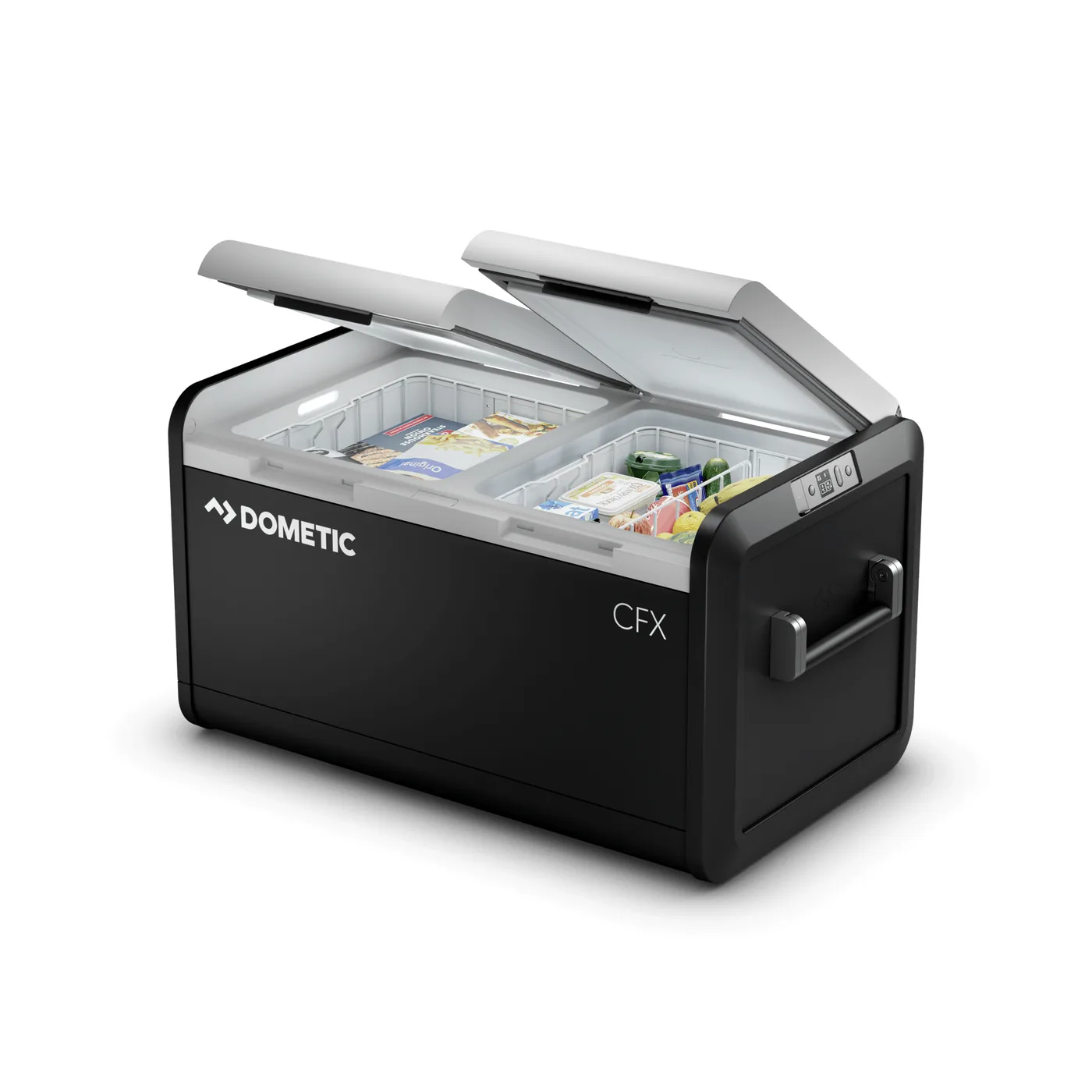
The Dometic CFX3 75DZ. The direct successor to our 65DZ, which has run around the clock for eight years. If you want a chest, this is exactly what I'd buy.
Dometic is replacing the CFX3 with the CFX5, so a CFX3 on clearance is a lot of fridge for the money.
Get the CFX3 75DZUprightBuilt in, easy reach
The Dometic CoolMatic CRX 65. Karlee leaned toward an upright early on, and eight years of using the chest proved her right: no unloading the box to reach the bottom.
It's a built-in cabinet fridge, installed into your build, not a portable you can lift out.
Get the CRX 65Read the full review
The fridge is the one thing in the van you can’t let fail. Lose power to the fans and you sweat. Lose power to the fridge and you lose the food. That’s why, of everything we run, the refrigeration is the load I care about most.
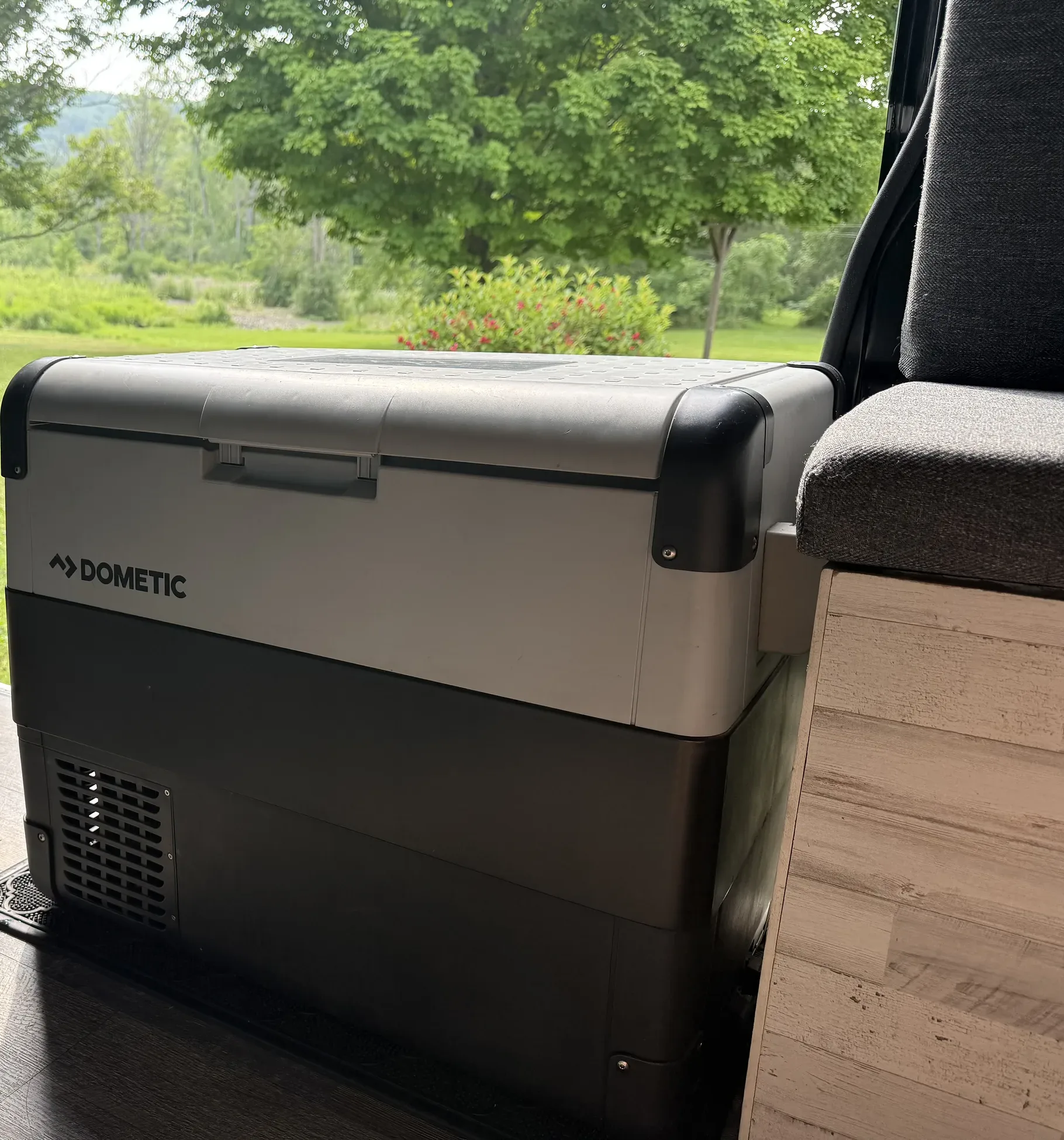
Ours is a Dometic CFX 65DZ, a dual-zone 12V compressor fridge/freezer that has been our only refrigeration through Florida summers, Colorado nights, and everyday road life. It runs 24/7 off our Bluetti Elite 200 V2 and it earns its spot.
One note up front: the 65DZ is the previous-generation CFX. If you’re shopping new today, the current line is the CFX3, and the direct replacement for our unit is the CFX3 75DZ. Everything I learned living with the 65DZ applies to the CFX3, so I’ll cover both.
Dometic CFX3 75DZ Dual-Zone Fridge/Freezer
Check Current CFX3 75DZ PricingQuick Verdict
Best for: full-time and serious part-time van lifers who want a real fridge and freezer that survives heat, runs off a portable power station, and lasts for years.
Skip if: you only camp a few weekends a year with a cooler and some ice, or your battery can’t comfortably support a compressor cycling around the clock.
A quality 12V compressor fridge is the single best comfort-and-food upgrade in a van. It’s also a real draw on your power system, so size the battery for it first. See our van power calculator before you commit.
Is this the right fridge for your setup?#
Tap the situation that sounds like you.
🚐 Full-time, this is my only fridge, and it runs all day every day. Strong fit
This is exactly how we use ours. The CFX 65DZ is our only refrigeration, cycling 24/7 off the Bluetti. Dual-zone means you can hold true fridge temps on one side and freeze on the other at the same time, so you're not choosing between cold drinks and frozen food. For a home on wheels, a compressor fridge this size is the sweet spot.
🥶 I want to actually freeze food, not just keep it cold. This does it
This is where a compressor fridge leaves a cooler behind. The CFX line runs down to deep-freeze temperatures (well below 0°F) regardless of how hot it is outside. Thermoelectric and ice-based coolers can't do that. If you want real frozen storage in the desert in July, you want a compressor unit, full stop.
🔋 I'm running off a portable power station, not a house battery bank. Works, plan for it
We've run portable-first for years and never built a hardwired house bank. A compressor fridge is friendly to that setup because it duty-cycles: the compressor kicks on to pull the temp down, then rests. It only draws its rated power when actually running. Pair it with enough capacity and fast recharge and it just becomes a background load. Undersize the battery and it becomes the thing that drains you overnight.
⛺ Weekends only, and a cooler with ice has been fine. Maybe overkill
If you camp a handful of weekends a year and don't mind a bag of ice, a $700+ compressor fridge is more than you need. The value shows up when you're out long enough that ice runs become a chore, or hot enough that a cooler can't keep up. If that's not you yet, start with a good cooler and upgrade when the ice runs start to annoy you.
What living with a 12V compressor fridge taught me#
Why the fridge is the load I protect first +
When you run low on power in a van, comfort goes first by choice. You stop running fans, you sit still, you ride it out. The one thing you never want to lose is the fridge, because a warm fridge in summer costs you the whole food box, not just a comfortable night. That single fact is why every buyer guide on this site ranks recovery speed over raw watt-hours, and why I'd rather run a slightly smaller fridge on a battery I trust than a huge one on a system that can't keep it cold overnight.
Florida summers are the real test +
Heat and humidity are what separate a real fridge from a cooler. In a hot, humid parked van the compressor works harder and runs a bigger share of the hour, which is exactly when a cheap unit gives up. The CFX has held temp through Florida summers without drama. The tradeoff is simple: the hotter it is, the more it cycles, and the more it pulls from the battery. That's physics, not a defect. Park in shade when you can, crack a vent, and don't let the fridge bake in direct sun all afternoon.
Dual-zone in practice +
The "DZ" is the dual-zone version: two compartments, two independent temperature settings, one compressor. In a van that flexibility matters more than it sounds. You can run the whole box as one big fridge when you're stocked with fresh food, or split it and keep one side frozen. If you mostly want fridge space and only occasionally freeze, the single-zone models save you money. If you want both at once without compromise, dual-zone is worth it.
Build quality after real road miles +
This is where the Dometic price tag shows up. The latch, the hinges, the corner protection, and the thick insulated walls are built to take vibration and abuse. It's a heavy, solid box, and after years of van life ours still seals and holds temp like new. In eight years of running it 24/7 down a lot of rough road, the only repair it has needed is a thermostat swap. Cheaper compressor fridges have caught up on cooling, but the thing you're paying Dometic for is that it keeps doing it after years of washboard roads.
The three numbers worth comparing#
The 65DZ holds roughly 60 liters split across two zones (about a 42L fridge side and a 19L freezer side). Spec Enough for two people to shop for a week without rationing space. The current CFX3 75DZ steps up to ~75L for a bit more room.
The spec plate rates it at 5.5A at 12V (~66W) while the compressor is running. Spec On ours, running on 12V at the low setting, it reads about 70W for the first minute of a cool-down, then settles to 45W and holds there until it hits temperature and shuts off. Measured So it overshoots the plate briefly and then runs about a third under it. The number that matters is daily consumption, and because it duty-cycles, real draw is a fraction of "45W times 24 hours." Ambient heat is the biggest lever. Model it for your climate here. Full figures on our real-world power data page.
True compressor cooling from fridge temps all the way down to deep-freeze, independent of outside heat. Spec Runs on 12/24V DC or 120V AC, so it works off your power station, off shore power, or off the alternator while driving.
Chest vs upright: would we buy this style again?#
Worth saying plainly, because it’s the fridge decision people agonize over. When we built the van, I chose the chest. Karlee leaned toward an upright early on, and over the years her reason turned out better than my spec sheet: if what you want isn’t on the top layer, you unload the box to reach it. Eight years later, she was right. Here’s the tradeoff.
Cold air sinks, so opening the lid doesn't dump the cold onto the floor. That's a real ~15–25% efficiency edge on paper, roughly 50–100Wh a day in hot climates. Estimate You can also pack it fuller (no shelves eating space), and it's usually a bit cheaper for the same capacity.
You open a door, see your food, grab it, close it. No excavating to reach the thing at the bottom, no holding the lid up with one hand while you dig with the other, no bending over a platform three times a day for years. Shelves and door storage mean your normal kitchen habits just work. The efficiency gap shrinks in mild weather; the usability gap never shrinks.
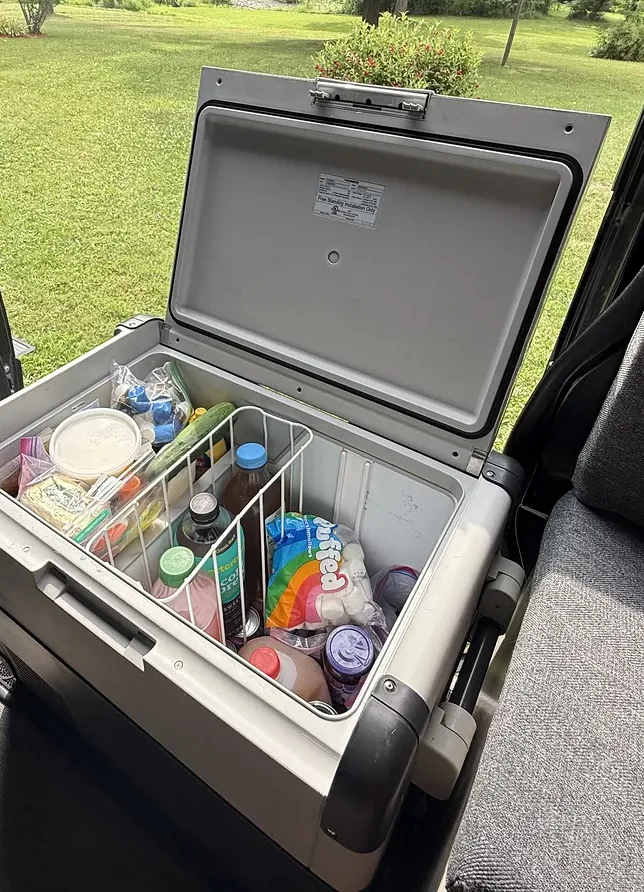
Our CFX 65DZ has been great and I don't regret it, but the daily "pull everything out to reach the bottom" wears on you. If we rebuilt today I'd give an upright serious thought. If you want the chest style anyway, for the efficiency, the packing, or the seat, the CFX3 below is exactly what I'd buy. We wrote the full story here: Chest vs Upright Fridge for Van Life.
Leaning upright? The Dometic upright I'd shortlist is the CoolMatic CRX 65, same ~60L class as our chest but front-opening with real shelves and a removable freezer. One caveat: it's a built-in cabinet fridge, meant to be installed into your build, not a portable you can lift out and take to the beach like the chest. Different install, same brand reliability.
Check Dometic CRX 65 Upright PriceBuying today: the CFX3 lineup, and the CFX5 that’s replacing it#
Our 65DZ is two generations back now. The CFX3 that replaced it added WiFi app control and a more efficient compressor, and it’s what the models below are. Dometic is now phasing the CFX3 out in favor of the CFX5, which brings vacuum insulated panels (a first for their electric coolers), an upgraded VMSO 3.5 compressor, and runs up to 5 dB quieter. Spec There’s also a cheaper CFX2 line below both.
That changes the buying advice rather than invalidating it. Vacuum panels are a real efficiency gain on a fridge that runs 24/7, so if you’re buying to keep for years and the budget stretches, look at the CFX5 first. But a line being replaced is also a line that gets discounted, and a CFX3 at a clearance price is a lot of fridge for the money. The compartment logic below is unchanged either way, because the sizes carry across: work out which shape you need here, then decide which generation to buy it in.
I haven’t run a CFX5, so everything below is CFX3 spec and the two CFX5 links are there because readers asked for the newer line, not because I’ve tested one.
CFX3 75DZ, the direct successor to our 65DZ +
Dual-zone, ~75L (a ~35L and a ~40L compartment). Spec Same two-zone flexibility as ours with a little more room, plus app control. For a full-time van this is the safe default shape, and the CFX5 equivalent is the same shape with better insulation.
Dometic CFX3 75DZ Dual-Zone Fridge/Freezer
Check CFX3 75DZ PriceCFX3 55IM, single zone with a built-in ice maker +
~53L single compartment with a rapid-freeze plate that makes ice in silicone trays while the rest of the box stays a fridge. Spec Smaller footprint, lower price than the dual-zones, and the ice trick is a nice bonus in summer. Good pick if you mostly want fridge space and don't need a permanent freezer half.
CFX3 95DZ, the big dual-zone +
Dual-zone, ~95L (roughly a 39L and a 54L zone). Spec This is more fridge than most two-person vans need, but if you cook a lot, travel with more people, or want to go longer between resupplies, the extra space is real. Just make sure your battery and floor space can carry it.
Dometic CFX3 75DZ Dual-Zone Fridge/Freezer
Compare Current CFX3 75DZ DealsLiving with it day to day#
Placement and airflow +
A compressor fridge needs air. The vent (ours is on the front-lower side) has to breathe or the compressor works harder and pulls more power. We keep ours where the vent isn't jammed against a wall and where we can pop the lid without moving anything. Top-loading chest fridges like this are efficient (cold air doesn't fall out when you open them) but you do need clear headroom above the lid, so plan that into the build.
Pairing it with your power system +
This is the part people underestimate. The fridge is a 24/7 load, so it's the single biggest input to how you size your battery and charging. We run ours off a Bluetti Elite 200 V2, and the reason that pairing works isn't just capacity, it's fast recharge: a fridge that never turns off punishes a system that recovers slowly on cloudy days. Before you buy any fridge, run your numbers on the power calculator and read what 700Wh actually runs.
Noise +
A compressor fridge is not silent. When the compressor cycles on there's a low hum, and in a small quiet van at night you'll hear it kick in and shut off. It's a gentle background sound, not disruptive, and you stop noticing it within a couple of nights. It's a different thing from a loud cooling fan, but if you sleep in total silence, know it's there.
Frequently asked#
How much power does it actually use per day? +
It depends heavily on ambient temperature, how full it is, and how often you open it, so the better answer is real averages from ours. The compressor only draws while it is actually running (~45W settled on ours at 12V on the low setting, briefly ~70W at the start of a cool-down Measured), then it shuts off, so the number that matters is the average across the day:
- Florida summer: ~20–25W average
Measured - Mild conditions: ~10–12W average
Measured - Cold weather: minimal, the compressor barely runs
Measured
Heat is the biggest lever. For the full breakdown see van fridge real power draw, and model it for your own climate with the power calculator.
Can I still buy the CFX 65DZ, or should I get the CFX3? +
The 65DZ is previous-generation, so new stock is limited and you may only find it used. For a new purchase, get the CFX3 equivalent: the 75DZ is the direct dual-zone successor. You lose nothing by going current, you gain efficiency and app control. I only mention the 65DZ because it's the exact unit I own and can vouch for after real road time.
Single zone or dual zone? +
Dual zone if you want a fridge and a freezer running at the same time, and you're okay paying and powering for it. Single zone (like the 55IM) if you mostly want cold storage with occasional freezing, want to spend less, and want a smaller footprint. Neither is wrong. Dual zone is more flexible; single zone is simpler and cheaper.
Is a Dometic worth it over a cheaper compressor fridge? +
For a weekend rig, a budget compressor fridge cools nearly as well for a lot less money. For a full-time van that lives on rough roads, the Dometic premium buys durability: the seals, latches, and build that keep working after years of vibration. I own the Dometic and I'd buy it again for full-time use. If you're part-time and budget-tight, a cheaper compressor unit is a reasonable call, just don't drop to a thermoelectric cooler and expect fridge performance in summer.
Does it run while I'm driving? +
Yes. It runs on 12/24V DC or 120V AC, so it can pull from your power station, shore power, or the vehicle while you drive (with the right wiring and battery protection). Running it off the alternator on travel days is a nice way to keep it cold without touching your house capacity. Just use the fridge's built-in low-voltage cutoff or a proper isolator so it can't flatten your starter battery.
The one load you can't let fail
A real fridge and freezer, built to survive van life
Dometic CFX3 75DZ Dual-Zone Fridge/Freezer
Check current CFX3 75DZ pricing →
Size your battery firstHow I evaluate gear#
- Real ownership over spec-sheet reads: I say when I own the unit and when I don’t
- Behavior under climate stress, especially heat and humidity
- Real power cost, modeled against real daily use, not marketing averages
- Durability after miles, not just performance on day one
- Fit by user type: weekender, part-time, full-time
See the full methodology: How We Test and Source Van Power.