
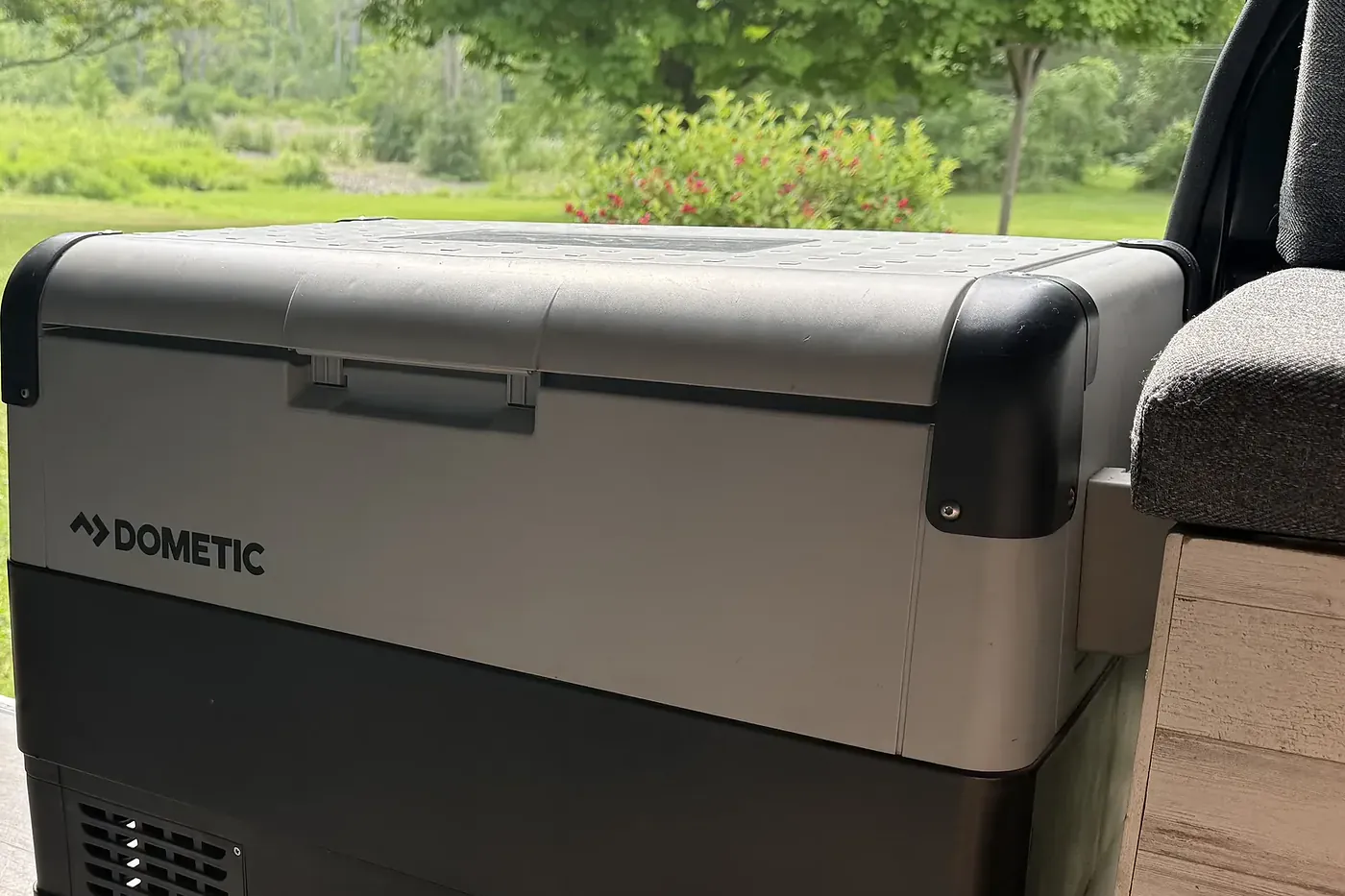
Most fridge power specs are measured in a 70°F laboratory. Your van is not a 70°F laboratory.
I’ve run a Dometic CFX65DZ chest fridge 24/7 for years in a black 2017 ProMaster, across humid Gulf-coast summers, Colorado winters, New York fall, and Arizona dry heat. The difference between what the spec sheet suggests and what I’ve observed in real conditions is the whole point of this post.
Find Your Climate#
Tap the one that matches where you park. The draw is the same fridge in all three.
🥵 Hot and humid. Gulf coast, deep summer. 20–25 Wh/hr
480–600Wh a day, fridge alone. The compressor runs close to continuously to hold 38°F against a hot interior. On a 1,000Wh station that's roughly half your battery gone before you charge a single laptop.
This is the number that decides your system size. It's also the number nobody plans for, because it only shows up in the weather where solar is least likely to bail you out.
🌤️ Mild. Spring and fall, 65–70°F. 10–12 Wh/hr
240–290Wh a day. The compressor works maybe 15 to 20 minutes out of every hour. Runs, hits temp, rests, repeats.
This is the number most spec sheets and most planning advice quietly assume. It's real, it's just not the one that breaks you.
🥶 Cold. Colorado winter, near-freezing nights. Almost nothing
Effectively free. When the ambient temperature is near or below the target fridge temperature, the compressor barely needs to run at all. I've watched it draw almost nothing for long stretches.
In winter the fridge stops being your problem. Your problem becomes how little sun you're getting to refill anything.
These fridge numbers live alongside every other figure we’ve measured (recharge times, cycle life, solar harvest) on our real-world van power data page.
Why the Numbers Vary So Much#
The compressor in a 12V fridge doesn’t run continuously. It cycles on and off to maintain the set temperature. How often it runs, and therefore how much power it draws on average, depends almost entirely on ambient temperature.
In Florida summer: The van interior gets hot. A black ProMaster in July can hit interior temperatures that make the compressor cycle far more often to hold 38°F. That is where the 20–25W average comes from. The compressor isn’t drawing that as a steady state: it runs at real wattage and then sits at 0W, and averaged over an hour in high heat the result is 20–25Wh consumed. It still spends more of that hour off than on.
In mild conditions: The compressor cycles more lazily. It runs, reaches target temp, stops for a stretch, runs again. In conditions around 65–70°F ambient, a 10–12W average reflects a compressor that’s working maybe 15–20 minutes out of every hour.
In cold weather: In Colorado winter, I’ve seen the fridge draw almost nothing for extended periods. When ambient temperature is near or below the target fridge temperature, the compressor barely needs to run at all.
Running Draw vs. Average Draw#
These are the two numbers people mix up, and mixing them up is what wrecks a power budget.
With the compressor actually running, ours pulls about 70W for the first minute of a cool-down, then settles to 45W and holds there until it reaches temperature and shuts off. Measured That was on 12V at the low setting, which is worth stating because we haven’t measured the other modes. The spec plate says 5.5A at 12V, roughly 66W. Spec So it overshoots the plate briefly, then runs about a third under it.
But the compressor is off most of the time. Multiply 45W by 24 hours and you get 1,080Wh, which is roughly double the real cost of a hot day and about four times the cost of a mild one. What the climate changes is how often the compressor runs, not how hard it pulls while it does.
I’m not going to give you a duty-cycle percentage. You can get one by dividing the hourly average by the running draw, and I did that at first, but it doesn’t hold up: the 45W is a spot reading on low setting, and the hourly averages come from years of normal use with no mode recorded. Dividing across two different conditions gives you a number that looks precise and isn’t. Timing the compressor over a full hour is the right way to get it, and I haven’t done that yet.
The averages above are what a full hour costs once that off time is counted, and those are the figures to budget from.
Why This Matters for Power Planning#
If you plan your fridge load from the manufacturer spec sheet, you’ll often plan for a 10–15W average and think you’re being conservative. In mild conditions, you might be. In Florida July in a dark van with no shade, you’re undercounting by 50–100%.
This is not a hypothetical problem. In high-heat conditions, the fridge alone can consume 480–600Wh per day, before you account for laptop, fans, lights, or anything else. That’s a meaningful portion of a 1,000–1,400Wh station just to keep food cold.
Practical planning rule: Use a 15W average as your baseline for fridge planning in temperate conditions. Use 25W if you spend meaningful time in hot climates. Add those numbers to your other loads before sizing your power system.
Put your own fridge in the math
See what this does to your battery over a full week.
About the Dometic CFX65DZ Specifically#
The CFX65DZ is a chest-style 65L compressor fridge. It’s one of the established choices in the van life segment, with a good track record for durability and consistent temperature. The compressor is quiet enough to sleep through, which matters when it’s cycling all night.
Its efficiency is real: 12V compressor fridges from reputable brands do draw less than their rated peak wattage on average, because the compressor cycles rather than running constantly. What varies is the cycle frequency, not the compressor efficiency.
In cold climates, it’s excellent, almost free to run. In hot climates, it’s doing real work and consuming real power. Plan for both.

Eight years running 24/7 in the van. One repair in that time, a thermostat swap. Every number on this page came off this unit.
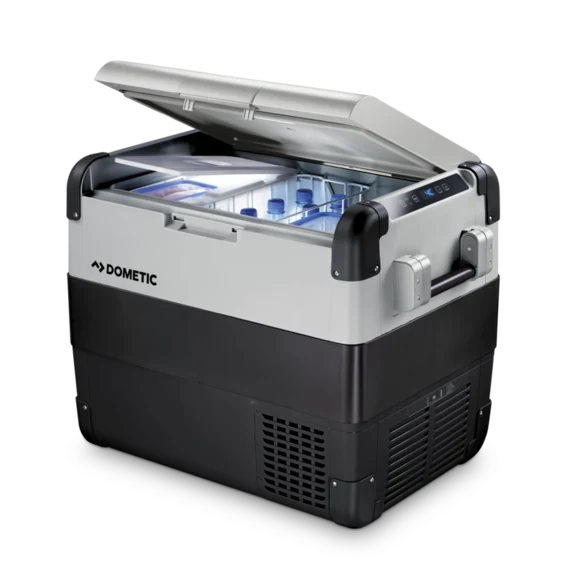 Dometic CFX 65DZ Dual-Zone Fridge/Freezer
Check CFX 65DZ on Amazon →
Dometic CFX 65DZ Dual-Zone Fridge/Freezer
Check CFX 65DZ on Amazon →What I’d Consider If Buying Today#
After years with the chest-style CFX65DZ, I’d seriously evaluate an upright fridge for a future build. Not for efficiency reasons (chest fridges have the efficiency advantage on paper), but for daily usability. Reaching into a chest fridge every single day for years gets old. An upright with pull-out drawers or door organization is easier to use on a daily basis, and that quality-of-life factor is real and cumulative.
The efficiency difference between a well-made upright and a chest fridge in the same size class is modest enough that I’d consider accepting it for the ergonomic improvement. Estimate