
We bought the Goal Zero Yeti 1400 in 2018.
At the time it wasn’t really a choice. It was the only serious option. If you were living in a van and wanted a portable power station that wasn’t a sketchy brand you’d never heard of, Goal Zero was the answer. Every forum said so. Every van lifer you followed had one. The reviews backed it up. So we bought it, put it in the van, and that was that.
It served us well for seven years. I want to be clear about that before I say anything critical: we lived full-time out of that unit for seven years across all 48 continental states. That’s not nothing.
But gear ages. And this category moved faster than almost any other in van life over that time. What was the obvious choice in 2018 became the outdated one by 2025.
Here’s how we knew it was finally time.
The night the power died on the Million Dollar Highway#
We were camped just off the Million Dollar Highway in Colorado, one of the more remote stretches we’d done in a while, surrounded by mountains, no hookups, no backup plan.
It was evening and we tried to cook. The Yeti was already showing some age. It had started struggling when we pulled higher wattage loads, which is something that creeps up on you slowly. You compensate without realizing it. You stop running the high-watt stuff. You time things differently. You work around it.
That night it shut off mid-cook and dropped to zero.
This was not the percentage-reset bug that stranded us in the mountains another time. The display was being honest here. The battery simply could not deliver that much current anymore. Two different failures on two different nights, and by the end we had lived through both.
We had no power until morning. And in the morning, with 300 watts of solar and late-season Colorado sun that barely clears the peaks, recovery was slow. We’re talking days of rationing: running as little as possible, watching the percentage creep up, trying to get back to 80% so we had a real buffer again before we needed it.
If you work remotely, you know how that feels. Every watt you spend is a decision. Every device you run feels like a risk. It’s a particular kind of stress that doesn’t let you relax, not because you’re out of power right now, but because you’re constantly one bad decision away from it.
That was the moment we started seriously thinking about what came next.
Why we stayed on the Yeti 1400 as long as we did#
Honestly? Inertia. And the fact that most days it was fine.
Van life with solar teaches you to adapt. When the weather is good and your loads are modest, 1,400Wh is enough to live comfortably. We had worked out a routine. We knew the unit’s limits. We managed around them.
The things we tolerated that we shouldn’t have:
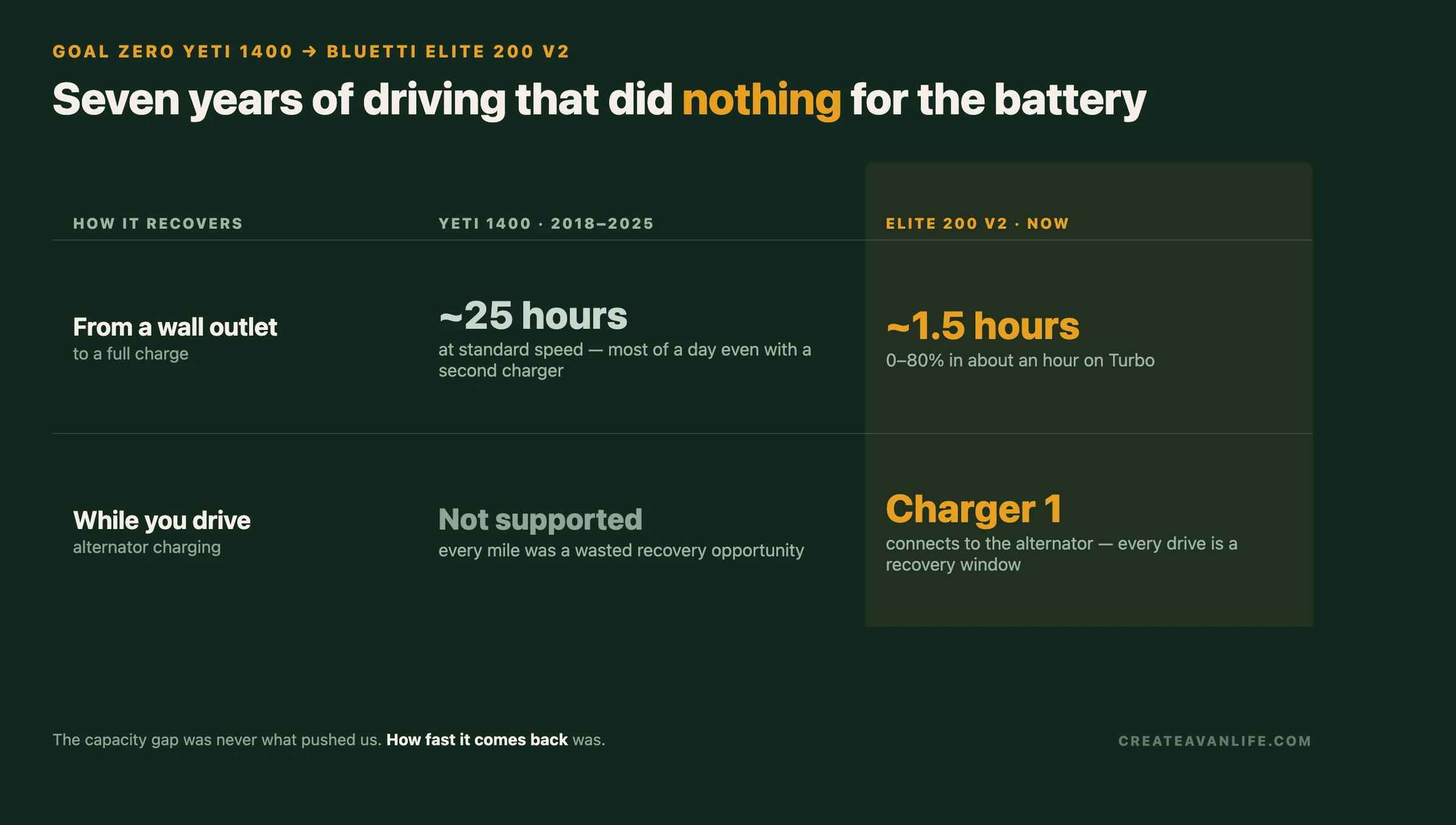
No alternator charging. The Yeti 1400 doesn’t support charging from your vehicle while you drive. That seems like a minor thing until you’re in a stretch of bad weather with limited solar and you realize every mile you drive is a wasted recovery opportunity. For years we just accepted that driving didn’t help us. It wasn’t until we switched that we understood how much we were leaving on the table.
25-hour wall charge time. At standard speed, the Yeti 1400 takes about 25 hours to fully charge from a wall outlet. You could cut that down with an additional wall charger bought separately, but even then you’re looking at most of a day. When we finally needed to bring it inside a coffee shop or hotel to recover, it wasn’t a quick stop, it was an event.
The high-watt ceiling. As the unit aged, higher wattage appliances became increasingly unreliable. Cooking was the main casualty. High-output loads started tripping it, and we didn’t even buy an air fryer until we had the Bluetti.
300 watts of solar not being enough. This one isn’t the Yeti’s fault, and it turns out it isn’t fixable either. In 2018 three panels was what the roof held around two vent fans, and that hasn’t changed: eight years of panel technology bought barely a point of module efficiency, so the same rectangle still holds the same watts. Spec What we’d do differently from day one isn’t a bigger array, it’s planning for recovery speed instead of harvest.
Why we chose the Bluetti Elite 200 V2#
When we finally decided to upgrade, the market was completely different from 2018. EcoFlow, Bluetti, Anker: real options with real specs and real track records.
We looked seriously at the AC200L as well (since discontinued; Bluetti’s current modular flagship is the Apex 300). It has expandable capacity: you can add battery packs up to around 8,000Wh, which was useful if you thought you’d want to scale up over time. It also had a slightly higher AC input spec.
We went with the Elite 200 V2 for a few reasons:
Weight. It’s about nine pounds lighter than the AC200L. When you’re lifting a 50+ pound unit in and out of a van, that matters more than it sounds.
Charging speed. The Elite 200 V2 charges 0-80% in about an hour from the wall on Turbo mode. Full charge in around 1.5 hours. Coming from 25 hours, this felt like a different universe. One stop at a campground hookup and you’re recovered. One morning at a coffee shop and you’re back to full.
The Charger 1 compatibility. This was a deciding factor: the Charger 1 connects the Bluetti to your vehicle’s alternator so you charge while you drive. After seven years of driving miles that did nothing for our battery, this was a feature we specifically wanted. Now every drive is a recovery window.
The size. Bluetti marketed this as fitting 2,000Wh capacity in a form factor closer to a 1,000Wh unit. That’s not marketing fluff; it’s compact for what it holds.
We chose not to go with the AC200L mostly because we didn’t think we’d expand, and the Elite 200 V2’s speed advantage was real. If you think you might want to add capacity later, see the current expandable picks. The AC200L has been discontinued since we made this call.
What life since the switch has been like#
The difference you notice immediately isn’t the capacity, it’s the recovery speed.
With the Yeti, a bad week stayed with you. Cloudy days compounded. You’d hit Thursday sitting at 40% wondering how you were going to make it through the weekend. Recovery was slow enough that falling behind felt permanent.
With the Elite 200 V2, one good outlet window erases it. You plug in at a campground, get two hours on a 30-amp hookup, and you’re back to full. Bad week effectively over.
That changes how you live. The low-level power anxiety that had become background noise just… goes away. You stop making small decisions based on battery percentage. You run the air fryer when you want to cook with it. You work the hours you need to work.
One thing to know before you buy#
Do the battery calibration reset before you start using it heavily.
We didn’t. The first time we cooked at around 50% charge, the unit shut down on us. Same feeling as the Yeti on the Million Dollar Highway, different cause.
The fix, in the order worth trying it: charge it from 0% to 100% in one uninterrupted go with nothing drawing from it while it charges. The no-output part is the whole trick, and it is what Bluetti actually asks for. If the percentage still drifts after that, do the full round trip: run it down to 0% under normal load, then charge straight back to 100% with no output again. Giving the BMS both ends of the range is what makes it stick, and it’s what finally worked for us. The battery calibration post covers exactly how to do this, including the two details we got wrong for years. It’s a 10-minute read that could save you a frustrating night.
One quirk that still bugs me#
The Charger 1 shuts off at night when solar stops producing and there’s no input coming in. That makes sense from a safety standpoint. But when it shuts off, it also stops waking the Bluetti in the morning when solar comes back online.
So if you forget to manually turn the Charger 1 back on in the morning, you lose your whole solar charging window for the day.
It’s not a dealbreaker. You just build it into your morning routine. Turn on the Charger 1 first thing. But I wish it was automatic. Worth knowing before you set up your system and wonder why your battery isn’t recovering during the day.
The short version#
The Goal Zero Yeti 1400 was the right call in 2018. It ran reliably for seven years and we got our money’s worth from it. If you find one used and your budget is tight, it’s still a functional unit for modest loads and solar-only setups.
But if you’re building a van life power system today, the category has moved on significantly. Charging speed, alternator integration, capacity-to-weight ratio, all of it is better now, and the prices have come down substantially from what we paid in 2018.
The Bluetti Elite 200 V2 is what we’d buy again. If expandability matters to you, see the current expandable picks. The AC200L we considered has since been discontinued. If you want the fastest recovery and the most compact form factor in this capacity tier, the Elite 200 V2 is the pick.
Either way, don’t skip the calibration reset.
Eight years full-time van life. These are our actual units. Claim labels: this post mixes Measured (our direct experience), Reported (third-party specs cited where noted), and Estimate (planning math). How we label claims →