
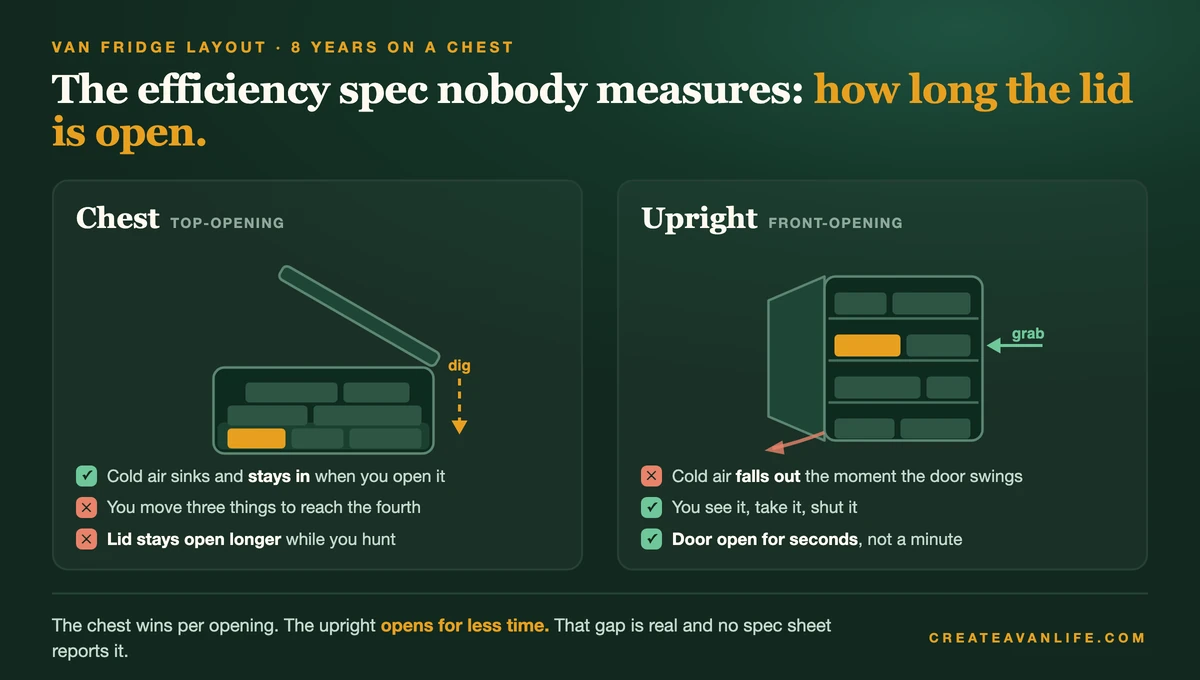
Jesse picked the chest fridge when we built the van. The spec-sheet case was on his side and it still is: cold air sinks, so a chest holds its cold when you open the lid, the compressor cycles less, and the average draw comes out lower.
I’m the one who opens it. Eight years of that, and if we were buying today I’d get an upright without thinking about it.
The Short Answer#
A chest fridge holds its cold better and draws a little less power. An upright lets you see and reach everything without unloading it first. If your power system is tight, take the chest. If you live in the van and open the fridge all day, the upright is worth the watts.
We have run the chest for eight years. I would switch.
| Chest | Upright | |
|---|---|---|
| Cold held per opening | Better, cold air sinks and stays | Worse, cold air spills out |
| Power draw | Lower. Published edge maybe 15–25% in temperate conditions Estimate | Higher, and the gap narrows in cool weather |
| Finding one thing | Unload whatever is on top | See it, take it |
| Taking inventory | You have to dig | One look |
| Bending | Every single time | None |
| Price at the same capacity | Often a little cheaper | Often a little more |
| Suits | Tight power budgets, trip use | Daily living, full time |
What’s Annoying About It#
Two things, and the second one is worse than the first.
The bending. Ours lives on the floor just inside the sliding door, so this isn’t folding over a box at counter height. It’s going down to the floor and reaching in, every time, instead of opening a door at chest height.
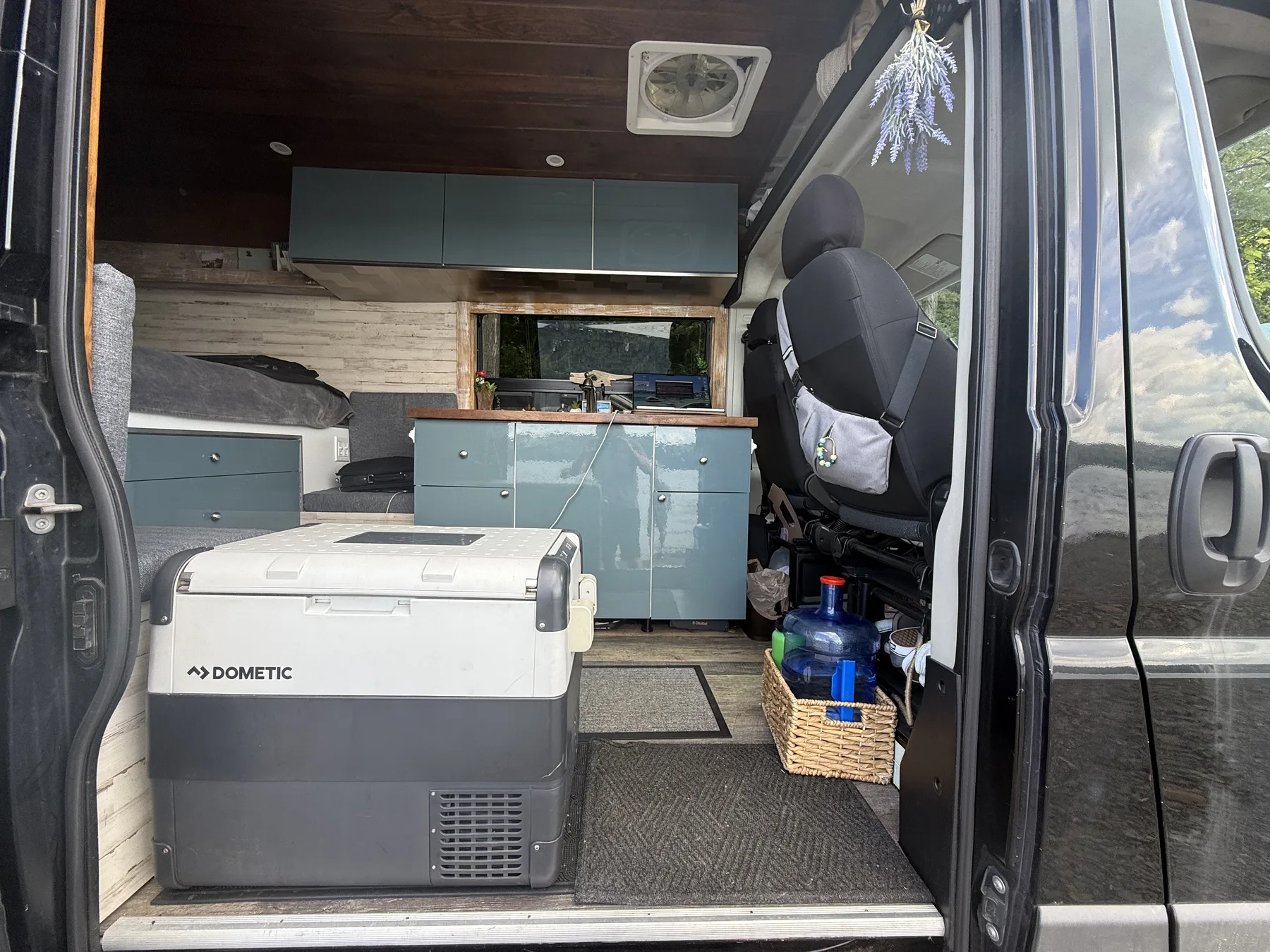
And then you have to take everything out to get what you want, if what you want isn’t on top. That’s the real one. The bread is on top. The cheese is under a head of lettuce and a container of leftovers. So the lettuce comes out and sits on the counter, the leftovers get shifted, you find the cheese, and everything goes back in.
None of it is hard. It’s just slow, and after eight years I’m tired of it.
The Thing People Assume, That Isn’t Our Problem#
Almost every chest-fridge complaint you’ll read online includes clearing junk off the lid before you can open it. We don’t keep anything on top of ours, so that has never been part of it for us.
I’m saying that because it’s the fixable version of the problem, and it’s the one that gets all the attention. Keeping the lid clear is a habit you can build in a week. Digging to the bottom of the box is not a habit problem. It’s the shape of the fridge, and no amount of discipline gets you out of it.
We’re In It All Day#
This is the part I don’t think you can feel until you live in one.
We’re in and out of the fridge multiple times a day. It isn’t a cooler that gets opened at lunch and at dinner. It’s our house and our kitchen. Every snack, every coffee, every time one of us starts cooking and then needs the one thing that’s underneath everything else.
A cost you pay a few times a week is a footnote. A cost you pay eight or ten times a day, every day, for eight years, is the fridge.
What I’d Buy Today, and Why#
An upright. I want to be able to see what I have without digging.
That’s the whole reason, and I think it’s a better reason than it sounds like. Half of the digging isn’t even retrieval, it’s inventory. You’re not looking for the cheese, you’re working out whether you still have any. In an upright you open the door and the answer is right there in a second and a half.
I should be straight about what I’m comparing, though. I have never run a 12V upright in the van. What I have is eight years of this chest, set against a lifetime of ordinary upright fridges in kitchens, and that is where the open-the-door-and-see-it instinct comes from.
A 12V upright in a van is not the same appliance as the one in a house, and someone who has lived with one full time could probably tell me things I don’t know. So take this as a strong preference from the person who does the opening, not as a head to head test.
Being Fair To The Chest#
I want to be careful here, because a post that only complains is just a sales pitch.
The chest fridge does its job. It has done it for eight years, running full time down a lot of rough road, and the only thing it’s ever needed was a $15 thermostat about three years ago. That’s a good record and this isn’t a story about a fridge that let us down. I just don’t prefer it anymore.
There’s also one thing a chest does that an upright this size mostly can’t, and I should say it even though it hasn’t turned out to matter much for us. Ours is the dual zone, so a section of it becomes a freezer when the spacer goes in.
We hardly ever put it in. We shop often enough that there isn’t much frozen food in our life, and the spacer goes back in when one of us wants ice cream. That’s about the whole of it. Most of the time we’d rather have the space as refrigerator.
So the capability is real, and I’d still be careful about paying extra for it before you know whether you’ll use it.
I also can’t tell you it’s costing us anything real in power, because it isn’t. Those are Jesse’s numbers, not mine:
- Florida summer: 20–25Wh per hour
Measured - Mild conditions: 10–12Wh per hour
Measured - Cold weather: minimal
His argument is that the published edge for a chest over a comparable upright is modest to begin with, maybe 15–25% in temperate conditions Estimate, and that it shrinks in the cold when neither compressor runs much. He also thinks some of what’s left gets given back every time the lid sits open while I stand there excavating, because the chest’s advantage gets measured per opening and nobody measures how long the opening lasts. He won’t put a number on that one, and he’s right not to.
Against a system in the 1,000–2,000Wh range, whatever is left of the difference is real and manageable. It’s just not the number that should decide your build.
When The Chest Is Still The Right Call#
Jesse would still buy one in one situation, and I agree with him on it: if your power system is marginal, take the chest and do the digging. When every watt-hour is fought for, that’s a fair trade.
A few others worth weighing:
- You’re in cool climates most of the year. The compressor barely runs, the efficiency gap narrows, and you’re paying the daily tax for less and less.
- Budget. At the same capacity, chest units often come in a little cheaper.
- You already run a strict bin system. Some people do keep a chest organized in labeled containers. I’m not one of them.
What About a Drawer Fridge#
Most comparisons put three options side by side, not two. The third is a drawer fridge, which slides out on rails so you look down into it the way you would a chest, without folding over the box.
We have never owned one, so I can’t tell you how one holds up over years, and I’m not going to pretend otherwise. Going purely on the shape of the thing, it looks like it solves the bending and leaves the digging, because you are still stacking food on top of other food and still seeing only the top layer. If you have run one full time I’d like to hear whether that’s right.
If You’re Not Living In It#
Everything above is about a fridge you open eight or ten times a day. That isn’t everyone.
If you’re out for weekends, or the van is a trip vehicle rather than a house, most of my complaint evaporates. A cost you pay a few times on a Saturday is a footnote. Take the efficiency, take the lower price, and don’t think about it again.
The daily tax only becomes the deciding factor when the days stack up.
After Eight Years#
The chest didn’t fail us. It just charges a small tax every single day, and it charges it in exchange for an efficiency edge that gets smaller the closer you look at it.
If you’re building right now, don’t only ask which fridge draws less. Ask which one you want to open ten times a day for the next eight years.