
The 30-second version
Is this your first roof fan?
Yes, my firstTap for our answer
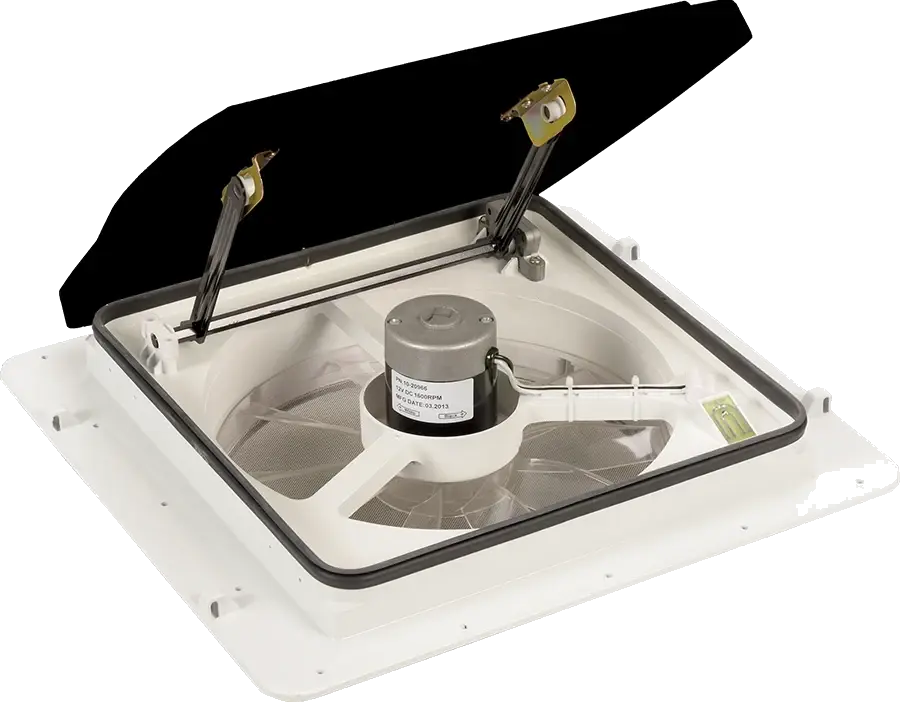
Buy this one. For most vans it is the right first fan: it moves the most air, and moving air is the whole job. In our van the 7500 feels like about half. Mostly rainy or cool, like Oregon or Washington? Start with the 7500 instead: it runs wide open in the rain.
Order the 00-04500K, not the 00-04000K. One digit apart, and the 04000K is manual with no remote.
Check Amazon PriceI have one alreadyTap for your second
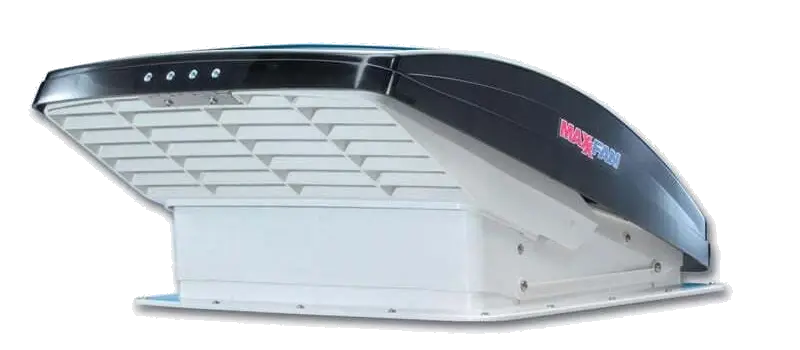
Have a 4500? Make the second a 7500. Its dome keeps it running in the rain. Have a 7500? Add this 4500 for the airflow. Either way you end up where we are: the 4500 in back, the 7500 up front.
Get the 7500 Get the 4500Read the full review
The MaxxAir 4500K is usually framed as “the cheaper option”: what you buy when the 7500 is out of budget. There’s been one in the roof of our 2017 ProMaster for eight years (two units, actually; the durability story is below), and the framing is wrong.
The 4500 isn’t a worse 7500. It’s a different fan with a different rain strategy, and on the thing a roof fan is for in hot weather, it wins. If your summers are hot and you are buying one fan, buy this one. Rain is a handful of hours a month. Heat is every night of the summer. If you mostly park somewhere rainy or cool, like Oregon or Washington, that math flips, and the 7500 is the better first fan.
MaxxAir 4500
Check Current MaxxAir 4500 PricingQuick Verdict
Skip if: you mostly park somewhere rainy or cool, or you want a second fan that keeps working when the lid has to close. Running through rain is the one job the 4500 can’t do.
Is the 4500K the right fan for your build?#
Tap the situation that sounds like you.
💵 First build, one fan to start. 4500 is right
If you're building your first van, one fan is the budget, and your summers get hot, the 4500K is the smarter starting point. Same 900 CFM rating as the 7500. The rain sensor auto-closes the lid when it detects water, so you're not exposed to leaks. You just can't run the fan during active rain, and for most travel that's a non-issue. Don't pick it for the savings, though: the two fans list within about ten dollars of each other and street prices overlap. Pick it because it moves more air.
🌬️ Two-fan setup, already running a 7500 elsewhere. Strong fit
This is our setup. 4500K in the back over the bed, 7500K up front. The 4500 is the primary "pull" fan when conditions are dry. It pulls more air than the 7500 because there's no permanent dome restricting flow. The 7500 takes over when rain rolls in. Two fans + cross-flow windows beats one fan in any climate.
🌴 Hot, dry climates: desert and inland summers. 4500 pulls more
In the desert and through most inland summers, what you need is air movement, not rain protection. The 4500's lack of a permanent dome means more CFM in real conditions when the lid is open, exactly when you want it. The rain sensor closes the lid if a storm comes through. You give up nothing for dry-climate travel.
🌧️ Pacific Northwest, coastal, mountain: rain is the daily reality. 7500 instead
Honest answer: the 7500. If rain is the daily reality and the summers stay mild, you don't need every last bit of airflow, and a fan that has to close every time it rains is closed when you need it. The 7500 stays wide open through a downpour. The cost is airflow: in our van the 7500 feels like it moves about half what the 4500 does. In a cool climate that's a fair trade.
If your summers are hot as well as wet, it flips back: buy the 4500 first for airflow and add the 7500 for rainy nights. See the 7500K review for the other side.
What 8 years with this fan actually taught me#
Rain sensor vs rain dome: the design choice that defines the fan +
The 4500K and the 7500K take opposite approaches to rain. The 7500 has a permanent dome cover that lets the fan run continuously, even during a downpour. The 4500 has a rain sensor that auto-closes the lid the moment it detects water, protecting the van but stopping the airflow.
Tradeoff in plain English: the 7500 keeps the air moving in any weather but restricts airflow even when it's dry. The 4500 pulls more air when the weather cooperates but goes silent when it doesn't. Neither is wrong. They're different bets about what climate you're sleeping in.
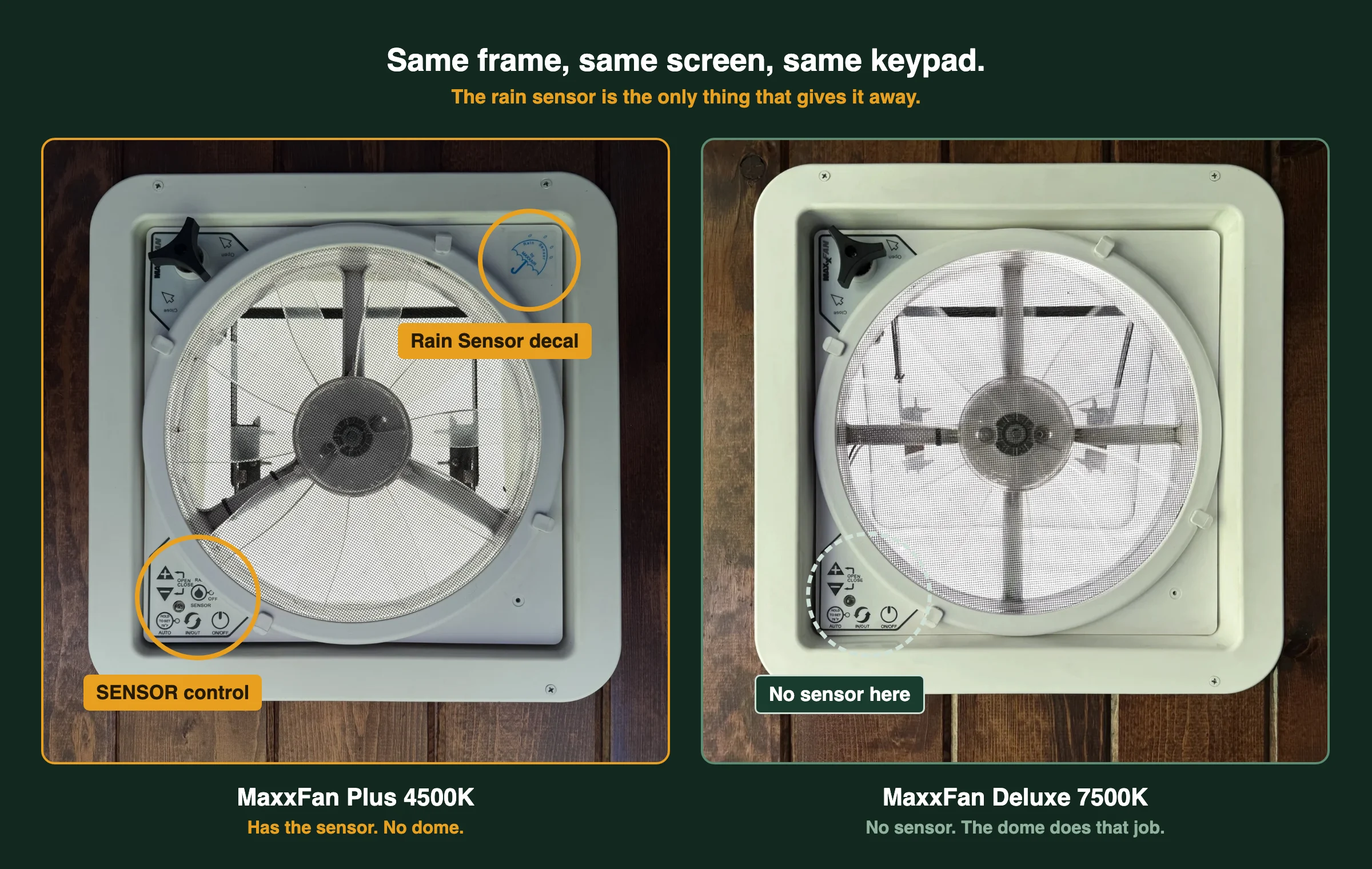
It's also the only way to tell them apart once they're in the roof. With the lids shut, a 4500 and a 7500 look almost the same from inside: same frame, same screen, same keypad, same manual crank. Only the 4500 carries the SENSOR control and the Rain Sensor decal, because only the 4500 needs to detect water and close itself. Spec The 7500 has neither. Spec So the fan with the extra button is the entry model, which catches people out. Useful if you're buying used or you inherited a build and don't know what's up there.
Why we run both, front and back of a ProMaster +
Both fans have been in this van since the build, along with T-vent windows on the driver's-side wall and the sliding door. I've never lived with a single fan in it, so I can't tell you what that feels like. What I can tell you is why the layout is the way it is: the 4500 sits in the back over the bed and the 7500 up front, so air moves the length of the van rather than swirling around one hole in the roof. One end pulls fresh air in, the other pushes hot air out.
Florida is what the pair is for. The fridge runs hot, the cabin holds the day's heat well past midnight, and a single fan in the middle of a sealed van mostly recirculates. Two fans plus T-vent windows on both sides is the combination that makes those nights tolerable.
If you're buying one fan to start and your summers get hot, make it the 4500, and make it for airflow rather than price. The two fans list within about ten dollars of each other and street prices for both swing by more than a hundred, so "the cheap one" is not a reliable description of either. In the heat, air movement is the entire job of a single fan, and the 4500 does more of it. Somewhere rainy or cool, the 7500 is the better first buy, because it keeps running when it rains.
Durability, honestly: we're on our second one +
Same story as our 7500: around year six we replaced both fans with the same models, and this spring both keypads needed swapping. I put that down to the winters we spend parked near the ocean in San Diego. The mechanism is condensation: we pull damp air through the van all night and it collects on and inside the fan, right where the keypad electronics sit. It bites because that damp is salt air, so what condenses is corrosive rather than just wet. Running it hard makes it worse. Reported Six years of daily full-time duty is a real service life for a roof fan, and when the original wore out I bought the identical fan again. That re-buy is the honest endorsement.
Cross-flow windows are not optional +
Any roof fan (4500, 7500, doesn't matter) can only move air it can pull from somewhere. If your van is sealed up and the fan is the only opening, you'll create negative pressure and very little actual circulation. We run T-vent windows on the driver's-side wall and the sliding door of our ProMaster, and both sides rather than one was the call that mattered. The fan does its job. The windows let air enter as fast as the fan pulls it out.
Don't buy a fan and skip the windows. Either upgrade the windows you have to crank-open style, or budget for at least one cross-flow opening. Otherwise the fan you bought is moving way less air than its rating suggests.
And skipping the intake eventually costs you the fan, not just the airflow. Running one of these against a sealed van is what starts the motor squeaking, which most reviews write off as inevitable wear. It isn't. The fix once it starts is pulling the motor and cleaning it, which is fiddly work that mostly succeeds. The fix so it never starts is free: keep a window, a vent or a cracked door open whenever the fan runs. The long-term review has the whole story.
Isolation tape under every fixture mount +
Eight years on rough roads and neither fan has ever developed a mounting squeak, which I credit entirely to how they went in rather than to luck. Two layers: butyl tape underneath, which is both the primary water seal and the cushion that stops metal riding directly on metal, and Dicor self-leveling lap sealant on top, which flows flat on a horizontal roof and covers the flange edge and the screw heads. Reported
The failure mode this prevents is well documented by everyone who skipped it: direct metal-to-metal, wood-to-metal or plastic-to-metal contact works itself loose on washboard and starts talking. It is a miserable noise to chase, because the source is a roof fixture and you will look everywhere else first. A few dollars of butyl at install is the cheapest insurance in the build, and it applies to any fixture you bolt to the van, not just this fan.
Specs (for reference)#
The two fans are far more alike than the price framing suggests. Same rated airflow, same speed count, same hole in your roof, and list prices about ten dollars apart. Spec One difference does the work.
| Spec | MaxxAir MaxxFan Plus 00-04500K | MaxxFan Deluxe 00-07500K |
|---|---|---|
| Rated airflow | 900+ CFM | 900+ CFM |
| Speeds | 10, reversible in and out | 10, reversible in and out |
| Rain strategy | Sensor closes the lid, fan stops | Permanent dome, fan keeps running |
| Rain sensor on the keypad | Yes | No |
| Roof opening | 14″ × 14″ | 14″ × 14″ |
| Thermostat | Yes | Yes |
| Remote | Included | Included |
| Runs with the lid shut | Yes, recirculates | Yes, recirculates |
| Warranty | 2 years, lifetime on the lid | 2 years, lifetime on the lid |
| List price | $467.09 | $476.00 |
| Draw at speed 10 | 32W Measured | 32W Measured |
The price argument for the 4500 is weaker than the internet thinks. Retail prices for both fans move constantly and they overlap. On the wrong week the “budget” fan is the expensive one. Buy the 4500 first because it moves more air, which is the durable reason, and check both prices anyway.
Same rated max as the 7500, and both draw the same 32W at speed 10 on our BLUETTI's DC readout. Measured In real use the 4500 pulls more air when its lid is open, because there's no permanent dome restricting the path. Same rating, same watts, different geometry: the dome costs airflow, not power.
A rain sensor closes the lid the moment water is detected. The fan can't run during active rain, but the van stays dry. Different bet from the 7500's run-in-rain dome.
Ceiling controls plus a remote, same as the 7500, and a powered lift that opens and closes the dome without hand cranking. Ten speeds, reversible in or out. Adjusting from bed at 3am works on this fan too.
Buy the 00-04500K, not the 00-04000K. One digit apart in a listing, and the 04000K is the manual-lift version with no remote. That is a bad surprise to unwrap after you have already cut the hole.
Frequently asked#
4500 or 7500: which should I buy first? +
One fan: for most vans, the 4500K. It feels like close to double what the 7500 moves, and in the heat that is the whole reason you bought a fan. In rain you keep the lid closed and open it again after. The exception is somewhere rainy or cool, like Oregon or Washington: the 7500K, because it never has to close and you don't need maximum airflow.
Does the rain sensor really work? +
Yes. Eight years and two units in, no leaks from a 4500. The sensor closes the lid quickly enough that surprise rainstorms haven't been a problem. The downside is exactly what you'd expect: the fan stops running the moment rain hits, so wet-climate full-timers end up wishing they had the 7500's permanent dome.
Is install harder than the 7500? +
Same install job: same 14"x14" hole, same sealing requirements, same isolation-tape lesson. If you've installed a 7500 you can install a 4500 the same afternoon. Plan a full day, work in dry weather, don't rush the sealant.
How much power does it draw overnight? +
32W on speed 10. Measured We read that off our BLUETTI's DC output, because MaxxAir publishes no amp draw at all. It comes in well under the 44 to 53W the third-party per-speed tables in circulation claim, so if you have sized a battery off one of those, you have budgeted about 40% too much for the fan. Speed 1 is roughly 0.2A, call it 2 to 3W. Spec
Eight hours wide open is about 256Wh. That is real against a 1kWh station, though still less than the fridge costs on a hot day. Most overnight running lands mid-range, nearer 15W, which is the figure our power calculator budgets. The fan is rarely the biggest load, but it is not free either.
The fan to buy first, and the one that earned its slot in a two-fan build
900 CFM rated, less restrictive design, 8 years of validation
MaxxAir 4500
Shop MaxxAir 4500 →
Compare with the 7500K