
Solar is the most talked-about power source in van life and the most misunderstood. The conversation usually focuses on “how many panels” and “how many watts” when the more important framing is this: solar is one charging method, not the charging solution.
Understanding where solar fits, and where it does not, saves you from both under-building and over-investing.
Solar Is One Charging Method#
Most van lifers have three ways to recharge their battery:
- Shore power (plugging into a campground or building outlet)
- Alternator charging (the engine charges your battery while you drive)
- Solar (panels on the roof collect energy from sunlight)
In terms of reliability, shore power is the most consistent: you get exactly what the outlet delivers regardless of weather or daylight. Alternator charging is consistent whenever you drive; a good DC-DC charger delivering 30–50A while driving gives you meaningful recharge for every hour on the road. Solar is conditional: it works well in direct sun, poorly in clouds, and not at all at night.
This hierarchy matters. If you drive most days, alternator charging may be your most reliable energy source. Solar fills the gaps on parked days in good sun. The two together, with shore power as the backstop, cover most real-world van life situations.
The mistake beginners make: designing around solar as if it were the primary or only charging source, then being surprised by power shortfalls in overcast weather or winter.
What Solar Delivers in Practice#
Panel ratings are measured under Standard Test Conditions (STC): 77°F, with 1,000 W/m² of direct sunlight, at a specific angle. Real-world output is lower than nameplate rating in almost every situation.
Realistic harvest estimates by climate and season: Estimate
| Condition | Actual harvest from 200W of panels |
|---|---|
| Desert southwest, summer | 700–900 Wh/day |
| Southeast, summer | 550–750 Wh/day |
| Midwest, summer | 500–700 Wh/day |
| Pacific Northwest, summer | 400–600 Wh/day |
| Most of US, winter | 200–400 Wh/day |
| Overcast day, any region | 50–150 Wh/day |
These ranges account for panel temperature effects (hot panels produce less power), real-world angles, charge controller losses, and wire losses. They are estimates, not guarantees; your actual harvest depends on your specific setup and location.
The overcast day number matters. In an extended cloudy stretch, your solar input drops to a fraction of normal. This is why battery sizing and backup charging sources are as important as panel sizing.
Sizing Your System: The Correct Sequence#
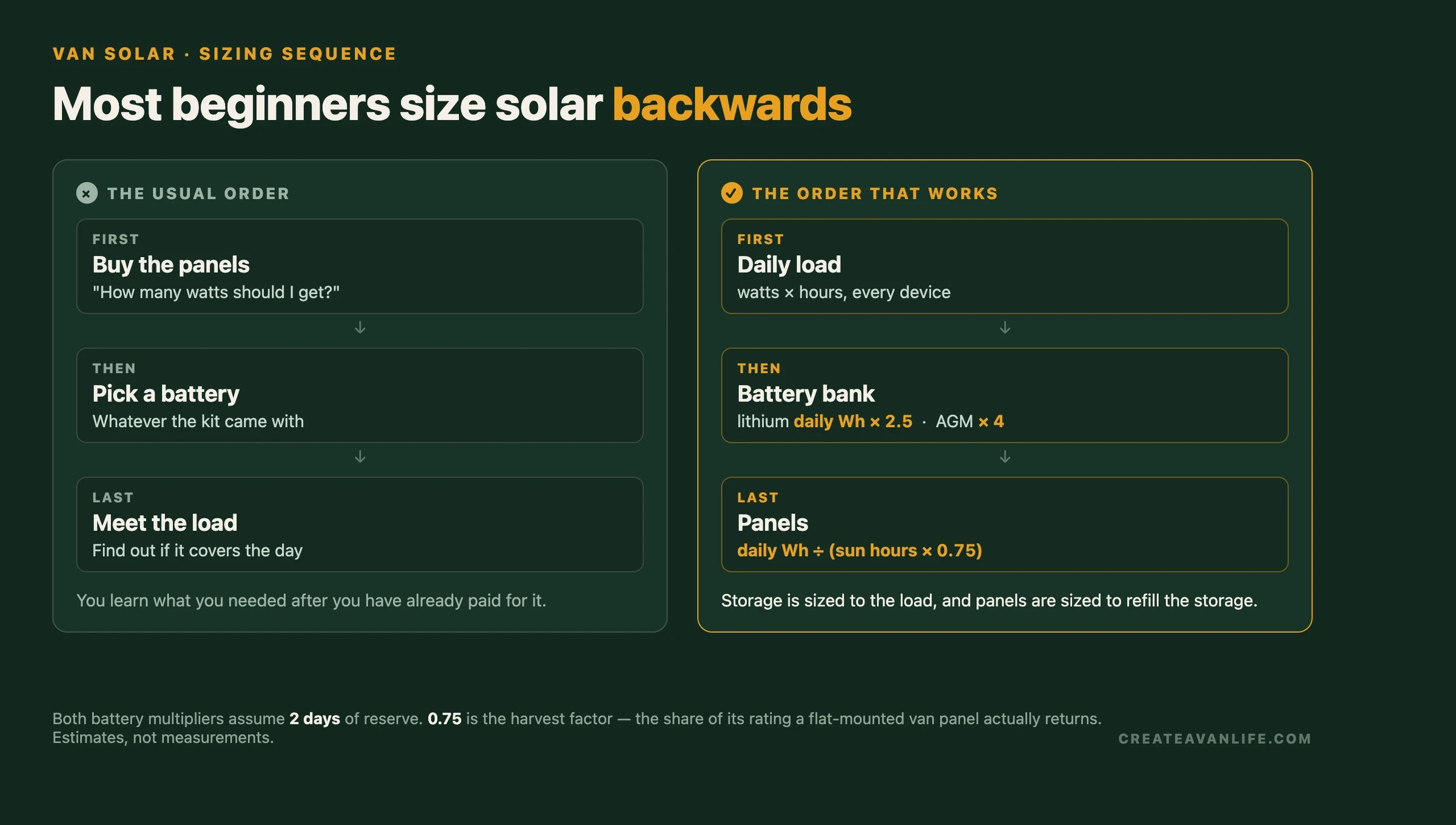
Most beginners size panels first and work backward. The correct sequence is the opposite:
1. Calculate your daily load in watt-hours. List every device, its wattage, and how many hours per day you run it. Multiply watt × hours for each device, then total them.
2. Size your battery bank to cover your daily load plus reserve days. Multiply your daily load by the days of coverage you want, then divide by the depth you can actually use. Two days on lithium (80% usable depth) works out to daily Wh × 2.5; on AGM (50% usable) it is daily Wh × 4. Estimate Two days is a common starting point for mixed climates.
3. Size your panels to fill that bank in your expected daily sun hours. The formula: daily load ÷ (peak sun hours × 0.75) = minimum panel wattage. Estimate That 0.75 is the harvest factor, the share of its rating a flat-mounted van panel actually returns.
Working through this in order prevents the common mistake of buying panels before knowing how much storage you need to pair with them.
For a full walkthrough with actual numbers, see How Much Solar Do You Need in a Van?.
Panel Types: Rigid, Flexible, Portable#
Each type has tradeoffs. Here is how they compare:
Rigid panels (monocrystalline or polycrystalline): The standard choice for permanent roof installs. Most reliable over time: rigid panels are rated for 25 years in many cases and hold their efficiency better in high heat than flexible alternatives. Require a roof rack or flush-mount brackets. Adding panels later is straightforward (just add more to the string or expand the circuit). Best efficiency per dollar. The downside: roof drilling is required for most permanent mounts.
Flexible panels:
Marketed as lightweight and roof-friendly (no mounting hardware, adhesive-bonded directly to the roof). They work, but with tradeoffs. Flexible panels run hotter than rigid panels because they do not have an air gap, and high heat reduces efficiency. Many flexible panels degrade faster than rigid equivalents. Reported They are a reasonable choice for lower-profile stealth roofs or if roof drilling isn’t possible, but expect lower real-world performance over time compared to rigid panels in the same wattage rating.
Portable suitcase solar: Foldable panels on a kickstand, connected to the station with a cable. No roof install required. This is the right choice for people who cannot or will not drill a roof (rental vans, van life trial periods, apartment dwellers who want weekend capability). The cost per watt is higher than roof-mounted panels, and the daily hassle of setting them up and storing them gets old quickly for full-time use. For occasional use or as a supplement, they work well.
The Mounting Question: Roof Drilling vs. Portable#
Roof drilling is the most permanent decision in the solar install. Once you bolt a panel mount or a fan to the roof and seal it, reversing it is a cosmetic challenge.
Arguments for drilling the roof:
- Higher daily harvest per panel (better angle optimization)
- No setup/teardown routine
- Better aesthetics for stealth
- Lower long-term cost per watt
Arguments for portable (no drilling):
- Zero installation risk (no potential leak points)
- Portable between vehicles
- Better for rental vans or uncertain-term builds
- Can be repositioned for optimal sun angle throughout the day
There is no universally correct answer. The right choice depends on how long you plan to keep this van, your roof condition, your comfort with making a permanent modification, and how much daily setup friction matters to you.
We are keeping this high-level: no wiring procedures here. For installs, follow manufacturer guidance or work with a qualified installer.
A Good Budget Starting Point#
For a first build with moderate loads (no fridge, light laptop use, fan, lighting; roughly 300–500 Wh/day), a practical starting setup:
- 200W of rigid monocrystalline panels (two 100W or one 200W panel)
- MPPT charge controller sized for future expansion (not just current panels)
- Battery bank sized for your load calculation, not a round number
- Quality wire and fuses sized for your actual current draw
This is not the optimal system. It is a sensible starting system that can be expanded without rebuilding from scratch. The controller choice matters here: buy one rated for more than your current panel wattage so you can add panels later without replacing the controller.
For current product picks, see Best Budget Solar for Van Life.
Mistakes That Cost Beginners the Most#
Wrong controller type: A PWM controller can lose 10–30% of solar harvest compared to an MPPT controller. Reported The gap is widest in cold weather and when your panel’s voltage sits well above the battery’s, and narrowest on a hot day with a 12V panel feeding a 12V battery, so treat the top of that range as the good-conditions case rather than the everyday one. The price difference between a budget PWM and a quality MPPT is $50–100. That pays for itself quickly in recovered energy. Always use MPPT.
Underbuying wire gauge: Wire that is too thin for the current creates resistance (lost energy) and heat (fire risk). Solar runs significant current: 200W at 12V is roughly 17 amps. Use wire sized for the actual current, not for the smallest wire that fits the connector. This is a safety issue, not just efficiency.
Ignoring shade: A single shaded cell can significantly reduce output from the entire panel, depending on the controller and panel configuration. Reported Plan your panel placement to minimize shade from roof vents, fans, and any antenna mounts during peak sun hours.
Oversizing before measuring real use: The most common expensive mistake. Building a 400W solar system before tracking actual daily consumption often results in a system that produces far more than the battery bank can absorb, or reveals that you needed a bigger battery before more panels.
Measure first. Build second.
Frequently Asked Questions
- Is solar power enough for full-time van life?
- In most climates, solar is one charging source rather than the only source. For moderate loads in sunny regions, 200–400W of panels paired with a quality lithium battery handles most days. For heavy loads or cloudy climates, solar works best combined with alternator charging while driving and occasional shore power access.
- Should I get rigid or flexible solar panels for my van?
- Rigid monocrystalline panels are more efficient, more durable over time, and better in high heat than flexible panels. Flexible panels are an option when roof drilling is not possible, but they degrade faster and run hotter. For a permanent install, rigid panels are almost always the better long-term choice.
- Do I need an MPPT or PWM charge controller?
- Always use MPPT. A PWM controller can lose 10–30% of solar harvest compared to MPPT (Reported); the gap is widest in cold weather and when the panel’s voltage sits well above the battery’s, and narrowest on a hot day with a 12V panel on a 12V battery. The price difference between a budget PWM and a quality MPPT is $50–100 and pays back quickly in recovered energy.
- Can I run solar panels on a van without drilling the roof?
- Yes, portable suitcase solar panels require no drilling. They fold up and connect directly to a portable power station via cable. The tradeoffs are higher cost per watt, lower daily convenience (setup/teardown required), and lower efficiency compared to roof-mounted panels that can be optimized for angle and shade avoidance.