
Last reviewed: August 2026
Lighting is one of the cheapest, highest-impact wins in a van build. A well-lit van feels larger, more livable, and more like a real home. An under-lit van feels like a storage unit you happen to sleep in. Better news: it’s one of the cheapest systems in the whole build, and it draws almost nothing.
Karlee and I built our 2017 ProMaster ourselves in 2018 and have lived in it full-time for eight years with my partner Karlee. Lighting is one of the few categories where the “do this once and stop thinking about it” advice works, but only if you set up the right zones from the start.
Below is what I wish someone had told me before I started wiring strips into the ceiling.
Quick Answer
Is this approach right for your build?#
Tap the situation that sounds like you.
🔌 Full build with a 12V house system already running. 12V strip + dimmer
Run a 12V LED strip under the ceiling perimeter or under upper cabinets, paired with a $10–20 PWM dimmer. Estimate One 3000K strip and a dimmer covers ambient. Add a 4000K puck or short strip at the work surface for task light. Two zones, one switch each.
🔋 Power-station build, no 12V wiring planned. USB pucks first
USB-powered puck lights run from any USB outlet: power station, USB car charger, or a small hub. No wiring at all. $15–40 for a set of 4–6. Estimate Works as a starting point. Most builders eventually upgrade to a 12V strip system once they decide on layout, but you can live on USB pucks for years if your van is simple.
🏠 Renter or one-shot conversion, minimum modification. USB or battery only
USB pucks or battery-operated LED fixtures with motion sensors. No 12V wiring required. Works fine for evenings and night use. Limitation is you can't dim USB pucks easily. Pick warmer color temperature (3000K) up front since you can't tune it later.
⚡ Worried lighting will eat my battery. It won't
A typical van lighting setup runs 10–20W total. Estimate Six hours at 10W is 60Wh, 6% of a 1kWh power station. Lighting is a rounding error on your power budget. The fridge is the problem, and on Florida nights, the fans. If you're rationing power, lighting is the last thing to cut.
What 8 years of van lighting taught me#
Isolation tape on every fixture mount +
Any direct metal-to-metal or wood-to-metal contact can squeak on rough roads. Use isolation tape or foam where the fixture meets the surface during install.
A $5 fix at install time becomes an annoying diagnostic problem if you skip it: you'll be pulling fixtures off six months later trying to find which one is rattling.
The dimmer is not optional +
A dimmer turns the same fixture into two different lights: task light during the day, ambient at night. In a van where you live, work, and sleep in the same room, this matters more than it does in a house.
We put a dimmer in from the start, and it's the best $15 in the circuit. Don't skip it to save money. Dimming a 3000K strip to 20–30% in the evening is the difference between "bright workspace" and "cozy living space" without rewiring.
Lay out lights before you cut anything +
The mistake I see most often: lights placed wherever they fit during the wiring stage, not where they'll actually be used.
Sit in your van during the build phase, in the seats and on the bed, and figure out where you'll be reading, cooking, brushing teeth. Mark those spots. Wire to those spots. The "perimeter strip plus a couple of pucks" approach works because it covers ambient and task without you having to plan every scenario.
Two zones, even if you have to fake it +
Ideal: one warm zone for evenings, one cooler zone for work surfaces. Reality in a small van: you might only fit one strip.
The compromise that's worked for us: one warm 3000K strip with a dimmer for ambient, plus a USB or 12V puck near the work surface in 4000K for task. Two switches, two color temps, no rewiring. The dimmer plus the second color temperature is what makes the van feel like a home and not a shop.
Color temperature: go warmer than you think +
When you spend most of your hours in a 70-square-foot space with the same person, color temperature becomes a comfort question, not a spec question. After eight years, I'd go warmer than my younger self would have.
Daylight LEDs in a small space at night feel like a hospital. Go warm (2700K–3000K) for the ambient zone, add a dimmer, and stop worrying about it. Save the cooler 4000K–5000K for the work surface only.
Lighting by zone#
Warm white. Lower color temperature supports wind-down and feels less clinical. This is your dimmer zone: drop to 20–30% in the evening for that "actually a home" feeling.
Slightly cooler than the ambient zone. You want to see what you're cooking. Color accuracy matters when food prep meets dim lighting. A small 4000K puck right above the prep surface does the job.
Daylight-range temperature reduces eye strain during extended screen or close work. If you only have one zone, skip this: 3000K with a dimmer covers most uses. If you have a dedicated work surface, give it its own cooler light.
Options in plain terms#
12V LED strips: the workhorse +
Connects directly to your van's 12V house circuit: two wires, correct polarity, a fuse. Simple electrical work but requires touching the 12V system.
Best for: Full builds. Mounted under cabinets, along the ceiling perimeter, or behind a valance. Creates warm, even ambient lighting that feels residential.
Cost: $15–30 for a quality kit with connectors, plus $10–20 for a PWM dimmer. Estimate Pair with the dimmer always.
Recessed puck lights: the flush ceiling option +
Strips give you an ambient wash. Pucks give you a ceiling that looks finished, and they are what most people picture when they picture a van ceiling. The tradeoff is that they need a hole saw and a plan, because the cutout is permanent.
The reference spec is the Acegoo 12V recessed puck: 2.5W each, 215 lumens, 0.2A on 12V, CRI above 92, in a 2-3/4″ body only 5/8″ deep that drops into a 2-1/4″ hole. Spec Six of them run about $33 to $39.
The number that matters for a van: six pucks on at once is 15W, about 1.2A. Leave all six burning for four hours and you have spent roughly 60Wh, under 3% of a 2kWh station and less than an hour of the fridge in Florida heat. Lighting is almost never what drains a van battery, which is worth knowing before you over-engineer it.
Depth is the spec people miss. At 5/8″ these clear furring strips and thin ceiling battens that a deeper fixture will not, which is the entire reason the slim ones exist. Measure your ceiling build-up before you buy anything thicker.
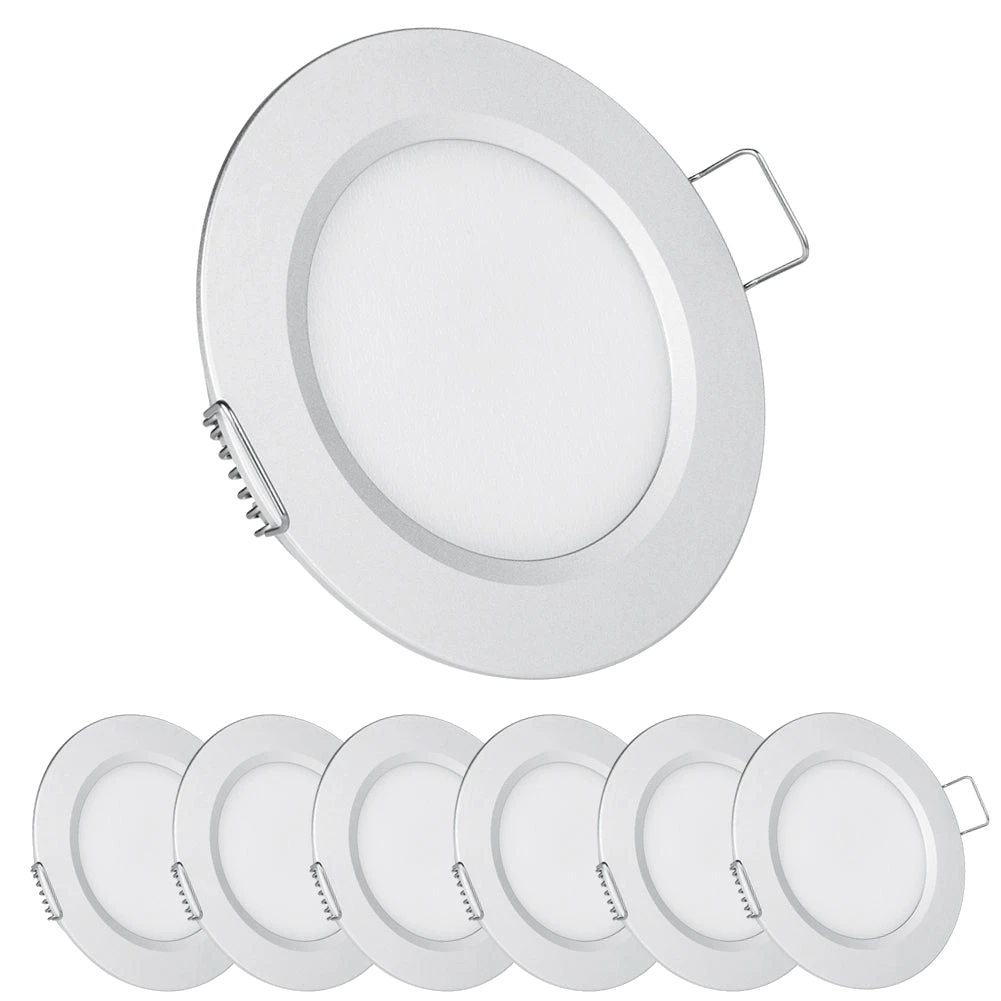 Acegoo 12V Recessed LED Puck Light (6-pack)
Check Puck Light Price
Acegoo 12V Recessed LED Puck Light (6-pack)
Check Puck Light PriceUSB-powered puck lights: zero wiring +
Run from any USB outlet: power station, car charger, USB hub. No 12V wiring at all.
Best for: Early builds where 12V isn't installed yet, renters, or anyone testing placement before committing.
Limitation: Less effective for whole-van ambient because the individual point sources are harder to diffuse. Most builders eventually upgrade to 12V strips for cleaner coverage and easier dimming.
Cost: $15–40 for a set of 4–6 with remote or touch control. Estimate
Overhead LED fixtures +
Single LED flush-mount fixture for broad ceiling coverage with minimal complexity.
12V options: Small RV-grade 12V LED fixtures, $15–40, connect to a 12V house circuit. Clean, even overhead light without visible strip runs. Estimate
Battery-operated: Motion-sensor or touch-activated battery fixtures need no wiring and work surprisingly well in small spaces. Battery cost over time is the main downside.
Best for: Single-source lighting in simple builds, or as an "on/off" main light supplementing strip lighting.
What to skip#
Colored accent lighting +
Fun for the first week. Rarely used after that. Save the money for a dimmer instead.
Smart-home lighting systems +
Not worth the complexity in a van-sized space. A $10 dimmer does everything you need. Phone-app controls and color-tuning systems are solving problems you don't have when the room is 70 square feet.
Shop lights as daily lighting +
A 500-lumen shop lamp creates harsh shadows and overlit spaces that feel uncomfortable for daily living. Bright is not the same as well-lit. Diffused, dimmable, warmer light wins for a space you live in.
Switches placed far from the light +
If your switch is across the van from where you use the light, you'll stop using the light. Put the switch near the bed for ambient lights, near the work surface for task lights. The switch placement matters as much as the fixture choice.
Frequently asked#
How much power does van lighting actually use? +
10–20W total for a typical setup. Estimate Six hours at 10W = 60Wh, or 6% of a 1kWh power station. Lighting doesn't compete with the fridge or fans for power. Don't bother optimizing 1W vs 2W LEDs.
Do I need a separate task light if I have a strip? +
Yes, ideally. A dimmable warm strip is great for ambient, weak for tight task work like food prep or close reading. Add a single 4000K puck right above the work surface. Two zones, two color temperatures, both with their own switches.
12V or USB: what's the actual decision? +
If you have or are planning a 12V house system, go 12V: better dimming, cleaner runs, more fixture choices. If you're on a power-station-only setup with no 12V build, USB pucks are fine and you'll likely keep them for years before upgrading.
What's the simplest complete lighting system? +
One 12V LED strip under the ceiling perimeter or upper cabinets, with a dimmer. Add puck lights or task lighting where you identify gaps after a few weeks of actual use. Complete system for under $60. Estimate Adjust based on real use, not on planning.
Keep it simple, keep it warm
One 3000K strip + dimmer + a 4000K task puck covers it
How Much Power It Draws#
We finally read it off the BLUETTI’s DC output. Six dimmable 12V LEDs pull 13W with everything on full, and under 5W with all six dimmed down, which makes the dimmer the best-value part of the circuit twice over.
Van light power draw: the measured numbers →