
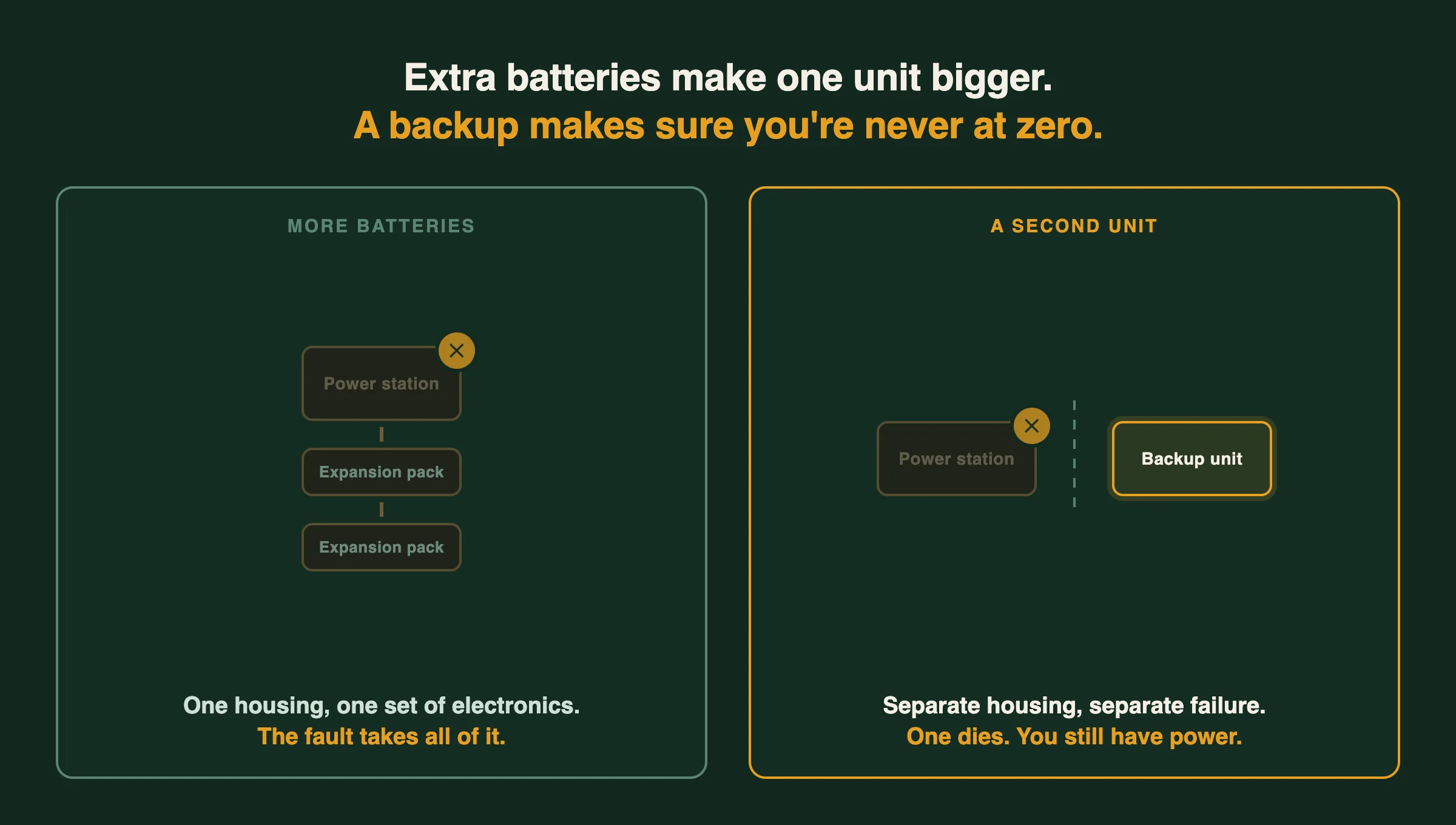
A few months ago our main power station melted while we were driving. You can read the whole story here, but the part that matters for this post is what got us out of it. It wasn’t a bigger battery. It was a second unit.
That trip rewired how I think about backup power, and it’s the opposite of what most people plan for.
More Batteries and a Backup Are Not the Same Thing#
When people plan for “what if my power runs out,” they usually think capacity: add another battery, get the bigger model, stack more watt-hours onto the one station. That solves running low. It does nothing for the failure that actually strands you.
Here’s the distinction. Extra batteries live on one power station. If that station dies, whether it’s a melted port like ours, a firmware lockup, a blown inverter, or water getting somewhere it shouldn’t, every watt-hour bolted to it dies with it. You can’t charge it, you can’t draw from it, and all that capacity is now a heavy box.
A second unit is independent. Different housing, different electronics, its own separate failure. When one goes down, the other doesn’t even notice. That’s the whole point of redundancy: not more of one thing, but a second thing that fails on its own schedule.
What the Backup Bought Us#
When our main unit melted, we were driving from California to Colorado to see family. Our backup was our old Goal Zero Yeti 1400. It’s well past its prime and only sort of works now. It runs the low-watt stuff and we couldn’t cook on it, but it kept the fridge cold and the lights on.
That did more than keep us comfortable. It bought us time, and time was the real prize. We got to take the trip at our own pace instead of white-knuckling it straight to Colorado. And it meant we could run the warranty exchange from a family member’s house, with a real address and no rush, instead of trying to ship and receive a replacement from campgrounds on the road. Doing that swap on the move would have been a real headache. The backup turned an emergency into an errand.
That’s the thing nobody tells you: redundancy isn’t really about power. It’s about flexibility when something goes wrong far from home.
Who Needs a Backup Most#
Not everyone. If you’re a weekend camper an hour from the house, your backup is your driveway. But the further you get from easy support, the more this matters:
- New to van life. You haven’t hit your first failure yet, and you don’t want it to be a crisis. A backup makes your first bad day survivable.
- Full-timers and boondockers. When you’re days from a return counter and living out of the van, a dead main unit is a real problem, not an inconvenience.
- High daily loads. If a fridge full of food depends on your power staying up, a second unit is cheap insurance against losing all of it.
Keep the Old One, or Buy Small#
Here’s my advice, and it’s cheaper than most gear posts.
If your old power station still works well enough, keep it when you upgrade. That’s the free backup. Ours is a beat-up Yeti that can’t cook anymore, and it still saved the trip. Don’t sell or trash a working unit just because you bought something better.
If you’re buying a backup on purpose, especially if you’re just starting out, you don’t need much. A small station in the ~500Wh range with good output is plenty to keep a fridge, lights, and devices alive while you sort out your main. The best pick we’d point you to in that class:
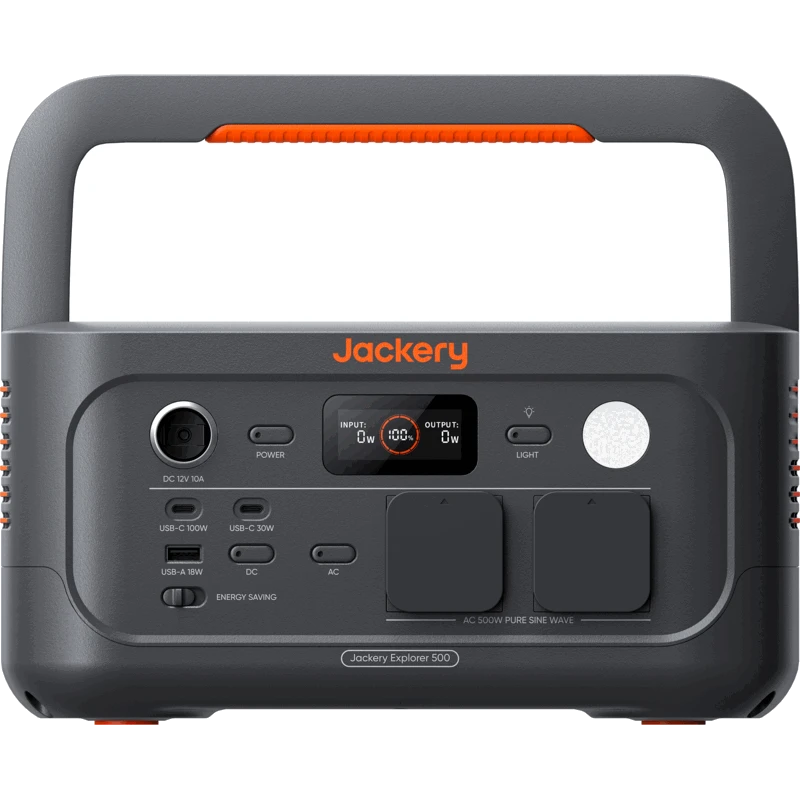
512Wh of LiFePO4, 500W output (1000W surge), fast recharge. Enough to keep a fridge, lights, and devices alive while you sort out your main unit, without being one more giant box to store.
Jackery Explorer 500 v2
Check Jackery Explorer 500 v2 on Amazon →If your daily loads run higher, size up through our under-$500 power station ladder.
One More Thing: Match Your Connectors#
If you’re buying fresh, try to keep both units in the same ecosystem, or at least on the same charge connectors. When your backup and your main use the same cables, solar adapters, and chargers, everything interchanges and swapping over is painless. Our backup is a different brand than our main, and while it absolutely did the job, matching connectors would have made the handoff seamless instead of a scramble for the right cable. Learn from our mismatch.