
⚠️ Outgoing: compare it with its replacement first
EcoFlow has moved to the DELTA 3 Max for this slot. The DELTA 2 Max is still sold direct, at $1,029 (EcoFlow direct, checked 2026-10-05 · Amazon varies).
Here’s the part worth knowing: the DELTA 3 Max carries the same 2,048Wh and sells for $879 (EcoFlow direct, checked 2026-10-08 · $320 off $1,199 list · Amazon varies). When we checked in August the outgoing unit was $150 cheaper. By October the newer one was the cheaper of the two.
An outgoing model at the same capacity as its replacement only earns its place at a discount. The DELTA 2 Max still has a fast 1.1-hour full recharge on its spec sheet, so it’s worth buying when its price is below the DELTA 3 Max’s, and not otherwise.
I’ve never had a DELTA 2 Max in the van. I run a Bluetti Elite 200 V2 in the same capacity class, so I know the tier well and this specific unit not at all. Everything below is a Spec and Reported read, judged against the recovery-first method. No Measured claims appear on this page, because I haven’t earned any.
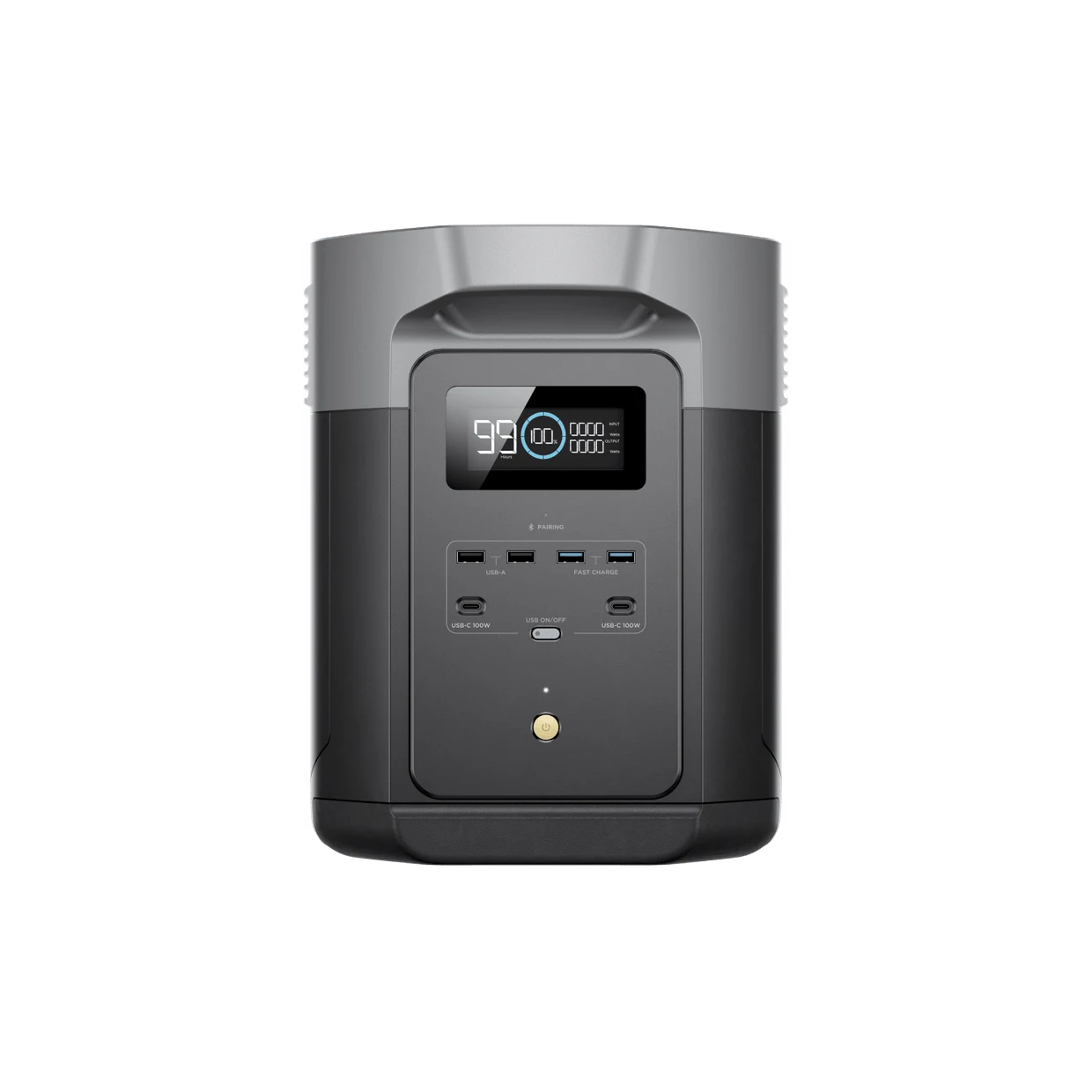 EcoFlow DELTA 2 Max
Check Current DELTA 2 Max Pricing
EcoFlow DELTA 2 Max
Check Current DELTA 2 Max PricingQuick Verdict
Buy the DELTA 3 Max instead if the prices sit where they did at our last check ($1,029 against $879). Newer platform, same capacity, less money.
Check first: whether the DELTA 2 expansion batteries are still stocked. The 6,144Wh ceiling only means something if you can still buy the packs.
Is the DELTA 2 Max the right power station for your build?#
Tap the situation that sounds like you.
📱 EcoFlow ecosystem: already trust the brand. Brand fit
EcoFlow's app reputation is one of the strongest in the category. If you've already bought into their ecosystem, the DELTA 2 Max extends that into 2kWh-class capacity. App-driven monitoring is a meaningful differentiator if you open monitoring apps, and noise if you don't. We run Bluetti for our brand bet; EcoFlow is a defensible alternative at this tier.
🌧️ Heavy daily loads, cloudy-week reserve matters. Strong fit
2,048Wh is double a mid-tier unit, and the doubling matters most on the days you'd least expect: hot, humid, overcast. Our fridge draws roughly twice as much in a Gulf-coast summer as it does at mild temperatures: 20–25 Wh/hr against 10–12 Measured, on our own unit over eight years. Those are the same days the panels give you least. Size on the mild number and the first humid overcast week takes you down; this tier is the buffer that stops that.
🍳 Daily heating loads: induction, kettle, air fryer. Capacity fit
Once daily cooking moves to electric (induction burner, electric kettle, air fryer), mid-tier 1kWh units run out of headroom. The DELTA 2 Max's larger capacity makes electric cooking practical. We could only start using a Ninja Crispi air fryer after upgrading from the Yeti to our Elite 200 V2; same category of jump applies at this tier regardless of brand.
🏆 Want a brand we've personally validated. Different ecosystem
Real talk: we run Bluetti, not EcoFlow. We can't tell you how the DELTA 2 Max holds up across years of full-time van use. Our personally-validated 2kWh-class pick is the Bluetti Elite 200 V2. If first-person validation at this tier is your deciding factor, that's the unit to read about.
Where the DELTA 2 Max wins and loses#
One rule decides every ranking on this site: time-to-recover beats raw capacity. The DELTA 2 Max scores well on it, which is why being outgoing doesn’t disqualify it on its own.
Scored against the one ranking rule +
Recharge speed: excellent for the tier. 1.1 hours to full on AC Spec. The BLUETTI AC200L, the same 2,048Wh, needs 90–100 minutes. Add 600W of solar alongside the wall input and EcoFlow claims 80% in 43 minutes, though note that figure is AC plus solar, not AC alone, which is the kind of asterisk that usually goes unmentioned.
Capacity: 2,048Wh, expandable to 6,144Wh. Enough to ride out a bad week rather than planning around outlets. The AC200L expands further (8,192Wh), if that ceiling matters to you.
Price: the thing to check first. $1,029 (EcoFlow direct, checked 2026-10-05 · Amazon varies) against $879 (EcoFlow direct, checked 2026-10-08 · $320 off $1,199 list · Amazon varies) for the DELTA 3 Max that replaced it, at identical capacity. Outgoing stock only earns its place at a discount, so compare the two on the day you buy.
Cycle life: 3,000 to 80% Spec. Below the AC200L's 3,500+ and well below our own Elite 200 V2's 6,000+. About eight years at one cycle a day, so it's a real gap without being a dealbreaker.
DELTA 2 Max vs Bluetti AC200L vs Elite 200 V2: the cross-shop +
At this tier, ecosystem and brand preference do most of the deciding. All three are LiFePO4. All three publish credible recharge profiles. All three are sized for full-time daily loads with cloudy-week headroom. Decision factors:
- App ecosystem matters most: DELTA 2 Max, EcoFlow's app reputation is a category leader.
- Bluetti family is your bet: AC200L (older, often discounted) or Elite 200 V2 (newer, what we run).
- Want first-person hours behind the recommendation: Elite 200 V2, we own it.
None of these is a wrong answer. We bet on Bluetti and specifically on the Elite 200 V2. That's a personal preference, not a knock against EcoFlow.
When 2kWh-class is enough vs when you need 3kWh-plus expandable +
2kWh-class is the right answer for most full-time van lifers, including us. With reasonable solar and one good shore-power day per week, 2kWh covers daily loads with margin for bad weather.
You need 3kWh-plus expandable territory when: multiple electric heating elements run daily (induction + air fryer + electric kettle stacked), full-time Starlink + heavy work + fridge run simultaneously through cloudy weeks, or your build is large enough that you're effectively running an off-grid cabin. Look at our overall best picks for that tier (Bluetti Elite 300, EcoFlow DELTA 3 Ultra Plus, Apex 300).
The three questions I'd want answered before buying outgoing stock +
1. Is it still the cheaper of the two? At the same capacity, price is the whole case for an outgoing unit. In August it undercut the DELTA 3 Max by $150; by October the DELTA 3 Max was the cheaper one. These prices move, so check both listings before you commit.
2. Are the Smart Extra Batteries still stocked? The 6,144Wh ceiling depends on packs for a discontinued platform. Verify before you buy the base unit on the strength of its expandability.
3. How long does EcoFlow support a retired product? Firmware, app compatibility, and parts all get deprioritized once a model leaves the lineup. The 5-year warranty is the commitment worth holding them to.
One real advantage of shopping an outgoing model: the DELTA 2 Max has been out long enough that real multi-year owner reports exist. Weight those over launch coverage.
The numbers, and how they compare#
Every figure below is a manufacturer claim Spec, pulled from EcoFlow’s own product page on 2026-08-07. Nothing here is measured by us.
The DELTA 3 Max that replaced it sells for $879 (EcoFlow direct, checked 2026-10-08 · $320 off $1,199 list · Amazon varies), for the same 2,048Wh.
AC only. The AC200L needs 90–100 minutes for the same capacity. EcoFlow's advertised "80% in 43 min" adds up to 600W of solar on top of 1,800W AC, which is a combined figure rather than a wall-outlet one.
Two Smart Extra Batteries take it to 6,144Wh. The AC200L goes further at 8,192Wh. Either ceiling depends on the add-on packs staying available, which is a fair question for a retired platform.
Matches the AC200L on continuous output, slightly behind on surge (3,400W vs 3,600W). Both are comfortably into daily-induction-cooking territory.
3,000 cycles to 80%, the weakest number on this page. The AC200L claims 3,500+, our Elite 200 V2 is rated 6,000+. Still roughly eight years at one cycle a day, but it's where the savings show up.
Frequently asked#
Why don't you own the DELTA 2 Max? +
We cross-shopped Bluetti and EcoFlow when our Yeti wore out and bought the Bluetti Elite 200 V2 at the 2kWh-class tier. The Elite covers our daily loads and we don't run two power stations, so EcoFlow never made it into the van. Nothing against the unit; we just bet on a different ecosystem.
DELTA 2 Max or Bluetti AC200L: which 2kWh-class is best? +
Ecosystem and brand preference. Both are LiFePO4. Both have credible recharge profiles. Both are sized for full-time loads. EcoFlow's app reputation is a category leader. Bluetti is the brand we personally trust. Pick the ecosystem you want long-term support from. Neither answer is wrong.
Is 2kWh enough for full-time van life? +
Yes for most full-time setups, including ours. With reasonable solar input and one good shore-power day per week, 2kWh covers daily loads with margin for bad weather. Heavier loads (multiple electric heating elements daily, full-time Starlink + heavy work) push toward 3kWh-plus expandable systems. Run the power calculator with your real loads first.
DELTA 2 vs DELTA 2 Max: when to upgrade? +
The Max's larger capacity matters most when: you regularly run electric heating loads, you spend long stretches in cloudy climates, or you've already hit "out of power" days on a 1kWh-class unit. If a mid-tier DELTA 2 covers you with margin to spare, the Max is overkill. If you're hitting empty regularly, the upgrade pays.
2kWh-class EcoFlow: credible spec, different ecosystem from ours
2,048Wh that refills in 1.1 hours. Price it against the DELTA 3 Max first.
EcoFlow DELTA 2 Max
Check EcoFlow DELTA 2 Max →
See the 2kWh-class we runRelated#
- Outgoing Models Still Worth Buying: when the superseded unit is the smarter spend
- Real-World Power Data: measured runtime, not marketing specs
- Bluetti Elite 200 V2 Review: what we run daily
- Bluetti AC200L Review: Bluetti family alternative
- EcoFlow DELTA 2 Review: smaller mid-tier sibling
- Best Power Stations Overall
- Van Power Calculator