
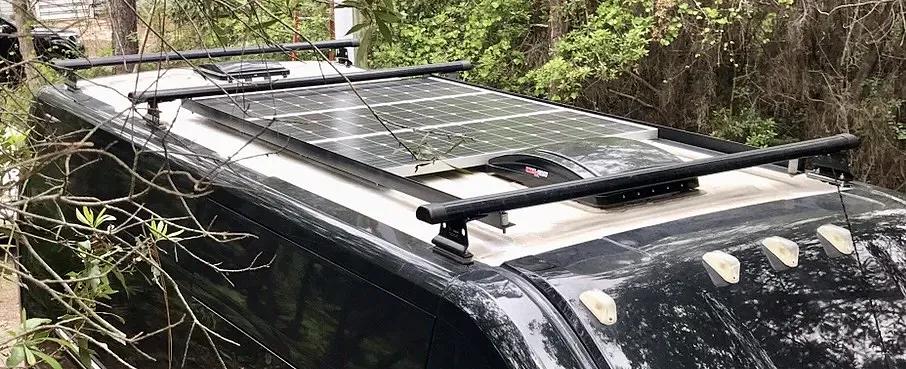
Three 100W Renogy slim panels. That’s what I put on the roof of my ProMaster in 2018, and that’s what’s still up there eight years later.
It worked. Most of the time. The “most of the time” is what I want to tell you about.
Why I Chose 300W in 2018#
Budget and roof space. Three 100W panels fit the ProMaster roof without cutting into the vent fan clearances, and 300W was the practical ceiling for the equipment I could afford at the time. What I didn’t understand then is that the roof, not the budget, was setting that number. Two fans and three panels is simply what fits.
The math on paper looked fine. 300W × 4 peak sun hours = 1,200Wh on a good day, against a daily load of 700–900Wh. The math said I had margin.
Here’s the trap, and it’s subtle. That 700–900Wh figure is real. It’s what a mild day costs: the fridge pulling 10–12Wh per hour, Measured plus a laptop, lights, fans, and a water pump. The problem is that a mild day is the wrong day to plan against. In Florida heat the same fridge climbs to 20–25Wh per hour, Measured which by itself adds 240–310Wh to the day, and the fans fighting that same heat run longer on top of it. A bad-week day lands nearer 1,000–1,500Wh. Meanwhile nameplate wattage is not what a flat roof delivers.
So I sized an optimistic harvest against an optimistic load, and both numbers fell apart on the same days. That’s the most common way van solar math goes wrong.
Where 300W Showed Its Limits#
Flat panels on a van roof realistically return 60 to 75% of their rating once you account for mounting angle, heat, and dust. Spec Every number below runs on that assumption, not on nameplate.
Colorado fall and winter. Peak sun hours drop from 5–6 in summer to 2–3 in fall, and lower still in December. Flat and untilted, that 300W array pulls roughly 1,200Wh on a long July day and 450–600Wh in November. Estimate Put a real 1,000Wh+ load against the November number and you are running a 400 to 550Wh deficit every single day. Three or four days of that and you are at the bottom.
This happened, not as a theory but as a real situation, multiple times. I got through it by driving more, by finding outlets, by managing loads more carefully. But I was solving a problem that didn’t have to exist.
The Pacific Northwest and Northeast. Extended overcast is the variable that 300W can’t compensate for. When there’s no sun for three days, it doesn’t matter how efficient your panels are. You’re not harvesting anything. We’ve spent months at a time on the Pacific coast, and New York in late fall and winter is the least I have ever harvested: low sun angles and heavy overcast together made the array essentially useless for a week at a time.
That is the lowest harvest. It is not the hardest week. In a Northeast winter the load falls with the temperature. The fridge barely runs, the fans are off, and the days are short enough that you are not doing much anyway. Very little comes in, but very little is needed. What breaks you is when those two come apart.
Florida in summer, which is the one that actually broke. Heat and overcast at the same time is the worst combination there is, because the two push in opposite directions. Our Dometic CFX65DZ pulls 20–25Wh per hour in Florida heat and humidity against 10–12 in mild weather, Measured so the load nearly doubles on exactly the days the sky closes in and the panels give back the least.
Santa Rosa Beach, summer 2019. Seven straight days of overcast. The fridge ran flat out, the fans couldn’t stop, and 300W of flat panel returned close to nothing. I hauled the Yeti 1400 into coffee shops nearly every day that week to keep it alive, and topping it off took 20+ hours on the charger we had then. That week is the reason this site ranks recharge speed ahead of raw capacity.
And it was not a freak week. Stretches like it are a normal part of a Gulf-coast summer, and we ran into them repeatedly across our Florida seasons. 2019 is the one I tell because it was the first time it properly cornered us, not because it was the only time. That is what makes Florida the hard climate rather than the cold ones: not that any single day is worse, but that the bad days arrive in runs, in the season when the fridge is already working hardest.
Hot roofs anywhere. The counterintuitive one. Output drops as cell temperature climbs, roughly 0.3 to 0.5% per degree Celsius above 25°C, Spec and a dark van roof in full sun runs far above ambient. Blazing sun and peak harvest aren’t the same thing. On the hottest afternoons the array gave up noticeably less than the spec sheet implies, which is the opposite of what you’d expect from a cloudless sky.
Mounting height is the lever most people miss here. Mine sit 1 to 2 inches off the roof, and that gap is doing real work: air moves underneath and carries heat away, so the cells never get as hot as the sheet metal under them. Panels laminated straight to the roof with no airflow behind them run hotter and lose more, which is the hidden cost of the flush-mount look. If you want the low profile, keep the standoff.
What 300W Got Right#
I don’t want to overstate the problem. 300W of solar has covered the majority of my days across eight years. In good sun conditions like the California coast or a Colorado summer, it was more than enough. Whole weeks went by where the battery was full by afternoon and I never touched an outlet.
The Renogy slim panels held up physically. They’re still on the van. After eight years of vibration, temperature cycling, and desert sun exposure, all three are still producing. The build quality justified the price.
What I’d Do Today#
Nothing about the panels. The roof was already full.
Start with the panel math, because the internet will tell you modern panels pack so much more wattage into the same rectangle that you can swap three for three and nearly double your array. That isn’t true. My Renogy 100W slim is 42.2 × 19.6 inches, Spec which is 0.53 square meters. Panels are rated at 1,000 watts per square meter, so 100W in that area is 18.7% module efficiency. Renogy’s newest small panel, the 16BB N-type, measures 34.1 × 22.8 inches and is still rated 100W, Spec which works out to 19.9%.
Eight years of cell technology bought barely a point, and the manufacturer spent it making the panel slightly smaller instead of turning it into a 118W panel. Drop that best-in-class efficiency into my exact footprint and you get 106W. Even at the 25% the best commercially available modules now reach, Spec that rectangle tops out near 133W, and that 25% is Aiko’s large-format back-contact module, not something sold as a 12V van panel. A 180W panel in that space would need 34% efficiency, and no commercial silicon module is close.
There’s a trick in the marketing worth knowing, too: when a van panel advertises “25% efficiency,” that is usually the cell rating, and the finished module lands two to five points lower once frames and cell gaps eat the area. Renogy’s N-type 200W carries that 25% headline and works out to 20.7% at the module. Spec Divide watts by area yourself; it is the only number that tells you what fits.
So more solar means more panels. And that’s where my roof runs out. Laid out full-size around a Vantech rack and two Maxxair fans, this ProMaster roof resolves two ways: three panels and two fans, or four panels and one fan. There is no version with 400W and both fans. I go through why total roof length is the wrong number to plan with in the van roof math.
Which makes it a straight trade, and it isn’t close. A fourth panel buys me about 300Wh on a good day: 100W at a 0.75 flat-mount derate across four peak sun hours. Estimate Losing a fan costs me the ability to move air through the van on a humid Florida night, which is the exact condition where the fridge is working hardest and the battery is already losing. I’d give up the panel every time.
That’s the ceiling: 300W, and it was never going to be enough on the bad weeks. At a 0.75 derate the array delivers roughly 1,200Wh on a long summer day of 5 to 6 peak sun hours, 900Wh at 4, 675Wh in a 3-hour Colorado fall day, and 450Wh under 2 hours of overcast. Estimate Against a real 1,000–1,500Wh daily load, only the best days break even, and everything below that bleeds.
Which is why the fix was never on the roof. If your array is capped by geometry and your load isn’t shrinking, the only lever left is how fast you can put power back in. That’s an alternator charger: up to 1,200W of alternator and solar combined while the engine runs, Spec which is four times what the whole roof makes at noon. Solar sets your ceiling. Driving is what saves you.
Orientation flexibility matters. Portable or tiltable panels let you angle toward the sun when parked. Fixed flat roof panels give up roughly 10 to 20% of annual harvest compared to optimal tilt, closer to 10% in southern states and 15% or more up north. Spec If you’re stationary for extended periods, a setup that lets you prop one panel at an angle while parked is worth considering. I never did, and I don’t regret it on a vehicle that faces a different direction every night, but it’s real output I chose to leave on the table.
What I’d Recommend#
Get on the roof with a tape measure before you buy anything, and lay out the fans first. Airflow and panels compete for the same real estate, and in real heat airflow wins. Fill what’s left, do the mounting and wiring once, and keep a standoff under the panels so they run cool.
Then size your recovery, not just your array, because the roof is going to cap you lower than the sizing math wants. That means a power station with serious solar input and, more to the point, one that can take real wattage off the alternator while you drive.
I’ve run 300W for eight years and it’s been fine. But every time a Florida summer or a Colorado winter showed up, I wanted more, and the roof never had more to give. Getting out of that corner meant charging faster, not harvesting harder.
Related Reading#
- The Van Roof Math: More Solar Means One Less Fan
- Solar Power for Van Life Beginners: panel types, mounting, and the mistakes that cost the most
- Solar Input Explained for Portable Power Stations
- How Much Solar Do You Need in a Van?
- Alternator Charging for Portable Power Stations
- Best Budget Solar for Van Life
- Cold Weather Killed My Charging: Winter Van Power, Honestly